


|
| |
| Welcome to myHanse.com the forum for Hanse Yachts owners throughout the world. | |
Volvo Penta D2-40 |
Post Reply 
|
Page 12> |
| Author | |
415 Singapore 
Vice Admiral 
Joined: 23 September 2013 Location: Singapore Status: Offline Points: 935 |
 Post Options Post Options
 Thanks(0) Thanks(0)
 Quote Reply Quote Reply
 Topic: Volvo Penta D2-40 Topic: Volvo Penta D2-40Posted: 31 July 2019 at 10:04 |
|
Hi, does anyone know if you have to remove the whole engine from a 415 to change a head gasket. 10 hours after being serviced our engine started to overheat, losing coolant etc. We don’t trust original engineers that carried out the service, so got a second company to look at it. They say the head gasket is gone and that we need to take out the engine. I guess they might need to mill the head flat but does this require removal?
Hoping to hear something positive!
All the best Paul
|
|
|
Paul - Night Train - 415 #136
|
|
 |
|
|
Remmen
Sub Lieutenant 
Joined: 19 June 2017 Location: Bruinisse Status: Offline Points: 12 |
Post Options
Thanks(0)
Quote Reply
Posted: 31 July 2019 at 12:38 |
|
Check the possibillity that your boiler has been broken down. Could be by frost damage and gives similar problems with your engine.
Regards, Maarten-Pieter
|
|
|
|
|
Wayne's World
Admiral 

Joined: 18 July 2012 Location: Cruising Status: Offline Points: 1434 |
Post Options
Thanks(0)
Quote Reply
Posted: 31 July 2019 at 12:43 |
|
Probably not a frost issue in Singapore.
Paul, I gather the engineers would always prefer to remove the engine to make their job easier. Easier to do other work on the engine if it is out if the problem is not just a head gasket problem. Not sure how difficult engine removal would be on a 415 - but my guess is -difficult.
|
|
|
Wayne W
Cruising, currently in the Pacific until the end of 2026. |
|
|
|
|
415 Singapore
Vice Admiral
Joined: 23 September 2013 Location: Singapore Status: Offline Points: 935 |
Post Options
Thanks(0)
Quote Reply
Posted: 31 July 2019 at 12:57 |
|
Thanks for the replies, sorry Maarten but Wayne is right definitely not frost damage. I think the amount of work involved taking the engine out is more than the difficulty in taking off the head in situ, but would welcome any other thoughts
All the best Paul
|
|
|
Paul - Night Train - 415 #136
|
|
|
|
|
High Time
Vice Admiral
Joined: 04 September 2012 Location: Portsmouth UK Status: Offline Points: 819 |
Post Options
Thanks(0)
Quote Reply
Posted: 02 August 2019 at 13:01 |
|
Hi Paul
Sorry to hear about your problem. As a fellow owner of a 415 with the same engine I'm obviously interested in the cause. Have you any thoughts about why it happened? Do you think your service engineers did something wrong or is it just 'bad luck'? Regarding changing the head gasket, it should be perfectly possible to do this in situ. Access is OK from 3 sides. However, if the block needs to be milled flat (unlikely, I would have thought, unless the engine was run dry for some time) then it will have to to come out. I would discuss with your new engineers doing the job initially in situ but accepting if there is work required on the block then it will have to come out. Good luck
|
|
|
Roger
High Time (415 #038) |
|
|
|
|
415 Singapore
Vice Admiral
Joined: 23 September 2013 Location: Singapore Status: Offline Points: 935 |
Post Options
Thanks(0)
Quote Reply
Posted: 03 August 2019 at 11:08 |
|
Hi Roger
As with everything, nothing is clear cut. The original engineers didn’t clean the sea water filter which was almost completely full of bits of mussel shells, which I think they should have seen and made them question a blockage in the sail drive. But then we could have spotted that too, but they were official Volvo Penta agents. This caused the engine to overheat, spewing coolant out of the pressure cap. We immediately turned off the engine waited for it too cool, topped up the coolant and used it very sparingly and at very low revs back to the marina. We then had the sail drive cleaned, oil and coolant changed and all seemed ok. Next time we used the engine, low power and black smoke/water was almost immediately obvious in the exhaust, this time all the coolant had disappeared but into the engine. Again we turned off the engine sailed back to the marina entrance and were towed back to our berth. The engine is being taken out on Monday for inspection so I will report back after that, but it would seem that these engines are very sensitive to even a small amount of over heating. All the best Paul
|
|
|
Paul - Night Train - 415 #136
|
|
|
|
|
415 Singapore
Vice Admiral
Joined: 23 September 2013 Location: Singapore Status: Offline Points: 935 |
Post Options
Thanks(0)
Quote Reply
Posted: 03 August 2019 at 11:15 |
|
Sorry forgot to add that original engineers didn’t charge for second oil and coolant change which made me think that they accepted that they had cocked up the original service. Whilst I would like to have a go at them, I don’t actually want them anywhere near the boat again:((
|
|
|
Paul - Night Train - 415 #136
|
|
|
|
|
High Time
Vice Admiral
Joined: 04 September 2012 Location: Portsmouth UK Status: Offline Points: 819 |
Post Options
Thanks(1)
Quote Reply
Posted: 05 August 2019 at 15:19 |
|
Hi Paul
That sounds like real bad luck. Whatever the actual fault you should have had an overheat alarm from the Volvo cockpit panel before any serious damage was done. If your alarm didn't sound then that needs investigating as a priority - it could have saved the engine. The alarm should trigger around 120C, about the time that the pressurized water starts to boil. I know this because mine triggered last summer (2018) when I started the engine without turning the seacock back on. Normally when cruising I leave the seacock on but I had turned it off to clean the raw water filter (full of seaweed strands and small shrimps) and obviously forgot to turn it on again when I'd finished. Silly boy! When the alarm went off (next day) it caused a few seconds panic as we were exiting the cill at Trebeurden and didn't have any sail up or room to anchor! Fortunately no damage was done as the fresh water coolant was only just starting to boil and the exhaust hose and water trap/silencer also seemed to have survived. I have since fitted a sea water flow alarm that triggers if the engine is started and no cooling water is flowing. This should detect a potential overheat situation long before it becomes a problem. Unfortunately the company making the kit I used has recently ceased trading but Google can suggest several alternatives. Fingers crossed that your engine can be easily fixed. I'm sure several of us with the D2 series engine will be interested to hear the conclusion to this sad tale.
|
|
|
Roger
High Time (415 #038) |
|
|
|
|
415 Singapore
Vice Admiral
Joined: 23 September 2013 Location: Singapore Status: Offline Points: 935 |
Post Options
Thanks(0)
Quote Reply
Posted: 06 August 2019 at 09:39 |
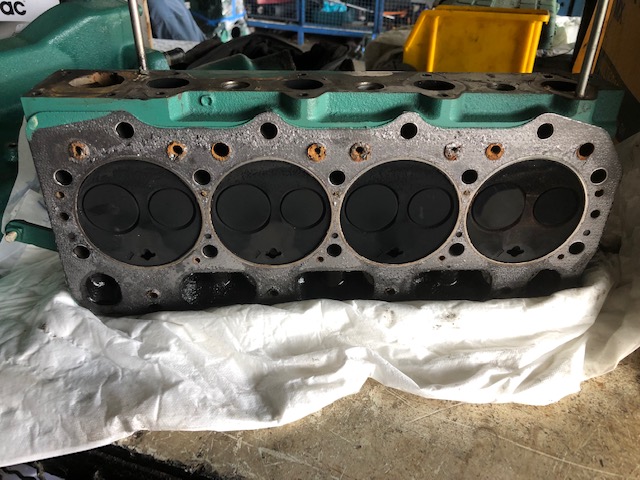     Hi HiRoger, the overheat alarm didn't work because our 8th MDI unit had failed after 1 engine cycle and we were using the engine without it, lesson learned but if Volvo built MDI units that lasted and honoured their warranty this might not have happened. But don't start me on that one! Ok the good news first, it was actually quite easy to get the engine out of the boat and onto the Marina pontoon and on inspection, the block, pistons and bearings seem ok. The head is being sent away for accurate measurement and (hopefully) milling rather than replacement. There was a significant amount of unidentified crud in the coolant waterways. As we have only ever used Volvo coolant, the engineers were at a loss to explain this, although they did suggest I see if the hot water cylinder and it's feed pipes were clear. As ever any thoughts would be welcome because I am not an engineer All the best Paul
|
|
|
Paul - Night Train - 415 #136
|
|
|
|
|
High Time
Vice Admiral
Joined: 04 September 2012 Location: Portsmouth UK Status: Offline Points: 819 |
Post Options
Thanks(0)
Quote Reply
Posted: 06 August 2019 at 12:29 |
|
Hi Paul
Thanks for the update and the photos. It's shocking that you have now had 8 replacement MDIs. Have your engineers attempted to understand why they are failing so often on Night Train? I understand there have been general problems with MDIs but you seem to have suffered far worse than most. I wonder if there is something particular to Night Train that is causing them to fail. I think you have a serious claim here for which Volvo Penta should take some responsibility, particularly as it has now directly aggravated your overheating issues. Regarding the overheating, was there a failure of the cylinder head gasket? If there was it is hard to see it in the photos. Have your engineers suggested checking the heat exchanger internals? This seems a more likely source of 'crud' (from salt water?) in the waterways than the calorifier (which only contains clear mains water).
|
|
|
Roger
High Time (415 #038) |
|
|
|
|
Post Reply
|
Page 12> |
| Tweet |
| Forum Jump | Forum Permissions You cannot post new topics in this forum You cannot reply to topics in this forum You cannot delete your posts in this forum You cannot edit your posts in this forum You cannot create polls in this forum You cannot vote in polls in this forum |
|
Links : www.hanseyachts.co.uk www.hanseyachts.com www.fjordboats.co.uk www.dehler.co.uk www.varianta.co.uk |


 Topic Options