


|
| |
| Welcome to myHanse.com the forum for Hanse Yachts owners throughout the world. | |
Blue Water Runner downwind sail |
Post Reply 
|
Page 12> |
| Author | |
Wayne's World 
Admiral 

Joined: 18 July 2012 Location: Cruising Status: Offline Points: 1434 |
 Post Options Post Options
 Thanks(0) Thanks(0)
 Quote Reply Quote Reply
 Topic: Blue Water Runner downwind sail Topic: Blue Water Runner downwind sailPosted: 21 June 2018 at 11:16 |
|
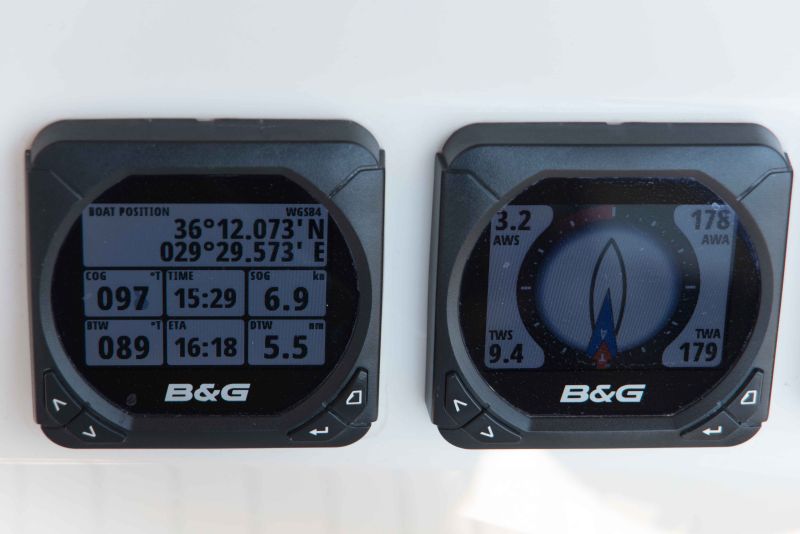
During winter we bought a Blue Water Runner downwind sail and have just had a chance to try it out. We were looking for a sail which would be usable downwind - say 160 to 180 degrees. We also want a sail we could furl and unfurl from the cockpit. Phil from Inspiration Marine Group in the UK suggested the BWR. After looking at the Elvstrom website we thought the BWR could be the right sail for us. Elvstrom suggested a 220 square meter sail on an endless furler. The sail cloth is a light weight Dacron but as the sail is 220 M2 with a torsional rope and furler and sheets the sail in its bag weights about 56 kg and takes up a fair amount of our forepeak space but I suppose that is what this area is designed for. Whilst travelling from Gocek to Kas we had winds behind us for some of the 52nm distance with speeds of between 8 to 15 kn. Our best boat speed was 8.6 kn in 14.7kn TWS but were very happy to get 6.9kn of boat speed in on 9.4kn of wind TWS at 179 degrees. The BWR can also be used as a larger headsail (110 M2) by joining the clews together and setting it to one side. The Elvstrom site suggests the BWR can be used in this "headsail" mode in upto 60 degrees TWA. We have used it at around 100 degrees TWA and it was useful in this situation.
  |
|
|
Wayne W
Cruising, currently in the Pacific until the end of 2026. |
|
 |
|
|
Maxenvledig
Sub Lieutenant 

Joined: 11 May 2017 Location: Sicily Status: Offline Points: 15 |
Post Options
Thanks(0)
Quote Reply
Posted: 02 February 2019 at 19:20 |
|
Hello, could pls tell the price without VAT?
TNX Maxim
|
|
|
|
|
Wayne's World
Admiral
Joined: 18 July 2012 Location: Cruising Status: Offline Points: 1434 |
Post Options
Thanks(0)
Quote Reply
Posted: 03 February 2019 at 05:34 |
|
Maxim,
The cost ex VAT was about E8,200 including the endless furler and freight.
|
|
|
Wayne W
Cruising, currently in the Pacific until the end of 2026. |
|
|
|
|
cuneytm
Sub Lieutenant
Joined: 27 November 2018 Location: istanbul Status: Offline Points: 8 |
Post Options
Thanks(0)
Quote Reply
Posted: 28 January 2020 at 08:41 |
|
Hi Wayne,
Is there any other experiences you can share about BWR lately? I've looking for a downwind solution for while and to be honest not much information on the internet in order to compare these solutions I mean, furlstrom/one sails ifs/bwr. Kind regards,
|
|
|
|
|
Wayne's World
Admiral
Joined: 18 July 2012 Location: Cruising Status: Offline Points: 1434 |
Post Options
Thanks(0)
Quote Reply
Posted: 04 February 2020 at 15:04 |
|
Cuneytm,
We recently finished our Atlantic crossing and used the BWR for a fair portion of the crossing from Las Palmas to Cape Verde Islands and then from CV to Barbados. We had winds mainly from about 155 degrees TWA which is at the outer end of the BWR downwind ability. There was normally a swell from a different angle to the winds and sometimes a big swell from the north with an over laid localised swell and significant winds drive chop as well. We used the boom to boom out the upwinds side of the sail as per the suggestions from Elvstrom. We did not have a pole of any description. We the very confused seastate the BWR was constantly moving back and forth across the boat which caused the BWR sheets to rub on the shrouds and the lifelines near the gennecker winches where the sheets came under the lifelines. We ended up adding additional Dyneema outer on the sheets at the places where the sheets rubbed which worked well. We also loosened the aft end of the lifelines and put garden hose over the wire to reduce the damage to the sheets. We had good speed with from BWR and we had it up in 14-20kn. We only had it up on one night because the winds always increased during the night. So we sailed overnight with 2 reefs in the main and the headsail half furled. During the 8th night from CV to Barbados we had up to 28kn and during one of these gusts the BWR started to unfurl from the top and within a short while the section unfurled tore. Because of the strong winds and rough conditions I thought it was too dangerous to go on the foredeck to put the BWR down so we left it up with the section unfurled flapping madly. We furled the BWR as much as possible to reduce the flap. We pulled the sail down the next morning when the winds moderated a bit. We are yet to get a price to fix the BWR but are expecting a large cost. We have not had a detailed look at the sail as yet but I expect the cause of the damage was the BWR rubbing on the UV strip on the furled head when the BWR was furler. The Hanse supplied XTS clutch for the gennecker halyard is no where near strong enough to hold the halyard tight and it was constantly loosening. This enabled the BWR to rub on the furled headsail and I think create a wear point in the leech of the sail which ultimately tore. Going forward, if the BWR is economical to repair we will move the tack pint as far forward as we can, fit a much stronger clutch for the BWR halyard and not leave teh sail up when not in use. This is a bit of a problem because the sail is heavy. The specs say 60kg (for the 220m2 size)but I think it is heavier. So getting teh sail in place and getting it down whilst at sea in rolly conditions when sailing two up is challenging. On the crossing we had 3 on board and with the two males on the foredeck and my wife on the halyard, the boat under motor and running directly down swell onautopliot we managed to drop it quickly onto the deck. Some friends who were crossing at the same time had a new Parasailer and experienced the same swaying, back and forth problem with it which we had with the BWR so in the conditions we had I think this problem would not be reduced unless you used a pole for one side of the sail and the boom for the other side to help stabilize the sail. We had two other boat friends who used double headsails and in the conditions we this option seemed to be by far the best. These were conventional overlapping headsails on the one foil. With this setup you can run downwind or close. You still need a pole and boom to hold them out and stabilize them but they can also be used furled which other downwind options can not. The problem with trying the twin headsail option on a Hanse is that the normal self tacker size sail is probably too small and does not normally allow you to let the sail out enough for downwind. So given the conditions the performance of the BWR was good but I think we should have had a pole and should have identified the rubbing problem before it caused the failure. We intend to fit a pole for downwind sailing (still need to cross the Pacific) and maybe look at having a second downwind sail which would cover a wind angle of say 130-160 degrees and up to 20kn. This could be a Furlstrom but I would be careful not to get a sail which is heavy because handling the sail at sea is a serious consideration. If you are sailing island to island or to an from your normal marina than the weight of the sail is less important because once you are in protected waters taking the sail down is fairly easy.
|
|
|
Wayne W
Cruising, currently in the Pacific until the end of 2026. |
|
|
|
|
Pzucchel
Rear Admiral 

Joined: 13 March 2020 Location: floating Status: Offline Points: 659 |
Post Options
Thanks(0)
Quote Reply
Posted: 30 October 2020 at 22:56 |
|
Hi @wayne's world
I am considering buying the bwr sail from elvstrom, or the tradewind from north sail, and put it on the forestay with a top-down furler (on a 588). Are you saying in the comment above that you were partially reefing the bwr sail, or I misunderstood? The permanent furler installation should address your clutch issue (I will keep the halyard on the mast). Finally, what is you experience with the bwr as a code 0? How do you pass the second sheet from starboard to Port or vice-versa, without going to the bow and with the self tacking jib in between? Thanks again for sharing....
Edited by Pzucchel - 30 October 2020 at 22:58 |
|
|
Hanse588#55
|
|
|
|
|
PeteA
Lieutenant 
Joined: 18 August 2024 Location: Falmouth Status: Offline Points: 23 |
Post Options
Thanks(0)
Quote Reply
Posted: 18 September 2024 at 11:14 |
|
Hi both @wayne’s world and @Pzucchel
It has been a few years from this post but I’m considering buying a blue water runner from Elvstrom for my 588 for my forthcoming trip. Do you have any further updates on the sail, how has it performed, issues etc Thanks Pete
|
|
|
Hanse 588, hull no.28, 150hp Volvo, based in Falmouth, UK. Circumnavigation starts 2025 🤞
|
|
|
|
|
Pzucchel
Rear Admiral
Joined: 13 March 2020 Location: floating Status: Offline Points: 659 |
Post Options
Thanks(0)
Quote Reply
Posted: 18 September 2024 at 15:00 |
|
Hi Peter,
i had bought the trade wind sail from NorthSail, and it technically worked as expected. When i use it, it's normally fully downwind, no mainsail and no jib. It can flog with waves because it's attached to the forestay, but it also stabilises the boat because it's attached to the forestay....So, good and bad. In any case, pay a lot of attention to sheets chafe on the rigging if you want to use in oceanic crossings (sheets did break few times in the crossing). I have used it primarily in the atlantic towards the caribbean, it gave a serious and significant boost. I had made the mistake of letting my crew using it overnight too....and a squall that had not been anticipated broke the sail. The surprise was...that we were unable to furl it anymore, so we kept sailing for about a week with the sail badly furled - but in tailwind it didn't matter much.... ...However, when we arrived in Rodney Bay, we had to go upwind...and a storm arrived...to make the story short, we were unable to enter into the harbour after the ARC finish line because the sail was creating too much drag and we couldn't steer the boat! We waited for calm winds, we entered into the harbour...and 5x of us spent a full day to take down the sail. You have to realize they are normally two sheets wrapped together, but because of the tears in one sail it became an interesting puzzle of turning and twisting pieces of sail from the deck to the mast top... The sail was finally repaired, and I've only used it occasionally since then. My sail is black, chosen to better stand the UV. great idea? i don't know until the day it will start tearing because of the amount of UV... You also have to realize that the cleats are about 3-4 meters above deck, so it's necessary to leave the 4x sheets attached all the time if you don't want to do acrobatics every time you use it. By color coding 4x sheets, red and green on both sides, you can push/pull the sheets with the RIGHT LOGIC in order to achieve the 6x basic actions: - unfurl port - unfurl starboard - unfurl downwind - furl port - furl starboard - furl downwind (but there are forbidden combinations! :-)) It's not a sail i use often, despite it's much easier than a spinnaker/parasailor. It's always a "colored" sail, so something for special conditions....in the med, i admit i rarely find the right conditions for enough time to be in the mood of opening it up, because i know that the wind will change after a while and i will have to go back to another configuration...but i am probably lazy. What did i learn? - it's a good specialized sail that works as advertised. - Pay attention to chafe in crossings, and don't use it overnight if the crew is not reacting promptly to squalls and two are readily available in furling it. - when you have an issue and it breaks, it can be a nasty sail to manage - For operating it, even expert crew members can pull the wrong sheets if not specifically familiar...so don't use the electric winches :-) - On a large boat like ours, with a crew short-handed and lazy, I would probably opt today for the best white sails and be patient :-) Advice on white sails: i was told by a very expert sail designer (the person that designed our elvstrom sail) that if you want to cross oceans/circumnavigate you need to have sails in Dyneema/polyester (also known as hydranet). Having sailed a full season in the caribbeans with laminated sails, that are not laminated anymore, i completely understand it's the right thing to do... FWIW! Piero |
|
|
Hanse588#55
|
|
|
|
|
Wayne's World
Admiral
Joined: 18 July 2012 Location: Cruising Status: Offline Points: 1434 |
Post Options
Thanks(0)
Quote Reply
Posted: 19 September 2024 at 01:15 |
|
Pete,
We have given up using this sail in the full out (both sides) downwind configuration. During crossings like the Atlantic we had winds from about 150 degrees and swell from just aft of abeam which meant the sail was constantly moving back and forth across the bow. We have recently completed a crossing from from Panama to French Poly (4,000nm) and used this sail in the single side (genoa) configuration. But again if you have winds and swell from different angles the sail still sways back and forth - unloading and loading up again etc. We used the boom laid outboard as far as it could go and ran the sheet to the end of the boom to "pole" out the sail and this is reasonably successful. The main problem I find is that the clew of the sail is so high off the deck that you can not reach it do attach sheets or change sheet and to attach a whisker pole. Without a pole or poles (or a pole and boom used as a pole) the sail can be uncontrollable in the wrong wind and swell conditions. Our sail is 220m2 which I find is way too big. The sail is heavy - about 70kg and very bulky because the the sail area and the material thickness. You need to be careful when furling it in (in either the downwind or genoa configurations) because it can furl unevenly and create a unfurled sail portion in the top half of the sail. If you are furling because of stronger winds you don't want to unfurl and start furling again. After discussions with a sailmaker in NZ - Zoom Sails, we have decided we will get a code Zero type sail made of about 120M2 (or smaller) with a clew height that we can work with but still made of a "white" sail material. It would be lighter and easier to handle than the BWR and we could use our whisker pole without needing to use the boom. This sail will not allow us to go direct downwind (180 degrees ) more like a max of 140 degrees but angles we needed for the Atlantic and Pacific crossings completed were around the 140-150 degrees. We also tried "wing on wing" with the headsail poled out "up wind" and the boom out to the leeward side. This worked reasonable well. We ran the mainsail with two reefs in this configuration. The good thing with this option is you can furl the poled out headsail easily to reduce sail area. We have friends who used this configuration for their Atlantic and Pacific crossings. Other friends with monos who used twin headsails with either twin poles or one pole and the boom. And this apparently worked very well. Also very easy to furl to reduce sail area and you can run dead downwind (180 degrees) if you want. For a least half of our Panama to French poly crossing we used our standard headsail poled out and this in the conditions (and current assisted) still gave us 7+kn of boat speed which is plenty when you are doing a 25 day crossing. Would we buy a BWR now that we have used one -NO.
|
|
|
Wayne W
Cruising, currently in the Pacific until the end of 2026. |
|
|
|
|
PeteA
Lieutenant
Joined: 18 August 2024 Location: Falmouth Status: Offline Points: 23 |
Post Options
Thanks(0)
Quote Reply
Posted: 19 September 2024 at 10:12 |
|
Thanks to you both for coming back to me. I note that you have both had issues with the height of the clew which is certainly a consideration and with furling.
I also have a Elvsrom Geneker in a snuffer which came with the boat - it got soiled in a flood whist ashore in the yard prior to my finalising the purchase of the boat and as I only got it back last week, I haven’t used it yet. It is 240sqm, so large and may not be that useful on an oceanic crossing with a smaller crew. Have you used the reacher on the forward roller and the main on opposite sides with the reacher polled out to any effect in your crossings. The reacher is 110sqm The smaller furling code sail is something that I will think about, or a second headsail on the forward roller alongside the reacher, wing on wing. Thanks guys Pete
|
|
|
Hanse 588, hull no.28, 150hp Volvo, based in Falmouth, UK. Circumnavigation starts 2025 🤞
|
|
|
|
|
Post Reply
|
Page 12> |
| Tweet |
| Forum Jump | Forum Permissions You cannot post new topics in this forum You cannot reply to topics in this forum You cannot delete your posts in this forum You cannot edit your posts in this forum You cannot create polls in this forum You cannot vote in polls in this forum |
|
Links : www.hanseyachts.co.uk www.hanseyachts.com www.fjordboats.co.uk www.dehler.co.uk www.varianta.co.uk |


 Topic Options