


|
| |
| Welcome to myHanse.com the forum for Hanse Yachts owners throughout the world. | |
Engine Water Leak |
Post Reply 
|
| Author | |
PMFarr 
Sub Lieutenant 
Joined: 12 April 2022 Location: UK Status: Offline Points: 4 |
 Post Options Post Options
 Thanks(0) Thanks(0)
 Quote Reply Quote Reply
 Topic: Engine Water Leak Topic: Engine Water LeakPosted: 12 April 2022 at 08:51 |
|
I have recently bought a Hanse 371 (2004) and been living on it on the marina for just over a month.
In the viewing, survey and sea trial the bilge under the engine was clean though over the past month, around 500ml of water with coolant in it has collected and been cleaned away whilst the engine has not been running. If I dry this out then a small puddle collects each day. From what I can see - it looks like it is coming from somewhere around the fresh water pump. My confusion is that the level in the header tank is normal and also when opening the filler cap on top of the heat exchanger - it is up to the brim. Is there any separate water circuit for the hot water clarifier or any top up from the water tanks? It had been standing for a few months prior to me buying it so the only difference that I can see between clean bilge and one with water drips is that the water pressure has been turned on since then - though possibly it could also be that the engine start-up and run around to the lift out point for the survey may have disturbed something. |
|
 |
|
|
32mike
Commadore 

Joined: 26 March 2020 Location: FLorida, US Status: Offline Points: 453 |
Post Options
Thanks(0)
Quote Reply
Posted: 12 April 2022 at 12:34 |
|
If you’re living on it then you’re probably using hot water? It sounds like a common issue of the hot water tank over pressure valve venting water into the bilge. Unfortunately, it is designed that way. With the engine running or the electric heater on at the dock, the hot water tank will pressurize with the water pressure pump on. The tank then vents the pressure out into the bilge and/or it leaks from the fixtures in the heads. The color of the water is a result of rust in the area caused by the water leakage.
There are a few different solutions here in the forum in several different threads. Try searching for “hot water heater” or “fixture leaking.” Just make sure to select advanced search settings and change from the default time frame of “last 6 months” to “all.” The easiest solution is to leave the water pressure pump off when not in use - especially while motoring, and leaving a hot water tap open while motoring or heating water at the dock. This keeps the tank from overpressurizing. You’ll find other methods involving drain tubes/tanks and accumulator tanks. Congratulations on your new boat!
|
|
|
Mike
S/V Dulces Sueños 458 #087 Tampa, FL |
|
|
|
|
PMFarr
Sub Lieutenant
Joined: 12 April 2022 Location: UK Status: Offline Points: 4 |
Post Options
Thanks(0)
Quote Reply
Posted: 12 April 2022 at 16:22 |
|
Thanks Mike, you were pretty much bang on.
What the previous owner seems to have done is to route a tube from the pressure relief valve though to a water bottle to collect it in a more organised and accessible location. I have been using hot water daily and that bottle was full and overflowing into the bilge under the engine. To confuse things, there had been a few drips of antifreeze from the a spillage during winterisation which had crystallised but was dying the water blue as it ran over it. I have emptied the bottle and cleaned things up so hopefully that will resolve things. 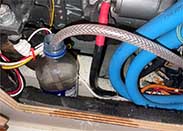 |
|
|
|
|
Martin&Rene
Vice Admiral 

Joined: 06 December 2009 Location: United Kingdom Status: Offline Points: 967 |
Post Options
Thanks(0)
Quote Reply
Posted: 12 April 2022 at 16:33 |
|
I am just a bit confused as you mention the "fresh water pump". I think most people would use that term for the drinking water pump. I am guessing that what you actually mean is the sea water cooling pump.
On my 341 and I am guessing your 371 will be very similar, the seawater is picked up through the saildrive, leg, through a strainer, then to the belt driven sea water pump into the heat exchanger then through an anti-syphon loop with a anti-syphon air vent valve, (above the engine), then into the exhaust system. The anti syphon air vent will probably have a drain valve that may drip a bit when the engine runs, so try and ensure if drips into the area under the engine. Normally this system has sea water in it, but at the end of the season, I will shut the saildrive valve, and put a pipe onto the sea water pump and pump anti-freeze through the sea water system. Probably a bit of an overkill for the West Coast of Scotland, but better safe than sorry. With the boat being new to you, is this something the previous owner may have done which may be confusing you with the colour of the water? Apart from the obvious pipe connections, other sources of leaks are the seawater pump cover and the seawater shaft seal. (Mine leaked last year.) First approach could be to put tissues in certain areas so you can see where the first drops appear, The pump will have a slight pressure head on it from the seawater strainer, so you could try shutting the saildrive leg valve, draining the pipe feeding the seawater pump and see if you still get leaks. The engine cooling system has a pump in the engine which will pump the cooling water back to the the calorifier and then through the other side of the heat exchanger. Somewhere there will be a branch pipe off to the expansion header tank. Mike is dead right on the issues with the calorifier pressure reducing valve, but I think that will just drain into the main bilge, whilst I am surmising that you are talking about the area just underneath the engine. The only place the engine systems interface (but not connected) with the domestic water systems is in the calorifier with them being on different sides of the heat exchange system I have drawn some very rough sketches to show the piping systems on my 341 and I think your yacht will be very similar, so pm me your email address if you are interested in them.
|
|
|
Martin&Rene Hanse 341 Dipper Wheel steering, 3 cabin layout, normally based in Scotland
|
|
|
|
|
PMFarr
Sub Lieutenant
Joined: 12 April 2022 Location: UK Status: Offline Points: 4 |
Post Options
Thanks(0)
Quote Reply
Posted: 13 April 2022 at 07:41 |
|
Hi Martin,
by freshwater pump, I meant as opposed to sea-water pump - the engine coolant pump describes that better. The pipework sounds very similar to how you explain aside from that both the anti-siphon valve on the seawater system and also the calorifier pressure reducing valve have both had tubes fitted so that the drips are fed back to water bottles (the pressure reducing one was overflowing). Apart from going the sea trial and around to the the lift out point for the survey and back, the engine has hardly been run since I bought it. I am also on West Coast of Scotland (Kip Marina) but have been waiting for the return of the sails so have not actually taken it out yet. I have the headsail back now and I'm looking around everything and starting to get ready but I'm new to sailing so very anxious about the whole thing and maybe panicking too much about a couple of drips under the engine. I ran it for a couple of hours and it seems fine with nothing dripping and no overheat. When I undid the cap on the heat exchanger - it was full to the brim very bright vivid blue coolant which rather than the watery washed out colour of the puddle that had formed under the engine. I'll PM you email details as any diagrams or advice would be very much appreciated for us newbies. Thanks Paul |
|
|
|
|
Post Reply
|
|
| Tweet |
| Forum Jump | Forum Permissions You cannot post new topics in this forum You cannot reply to topics in this forum You cannot delete your posts in this forum You cannot edit your posts in this forum You cannot create polls in this forum You cannot vote in polls in this forum |
|
Links : www.hanseyachts.co.uk www.hanseyachts.com www.fjordboats.co.uk www.dehler.co.uk www.varianta.co.uk |


 Topic Options