Westabo heating
Printed From: myHanse.com
Category: Hints & Tips
Forum Name: 461 / 470
Forum Description: 461 / 470 Hints and Tips
URL: https://www.myhanse.com/forum_posts.asp?TID=10001
Printed Date: 27 March 2026 at 03:51
Software Version: Web Wiz Forums 12.06 - https://www.webwizforums.com
Topic: Westabo heating
Posted By: Arnie
Subject: Westabo heating
Date Posted: 07 December 2016 at 14:48
|
Can any one help? I have just purchased a eight year old 470e which has a 5000 Westabo heater with three outlets two 90mm in the cabin and one 60mm in the rear shower room which doubles as a drying room. Can anyone help me with the maxium number of outlets I could have from this one 5000 watt heater, after I have covered the 90 and 60mm ducting in the heat jacket sleeving. The boat is staying in the UK for the next couple of years while my pals and i get use to is prior to heading off? I would like to keep it warm and dry, not damp as the forward cabin is cold and humid without any heating Regrads Arnei |
Replies:
Posted By: sailkoop
Date Posted: 08 December 2016 at 04:51
|
Hi Arnei, I've installed a Webasto 5500 in my boat. So, one Main hose 90mm runs from the Stern to the front cabin and ended in a 90mm outlet. Another two outlets (60mm) for the heads, two in the salon and another two 60mm, each in every stern cabin. I am sailing in the Northsea and the Balticsea. Works perfect.... ------------- best regards Bjoern |
Posted By: Fendant
Date Posted: 08 December 2016 at 08:16
|
Hi Arnei, You can always add a y-piece and run a 60 mm hose to your cold forecabin. This will be the longest hose in your system and normally you do not get enough airflow into the forn cabin. Even insulating the hose does not have a significant effect. One of my projects for the winter is to install a small laptop ventilator inside the forecabin's outlet. ------------- Frank |
Posted By: JonB
Date Posted: 08 December 2016 at 16:17
|
Hi guys, Norse King is a 2008 470e and we have a single 5000 heater. Ours has a 60mm outlet in both rear cabins and heads, one in the saloon and one in the Master cabin, where nothing but apprehension comes out ! After the saloon take off the system is reduced to 60mm. Again I've spoken to many people including the Webasto team who are helpful here in the UK. NK is kept in Cowes, Isle of Wight. I've a sneaking suspicion that part of the ducting that heads to the master cabin has been partially squashed. Mine tends to turn itself off as it overheats and therefore nothing gets warm and I'll explain this later. Despite some reservations from the Webasto team, this is what I'm proposing to do this winter. Replace the main run from heater to master cabin with insulated (sleeved) 90mm duct, change the 60mm outlet to a 90mm of course. Insulate all other runs. Fit a variable speed fan in line to assist the Webasto fan in drawing the warm air forward. Variable speed as I can adjust the amount of air (heat) forward. Listening to ducting Engineers and assuming I've understood correctly, the square area of the duct influences greatly the volume of air that can pass through, hence remove the 60mm to a 90mm forward of the saloon outlet. It is here I will fit the on line fan, with the variable control at the chart table. By drawing the air away from the heater unit, it shouldn't over heat and turn off. The Webasto guys feel that the electric fan will cease with the heat, well that's a start, some heat would be good ! I'll keep you posted on how it goes and how successful it is, alternatively keep an eye on the blogsite. ------------- Jon B 470e http://www.norse-king.blogspot.co.uk |
Posted By: Arnie
Date Posted: 09 December 2016 at 19:27
|
Dear All, Thanks for the advise guys,what i think may be the solution is what Bjoen has stated, but i may insert a 3 inch 12 volt fan between the main cabin middle outlet and the main cabin front outlet. Having it installed on a independant rocker switch that would controll its usage to warm the front cabin and front shower and this would allow forusage only when required. I will be covering all existing and new ducting in the Wabasto thermo ducting cover and will let you know the outcome. Many thanks and good times aboard to you all Arnie |
Posted By: JonB
Date Posted: 30 December 2016 at 17:48
|
So, today was thick fog and my hopes to carry on cleaning and polishing the hull was going no where, I turned my attention jobs inside and to the Webasto heater once more. I decided that as I'm fitting the insulation sock through the entire boat, I'd replace the first length from the heater unit to the first Y junction in the rear port cabin. This meant that it has to go through the protective plastic duct, which had probably been trodden or sat on at some point squashing it slightly. I took the lot out as it must be easier to feed it through off the boat. As you can see from the photo's the 90mm duct on our 2008 boat came with an inter-liner which has come away from the foil duct and created blockages. 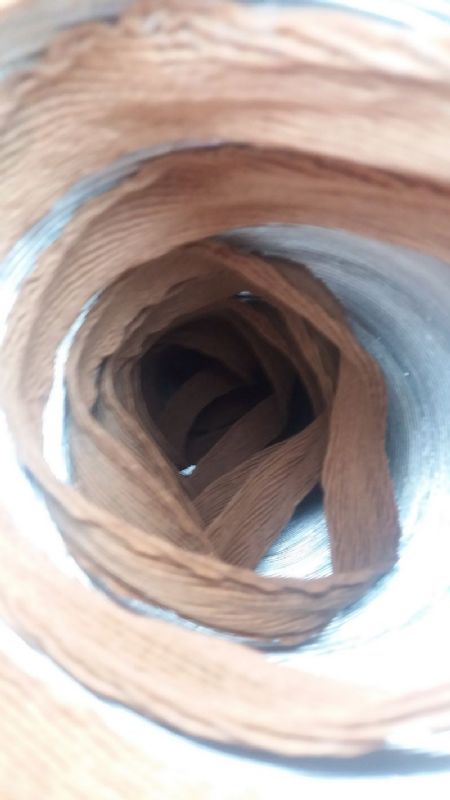 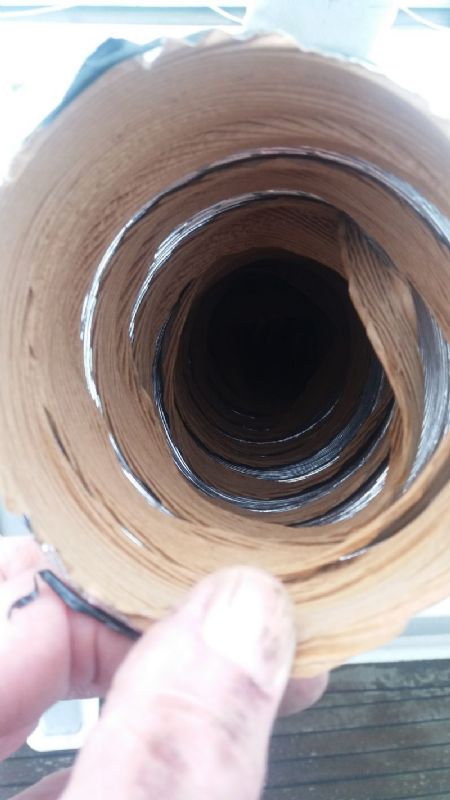 Heater end Y junction end It appears that the further away from the heat source the inner-liner is not as bad, but this is speculative. I'm going to fit the insulation sock to the 60mm duct that serves the two rear cabins, the liners don't appear to have detached from the main body but I may as well replace the duct as it's easier to replace with the sock already on rather than try to feed the sock along the duct. I'll then replace the 90mm to the next two Y junctions, at the saloon heads & the saloon. This is where I intend to fit the in line variable speed fan, but I'll see how much air flow I now get from the heater itself at this point before making that decision. ------------- Jon B 470e http://www.norse-king.blogspot.co.uk |
Posted By: bovine
Date Posted: 31 December 2016 at 08:46
|
Hi Jon I'm very interested in your fan idea to draw air to the forward cabin, We had our ducting lagged years ago and it did make a big difference, however the forward cabin being the last in line gets very little heat. Hydronic is the way forward with bigger boats, it's much easer to circulate hot water to matrix heaters. David |
Posted By: JonB
Date Posted: 31 December 2016 at 17:35
|
Evening Bovine, The issues I have are that there's nothing but hope that comes out of the master cabin vent and likewise the en-suite shower. Secondly the unit it self shuts down as it appears to overheat only after a short period of running. I've replaced the burner and spoke to the manufactures, suppliers & fitters as to gain any help I can, I also spoke to a very helpful chap regarding the ducts. On Norse King, after the en-suite take off the duct reduces from 90 to 60mm and feeds the master cabin duct at the foot of the bed. The duct man, suggested that the volume of air or gas that can pass through a duct greatly increases with an increase in cross sectional square area. I'm sure there's an equation on the internet that will prove the case. (Kn=0.066/Pd for air at 20C). If I can ease the back pressure on the heater unit by increasing the volume, then hopefully the unit will not overheat. So what if I install an in line fan, downstream of the saloon vent take off, that will enable me to draw the heated air away from the unit and push it towards the master cabin. A variable speed switch will enable me to control the amount. I'm not after trying to create a hair drier, after all, mines thin enough as it is these days and a simple shake of the head tends to do the trick. The Webasto men suggested that this fan will struggle with the heat and pack up, but weren't aware where it is to be installed within the system. None of the Webasto guys I've spoken to over the years have ever mentioned this liner within the duct that I found, nor its potential to cause a partial blockage. Clearly this causes back pressure on the heater unit which cuts out as it is unable to reduce the heat from within it. I'm going to work my way through the boat replacing this lined duct with new together with the insulation blanket and when I reach the Y junction under the chart table make a decision as to whether I feel there's enough air flow to omit the fan or not. What mustn't be forgotten is that all the time I have a free and open end, air will flow out of it more easily causing the other outlets to appear not to work. It is only once the system is contained will their be some pressure that will enable the air to pass through the vents. A euphemism is that of an electric circuit, it has potential which can be easily diverted to earth if you touch the wrong wire. A stationary fan will create pressure, but enable the two rear cabin, saloon heads and saloon vents to flow. The saloon vent is of the type that cannot be closed. Hopefully by closing the two rear cabin vent and increasing the speed of the fan I can draw more heat forward. That's my thoughts !
------------- Jon B 470e http://www.norse-king.blogspot.co.uk |
Posted By: Fendant
Date Posted: 01 January 2017 at 11:27
|
Hi Folks, I am on the same topic as my wife is complaining about the lack of heat in the forecabin. I measured a temperature of only 49 deg at the outlet and a very low airflow. I will install a small laptop ventilator inside the outlet hoping to a) increase the airflow and b) achieve a highter air temperature. I discarded the solution to install an inline fan further upstream due to measured air temps at the main cabin outlet wellin excess of 60 deg C. Happy New Year to you all ------------- Frank |
Posted By: JonB
Date Posted: 01 January 2017 at 17:13
|
Yes Happy New Year, What year of manufacture was yours ? I have no air flow out of the vent in the master cabin nor the en-suite. Ours is the Air-Top 5000ST I believe. Today I ran it and measured the air temperature and the velocity within the open ended pipe in the rear cabin. It reached 102.7C and 8.5 m/s. I left it running and returned some hours later to find it had turned off again with two flashing indicating a fault with the burner ! However the saloon by then was toasty. I shut the system down waited for a while before trying to fire it up again, which it didn't want to do. I checked for an amperage increase in the boats system but this didn't change, an indication that it just shuts down completely and locks out for a while.
------------- Jon B 470e http://www.norse-king.blogspot.co.uk |
Posted By: bovine
Date Posted: 01 January 2017 at 21:23
|
Hi Jon One of my past yachts had a wabastow heater and that used to shut down, I never did get to the bottom of it. My current heater is a aberspacher which does not have that problem, however the lack of heat forward is a problem. David |
Posted By: Niels
Date Posted: 02 January 2017 at 11:08
|
When I bought JUNIK in 2009 I was advised that I needed 2 heaters 1 for main saloon and aft cabins and one for marster and heads, I was thinking at the time it was over the top but today I'm pleased I did get 2 as I haven't had any problems with heating the boat, I know it is a lot of monies to retrofit another but it pays of in the end here in winter time. Mine are 2 x Airtronic M 3000 Eberspacer ------------- Niels |
Posted By: JonB
Date Posted: 02 January 2017 at 20:33
|
Evening Niels, I understand that boats of 45' + now come with two heater units, they've realised that one unit doesn't do it. So your correct, one serves the master cabin and it's en-suite if that's the layout chosen and one serves the rear cabins, saloon & saloon heads. My thoughts are to provide assistance to the single unit we have by introducing an in line fan, to help draw the heat/air forward. What I need to happen is for the unit to run without cutting out, so there may be an underlying fault with the unit. Once I can get it to run consistently without cutting out, then I can continue to replace the ducting and keep taking measurements of the velocity & temperature at the outlets. What's disconcerting is the lack of input (for now) Webasto is making regarding their product. I'll give them every opportunity to assist me in getting it to run as intended. I'll not take any prisoners if they fail to show professionalism and get it working as it should. ------------- Jon B 470e http://www.norse-king.blogspot.co.uk |
Posted By: Niels
Date Posted: 02 January 2017 at 20:44
|
I understand your concerns John as you described even with a open duct and minimal velocity it still cuts out it doesn't sound right to me unless the suction side is blocked as well sought not likely. Happy new year can't wait until the new sailing season hope you get it fixed. R Niels ------------- Niels |
Posted By: JonB
Date Posted: 02 January 2017 at 22:37
|
And a happy new year to you and all us Hanse supporters. I'm sure there's a simple answer and may be we don't use our boats enough to get to the bottom of some of our issues. I understand the laws of unintended consequences, Hanse may have appointed Webasto as they do other manufacturers to supply equipment to their models. It's a new field and therefore not fully understood at the time of release, but you'd think that development doesn't stop. The manufacturers Webasto or Eberspatcher ought to be monitoring their systems to ensure future product development, rather than be short sighted with past sales made. I live in the UK, and so the climate is such that it needs a gentle hand to make it more bearable to sail during certain times of the year. Lining the cabin with all the pillows we have and sleeping under two duvets is a discussion to have, but the experience is not so enjoyable. We're blessed with beautiful boats, even if not all the equipment is up to expectation. It is up to us to bring them down a peg or two and pull them in line. If they're not prepared to assist, then we need to tell the industry how crap they are ! Fair winds. ------------- Jon B 470e http://www.norse-king.blogspot.co.uk |
Posted By: bovine
Date Posted: 03 January 2017 at 19:32
|
Good evening Jon I think it's possible your heater is shutting down because of over heating, due to the lining of the ducting partially blocking the air flow David |
Posted By: iemand
Date Posted: 03 January 2017 at 20:58
|
I would try to run the heater without any ducting connected. If it stops working there as well then you know where your are.... ------------- Hanse 312 MJ 2004 - Hanse 370e MJ 2007 |
Posted By: JonB
Date Posted: 04 January 2017 at 09:17
|
Experiments to date are :- I've replaced the length of duct from the heater to the first Y junction in the rear cabin (port side, same side as the unit), with new and insulated it, it has a free discharge and not connected to the downstream duct. I've run the heater with the dial (thermostat) at 3'o'clock, it goes through its starting cycle ok and runs with 102.6C and 8.5m/s velocity for a couple of hours then shuts down, with the resultant 2 flashing of the arrow. If the thermostat cut in then I'd expect the heater to 'back off' not shut down or am I wrong in my assumptions ? When this happens I can, after a pause, turn the dial off for a couple of seconds and have just the fan running only. This I did until no more warm air came from the heater. I can then fire up the unit once more and it'll run again. I've run it at 3'0'clock again, then turned the thermostat down (anticlockwise) so the arrow points to 12'o'clock. The fan does what I expect and the fan reduces speed (and another assumption is that the fuel pump probably delivers less by slowing down too), but then the amps drop off and the unit shuts down again. Yesterday, I reset it at around 10'0'clock, so it was on with no flashing lights, and left it overnight. Last nights ambient temperature was around 3C and whilst I do have two electric heaters, they will only provide a background heat and raise it another 7C internally. Today I'll go and check to see if it has run over night, or with luck is still running. Once I can get the thing to run without hesitation, then I'll connect the ducting down stream, which I'm looking to replace with new together with the insulating blanket. I've sent various e-mails to the manufacturer here in the UK, with the various scenarios to date and hopefully they will come back after their Christmas break and have some helpful comments. I am looking to replace the dial thermostat with the modern digital version as this will enable it to be programmed to come on. This modification would instantly remove any possibility of the old device causing an issue. Has anyone replaced the ducting retrospectively and if so does it have to be re-routed adjacent to the heads rather than follow the existing route beneath ?
------------- Jon B 470e http://www.norse-king.blogspot.co.uk |
Posted By: Fendant
Date Posted: 04 January 2017 at 21:42
|
Hi Jon, I have the Eberspaecher unit, so I am not really familiar with your Webasto. I have the 1st junction in the main duct going to the aft cabin. The second Y goes to the main outlet underneath the companionway which you can not close. The 3 rd Y ( already 63 mm ) goes to the shower/toilet outlet and finally I have the forecabin outlet ( which is not effective ). When I close accidentally the aft cabin outlet the heater will switch off after 20 - 30 mins. ------------- Frank |
Posted By: JonB
Date Posted: 04 January 2017 at 22:25
|
Thanks Frank, Which all makes sense. Boats of 40' + are too big for a single diesel fired heater system, which is why new builds have two, one serves the forecabin only. Also what you say is similar in that the units have an overheating sensor which triggers if air flow is restricted causing a high back pressure and not allowing heat to move away from the unit. The units themselves are not that different in design, simple & basic. This is why my thoughts of fitting an in line variable speed fan, which pull the heated air away from the unit and push it towards the fore cabin (master cabin), should work. I'm of the belief that providing I'm not trying to super heat the compartments, I should be able to regulate the heat throughout by adjusting the thermostat (unit) and the variable speed fan in unison to at least get something other than anticipation out of the vent at the front. I'll continue to work it out, all comments are appreciated. It's only by understanding what other people have gone through that a bigger picture can be provided and solutions can be made. ------------- Jon B 470e http://www.norse-king.blogspot.co.uk |
Posted By: High Time
Date Posted: 04 January 2017 at 22:47
That would be a very expensive overkill solution IMHO. I fitted an Eberspacher Hydronic system in High Time. This has a 5KW rating but heats water rather than air so the heat can be easily distributed to where it is needed without losing much heat en route. Rather than radiators (which would not look good on a sailing yacht) I used 4 small matrix heaters - one in each sleeping cabin and 2 in the saloon. The fan on each of these can be individually controlled with 2 speeds and off, which makes the system very flexible. After an hour the forepeak can easily achieve 21C when it is freezing outside. My only disappointment with the system is that it is a bit noisy when all the fans are on high! ------------- Roger High Time (415 #038) |
 JonB wrote:
Posted By: iemand
Date Posted: 05 January 2017 at 08:22
|
I like this idea of different addtional vents. I would think about a small control electronic, maybe with a raspberry pi pc with seperate temp sensors. On the other hand it will be difficult to adjust the general Temp and the vans speed. BR Thomas ------------- Hanse 312 MJ 2004 - Hanse 370e MJ 2007 |
Posted By: JonB
Date Posted: 06 January 2017 at 18:07
|
Don't forget Mr Thomas, Complicated electronics don't like damp environments and these are boats when all said and done. The Webasto has managed to run all night last night, a Wha Hoo moment as I stood on the hard looking up listening to the singing of the exhaust. So today I opted to connect the un-insulated downstream section of duct which goes beneath the saloon heads and finishes under the navigation table. I turned the dial (thermostat) up slightly and continued to polish the hull before the rain drifted in. With light fading and one more section complete, I sat on the floor with a cup of tea, a torch and my Kestrel 3000 and pondered as to how I'm going to feed the larger 90mm duct forward to the master cabin, as the existing is 60mm and attached to the hull with cable ties. I decided that I will have to 'drill' circular inspection holes (150mm dia) in the base of the storage space under the seats, so I can not only get to these cable ties, but also get two arms in to feed the new duct through, the next obstacle being the master cabin en-suite of course. With the torch I could see the cable ties under the seats but I could also see that at sometime during manufacture someone had stepped on the duct flattening it ! This clearly is one more reason why nothing but hope & anticipation came out of the front. Is the puzzle slowly unravelling ? With the Kestrel, I could measure accurately the velocity from the new free end and it reached 2.0m/s and the temperature was a cosy 45.0C. There is of course another take off (Y) under the saloon heads feeding the heads themselves. I like the idea of this being nice and warm acting as a drying room, but I mustn't get ahead of myself. So for now at the new setting, I've left it running, hopefully it has settled down. The fuel has dropped from 235l when I started trying to run it by 15l, suggesting that there is an issue. Last night it had only dropped 2l. I'll keep you posted.
------------- Jon B 470e http://www.norse-king.blogspot.co.uk |
Posted By: JonB
Date Posted: 06 January 2017 at 22:22
|
There's articles on the net that suggest that the diesel (Gas oil) from marina's (and we here in the UK add a red dye to it) just adds impurities making for canonisation of the burner unit more likely. So I may take the feeder pipe from the boats fuel tank and use a 10ltr jerry can filled with road diesel (Ultra Low Sulphur) instead with less impurities and see if it runs at the various temperatures without stopping. (http://www.ybw.com/forums/archive/index.php/t-354020.html) ------------- Jon B 470e http://www.norse-king.blogspot.co.uk |
Posted By: Martin&Rene
Date Posted: 07 January 2017 at 16:10
|
JonB I am not sure whether this point needs to be taken into consideration as well. I note that the forum article you refer to is from 2013. Over the last few years, the diesel you buy for road vehicles has bio diesel in it, whilst I know that about 3-4 years ago, our marina was particular to point out that its diesel was not bio-diesel, as it is generally accepted that this is more susceptible to diesel-bug. From numerous articles, I have seen, the conclusion seems to be that running the heaters on low for a long time leads to carbon build-up, so the advice seems to be you either run it in on-off mode, or make sure you run it at high after a period of running on low. ------------- Martin&Rene Hanse 341 Dipper Wheel steering, 3 cabin layout, normally based in Scotland |
Posted By: High Time
Date Posted: 07 January 2017 at 16:45
|
I would agree with Martin re bio diesel and also not running your heater on low for long periods. If your heater does suffer from a build up of carbon then another trick I have read about (with supporting evidence) is to run the heater on high for several hours burning pure paraffin (kerosene), rather than the normal diesel (gasoil). This burns off the carbon build up, apparently. The 'supporting evidence' included before and after photos and seemed genuine (on the YBW/PBO Forum a couple of years ago). ------------- Roger High Time (415 #038) |
Posted By: JonB
Date Posted: 07 January 2017 at 16:51
|
Martin, Correct governments have been encouraging bio additives in to the fuel and some suppliers add more than others. Also in that forum it does say that the heaters do need to be run hot to prevent the build up of carbon. Today is a misty/foggy one, so mild. When I went to the boat the heater had stopped working but no flashing. I was hopeful that the thermostat had done its thing and so I turned it up. It went through the start procedure then baulked and gave me two flashing. I checked the in line filter as I remember it had a slight air bubble, this had very little fuel in it, so I removed it and run it without the filter for now. I let it cool down and then fired it up again on the hotter setting and set to polishing the push & pull rails. It had been running for a while and I'd been up the bow end and was working at the stern, when a tale tale blue cloud of smoke came from the exhaust and it shut down ! I'll get my self some high grade diesel and lower the pump feed in to it and get the unit to run and see if fuel is the issue. If it is then I'll put a second tank dedicated to the heater unit. On Monday I''ll have a chat with Webasto and see what their opinion is as to whether they're working on a new type of burner that can cope with the lower grade fuels ! Roger - I think the forum discusses the running of paraffin too. I may buy a few litres of that too !
------------- Jon B 470e http://www.norse-king.blogspot.co.uk |
Posted By: JonB
Date Posted: 08 January 2017 at 18:09
|
Today Sunday (8th), I ran some paraffin through it and although I didn't measure the temperature it certainly felt hotter. I have since set it up to run on 10l of road diesel over night. So two thing will be learnt from this, firstly will the fuel make a difference and secondly is it over pumping causing it to flood and die. How long should 10l last ? Today the UK Webasto guys returned my e-mail and the content of the discussion was very interesting. C02 could be the answer to the problems. I fitted a new burner a while back, but knew nothing about C02 levels apart from those that you install an alarm for in a household situation. It would appear that if I take my unit down to a local fitter/supplier, he can set it up on his rig, run it and like your car, the exhaust gas analyser will tell him all sorts about how the unit is performing and can make adjustments to get it to the optimum burn. This means that the marina fuel which is ultra low sulphur road fuel, that
this "standard" fuel now has up to 7% FAME ( bio-diesel). So by adjusting the units C02 it can run as intended and efficiently as possible. So the way froward is to take the unit off and go get it set up on a bench and I'll let you know what happens. ------------- Jon B 470e http://www.norse-king.blogspot.co.uk |
Posted By: JonB
Date Posted: 10 January 2017 at 18:20
|
It's Tuesday and I've had the unit running continuously for 48hrs now, every day I've raised the temperature slightly. I think it's used around 4l in that period but not easy to tell with a black can. ------------- Jon B 470e http://www.norse-king.blogspot.co.uk |
Posted By: JonB
Date Posted: 11 January 2017 at 22:47
|
Wednesday, come back from a meeting at 1900 & the units shut down. I'm not disappointed as it had run out of fuel. What niggles me slightly is that it's used about 10.5l since I set up this experiment. This might be correct I see the manual suggests that a 5kw unit uses up to 0.5kg per hour. A litre of grade 2 weighs about 838g (0.838kg). Grade 2 being that which lorries use, why they can't talk the same language is no doubt to stop people like us understanding what they're doing. So what I've done is to link the unit back to the boats tank & see if the absorption of water in our tank may be the cause of the burn outs. If the unit struggles then my next move is to buy some fresh marine fuel (low sulphur 7% bio + dye) 'standard' fuel in my spare fuel can & see what happens. The mild winter is not helping to a degree as the thermostat appears to be doing its job & putting the unit in idle till the temp drops during the night. Not complaining the system appears to work. ------------- Jon B 470e http://www.norse-king.blogspot.co.uk |
Posted By: Niels
Date Posted: 12 January 2017 at 17:23
|
I think you are right John, mine is quite thirsty when running max, I've only had one shut down in the past, when checking I still had 35% of fuel left when investigating the glass in the fuel pumps they where empty the intake are sitting rather high on the tank not to suck contaminants, from the instructions in the manual the pumps has to be angled at 15% to horizontal I guess to get rid of air if run dry, mine had been left horizontal from installation, perhaps a small detail to check. R Niels ------------- Niels |
Posted By: JonB
Date Posted: 12 January 2017 at 18:59
|
Evening R, I learnt that the oil fired heater pick up within the main tank is about a 1/3rd of the way up, at least enabling you to at least still have fuel to move the boat under engine if needs be rather than be out of juice, but warm whilst waiting for the coast guard for a tow ! Mine too is horizontal which the manual 8.6.3 - 8.6.4 suggests is ok and having watched both transitions from marina fuel to paraffin and then to forecourt fuel the pump appears perfectly happy with even when there is air in the system. It just passes through. Now I've linked the pump back to the yachts fuel tank, it struggles to fire up again, so I'wondering if the moisture content in my diesel is causing the unit to struggle to burn. Going back to what the manufacturer & a supplier said, if the CO2 was set absolutely correctly, this may allow this fuel to burn. Also I'm sure I'm not the only one but at winter we top up our tanks to prevent that air gap that could encourage condensation build up, but we probably use no more than 50 - 60 litres in a season. So there's a residue of old fuel not forgetting of course a dousing of de-bug chemical. So the plan tomorrow is to go to a local supplier I don't usually use (used heavily by ribs & speed boats) fill the 10l can up again and see if it will run constantly on that, if not go back a stage and run forecourt (car) fuel through it again so I can get it to run consistently. I will take it off and take it to the supplier to whom I've been talking and set it up on his rig and watch the process of setting the CO2 level. If I still can't get it to run on the fuel in the yacht tank, my suspicion of high moisture content in the diesel may be true. I then have two option :-
------------- Jon B 470e http://www.norse-king.blogspot.co.uk |
Posted By: bovine
Date Posted: 13 January 2017 at 08:42
|
Morning Jon You say the fuel pickup is one third up from the bottom of the tank, on my H430 200lt tank it is definitely not. It picks up from the bottom . David |
Posted By: JonB
Date Posted: 13 January 2017 at 20:26
|
Evening David, Yes on the 470 on that fateful trip down from Scotland (when the window fell out), We ran out of fuel just as we pulled in on the fuel pontoon, the right place to do so. However when we handed NK over to have the deck windows removed & replaced, the Webasto didn't work, this was as we'd put air in to the pick up (so we were told) and also informed that the pick up is about 2/3rds down from the top. Today Friday, I picked up some fresh marine diesel, but the unit struggled to run beyond 14 minutes. I then ran more paraffin through it to clear any build up carbon that may have occurred and switched back, leaving it running at 1845, see if its running tomorrow ! My thoughts so far on this issue is that our yachts hold a fair amount of marine fuel, ours is 240l. During the season we probably use on average 50l (we haven't used the Webasto as it never worked properly), which means come winter to prevent build up of moisture within the tank it's topped up. So there's at least 190l of old diesel that contains a bio content known to be highly susceptible to moisture that appears to cause our Webasto issues with trying to burn it, road diesel (no red dye or anti-bug mix), it runs on, hopefully, the fresh marine diesel it'll run on. So if the C02 setting is slightly out causing an over fuelling it will stutter and flame out, if its the other way then I assume it'll be too lean causing the gauze to burn up and the unit to stop. So I'll get the unit on a bench and gas analysed and reset. With luck it'll burn hot enough to overcome the moisture content. If that's not the case then I'll retro fit another tank dedicated to the unit only, at least the turn over of fuel will prevent moisture build up. ------------- Jon B 470e http://www.norse-king.blogspot.co.uk |
Posted By: bovine
Date Posted: 14 January 2017 at 10:27
|
Morning Jon Have you checked yourself ,regarding the position of the pickup pipe Water as I'm sure know is heavier than diesel so sits at the bottom ,just where my heater picks up from. I run my tank dry every year and wipe out with a rag, you would not believe how much crud I have found some years . If your heater runs fine on fresh fuel then I would say you need to look at the bottom of your tank. David |
Posted By: JonB
Date Posted: 14 January 2017 at 19:38
|
No David but I've removed the in line filter and substituted that with a piece of clear plastic pipe, which I can dip in to the paraffin or a spare can. So I can see that there's no trace of sludge stopping or appears to be passing through that's causing an issue. Today (Saturday) it was sunny in Cowes this morning, so I wanted to finish of the last panel of polishing on the starboard side. The Webasto was still running on fresh marine diesel and at 1345 I switched it back to my tank of old diesel. This heater has nearly been running for a week now, paraffin, forecourt fuel, fresh marine and back to my tank. I checked it this evening its 1 point shy of 18oC in the saloon but more importantly it's still running ! 217 litres in the tank. When I left it there was 44.50C and 2.5m/s from the saloon vent, the unit was on standby and I expect as the temperature falls tonight it will increase its rate to keep up with that of the thermostat. Is it so close with the C02 setting that its now happy to burn my old diesel as the unit is working at its' optimum temperature ? Fingers crossed, It'll keep going and I can run down the tank. Then I'll get the chance to take off the inspection hatch of the fuel tank and see, as you say where exactly my pick up is and what state the tank is in.
------------- Jon B 470e http://www.norse-king.blogspot.co.uk |
Posted By: JonB
Date Posted: 15 January 2017 at 17:04
|
So nearly 24hrs & it's still running, 7 litres burnt so down to 210l, saloon still 18°C, what next ? Think I'll continue to let it run burning fuel for a while, then shut it down & try to start it from cold a day or so later. Meanwhile I'll continue to replace & insulate the ducting replacing the front section to the master cabin from 60mm to 90mm. ------------- Jon B 470e http://www.norse-king.blogspot.co.uk |
Posted By: sailkoop
Date Posted: 17 January 2017 at 01:50
|
Hi Jon, Your are on the right way..... Fingers crossed ------------- best regards Bjoern |
Posted By: JonB
Date Posted: 18 January 2017 at 22:38
|
Tuesday 17th, I went down to check, it had stopped, two flashing ! Had the constant running carbonised the burner, unlikely, did the drop in temperature demand more fuel to keep the saloon at 18°C, which it struggled to burn as the C02 content slightly out probably. At least its cold now ready for a re-start with a new in line filter fitted. See what happens. ------------- Jon B 470e http://www.norse-king.blogspot.co.uk |
Posted By: JonB
Date Posted: 21 January 2017 at 11:08
|
Thursday & Friday (19th/20th), Congratulations to Armel & Alex for a fascinating race. Tried to cold start but it refused to fire up, switched to the remaining fresh fuel and removed the filter, but again no go. I looked back at the log and we took the tank down to 80 litres before refuelling, so a third of a tank of old fuel only remained. I spoke with my local Webasto specialist, from whom I've bought new burners, exhaust & ducting etc., from and we've decided that I'll take it off and we'll have a look at the burner, then check the C02 level, back in-situ and remove to adjust, it must be that it is not burning efficiently enough to burn off any slight combination of impurity, be that higher moisture content, dye or/& diesel-bug. I'll keep you posted. With the unit removed I'll undo the inspection hatch to the tank and see what that reveals too !
------------- Jon B 470e http://www.norse-king.blogspot.co.uk |
Posted By: sailkoop
Date Posted: 21 January 2017 at 21:32
|
Hi Jon, Another experience from my side: The fuse for the Heater is underneeth the floor. He is connected together with the Automatic Bilgepump. The corrosion on the fuse connector redused the current to the Heater to a minimum! The Result was, that the Sysrem runs and time by time it redused the current that the burner inside the heater didn't burn in the correct way. At the end the heater failed completly.... So, my advice to you, check the fuse under the floor, near by the batteries. ------------- best regards Bjoern |
Posted By: JonB
Date Posted: 23 January 2017 at 21:50
|
Bjoern, I've checked my fuse today (30amp) and it sits high & dry cable tied to the bank of four batteries, so is clean and dry, with a fresh layer of oil from my fingers. The unit refused again today to start on fresh marine diesel, so I'll take it off and examine the burner with the my friendly supplier, then get it running so the CO2 levels can be checked. ------------- Jon B 470e http://www.norse-king.blogspot.co.uk |
Posted By: bovine
Date Posted: 23 January 2017 at 22:59
|
Hi Jon Just. A thought, are you always plugged into shore power when you try to fire it up, The reason I ask is I fitted a hydronic unit to my boat and it would only fire up when pluged in, or when the engine was running, the fault was voltage drop, the wire I used was to small, When plugged in the voltage is pushed up to 14.2 and therefore overcame it David |
Posted By: JonB
Date Posted: 24 January 2017 at 19:11
|
Good point David, With the electronic issues I've had following the window falling out years ago, I'm wary of not spending another £1200 on replacement batteries just yet. So I'll allow the shore power battery charger, of which I replaced, to float (trickle) charge the batteries for a while then I turn it off and allow the AIS to draw charge. if I'm working on board I fire up the VHF, radio at minimum and sometimes run the instruments just to keep a current going through them on occasions. I've also tried to fire up the heater in both battery and shore power mode without luck recently. Webasto now sell an electronic thermostat which has a digital clock, I've also heard rumoured that there's one that will link to your phone. This is to enable you to programme a start time enabling the boat to have warmed up before getting up. I purposely didn't say awake, as I'm sure the noise of such things will wake you up anyway. Alternatively, you can start it remotely. So it should start on 12.5v and there's plenty of amps in our batteries after all we carry enough, I've linked the 3 service batteries with the 4 large use items using an isolator switch, this means when sailing & I'm not anchoring or using the bow thruster I have all 7 prolonging the need to start the engine to recharge. So I doubt it was ever in Webasto's mind that the boat had to be plugged in or the engine running before it'll fires up properly, that defeats the object. ------------- Jon B 470e http://www.norse-king.blogspot.co.uk |
Posted By: Johan Hackman
Date Posted: 24 January 2017 at 19:38
|
Jon, I read that you have already replaced the burner at least once. How long ago was that? I have had my share of heater problems and if I had the same symptoms I would just replace the burner right away even if it is costly. Johan -------------  http://www.johanhackman.se" rel="nofollow - http://www.johanhackman.se |
Posted By: JonB
Date Posted: 24 January 2017 at 21:22
|
Johan, Thanks for the response, good to know people are out there. Time is almost immaterial, it must have been a couple of years ago, if not three, however because it never delivered any useful heat and shut down constantly, we never used it, relying on electric heaters if we opted to call in to a marina. For those weekends when at anchor, two duvets and a wall lined with pillows did the trick. Although I always managed to draw the short straw when making the first cup of tea ! Once I've taken the unit off again, I'll take it to my friendly supplier/fitter and we'll strip it down and see what state the burner is in. Bearing in mind I've run paraffin through it to burn off any carbon build up. He reckons that if there is excessive moisture in the fuel, rust spots will appear. It does seem logical that having opened up the unit to see what's happening inside, I may as well replace both the burner and the glow plug, it's a false economy not to. A lot of the problems seem to stem from the build, in that ducting has been trodden on, or the old liner has come away from within causing a blockage. Like the rest of Europe we're gripped with the cold, so I can't continue to deep clean the hull & polish and the Webasto is a job I've had on my books to sort. I'm sure once sorted the thought of having a drying room in the saloon heads and cabins kept at a constant temperature will mean that early outings will be looked forward to rather than a challenge of resilience. ------------- Jon B 470e http://www.norse-king.blogspot.co.uk |
Posted By: Johan Hackman
Date Posted: 26 January 2017 at 08:57
|
I will try to share my two cents of wisdom. I have had my share of Webasto problems and have written about it in this forum before. I have come to a few conclusions that may or may not be useful for others. When I got my first problem with white smoke and the heater turning off I thought the heater was rocket science. I turned to a Webasto technician that made me think even more that this was rocket science and made me pay for it. The next time I couldn't afford the same treatment and opened the heater myself and was soon to understand that it was not rocket science. What happens with time is that there is a build up and that makes the heater stop working. If you open up the heater (it takes me like 15 minutes to remove and dissassemble the heater now that I am used to it) you can easily remove the build up manually. The conclusion is that paraffin is not saving you time or trouble. Once you have a build up and remove it manually you will find that the mesh in the burner is damaged and you will soon have a new build up as the burner won't function properly. The conclusion is that removing the build up won't help much and neither would the use of paraffin. The big conclusion is that the only remedy is to replace the burner. Now, I use my heater a lot. I live on my boat permanently all year and I live in a cold country. I would say that it is the same procedure every day between Octobre and April: turn on the heater just before breakfast, let it run for an hour before I go to work, then turn it on when I get back in the evening and turn it off for the night. Sometimes I turn it off and on up to four times a day. I am saving money for when the occassion occurs when I need to replace the burner next time. I don't think that it matters whether the heater runs high or low. I think the heater is designed to handle both situations without a higher risk of a build up when the runner is running low. When you turn off the heater it will go into high for a while and the fan will cool the heater before turning it off completely. I have never bothered (for soon to be 12 years) about the quality of diesel and therefore don't believe it has a great influence on whether you will get a build up or not. What I do believe though, is that there is a slight probability that the fuel filter will prevent enough diesel to reach the burner and that this might speed up the build up and I have therefore removed the filter. I know that the Webasto technicians have those fancy computers that can be used to gain information and control the CO2, but when I had contact with the Webasto technician and he was going to tell me all the intresting details his printer didn't work. Very odd!  I hope this helps. Johan ------------- http://www.johanhackman.se" rel="nofollow - http://www.johanhackman.se |
Posted By: JonB
Date Posted: 26 January 2017 at 14:23
|
Thanks Johan, You're quite right about the unit, I too took it apart when replacing the burner and found it quite basic, the electronics must be the clever bit. I take you point regarding diesel quality, but I hadn't realised previous articles on the forum and was experimenting to gain knowledge. After all this talk about the introduction of bio-fuels it was an avenue that may have influenced it and was fairly simple to check. How often to you change the burner ? I took the inline filter off as there's no way in knowing whether this has become blocked, another reason to look in to the tank to see where the pick up line actually is, third up or at invert level of the tank as I think David has suggested. Fortunately I've worked closely with my friendly technician, so am not expecting rocket scientist fees ! I'm currently recovering from the result of an instant weight loss programme which I couldn't get to grips with. So I stuck my left index finger back on after it came off worse between a bench circular saw and a piece of wood ! ------------- Jon B 470e http://www.norse-king.blogspot.co.uk |
Posted By: Johan Hackman
Date Posted: 26 January 2017 at 19:36
That's interesting question. In order to find an answer I turned to the most reliable source to find information about my boat - myHanse! By looking at the search results I find that the first problems occured in 2008 when my boat was three years old. Despite the fact that I had the heater serviced (and the burner allegedly replaced) by a professional I had problems during 2009 up until 2010 when I replaced the burner myself. The next time I got problems was 2013 and the next time 2015. So, and I am answering this question also for my own benefit, it seems I replace the burner every two or three years. I am interested myself to see when the next time will be that the burner needs to be replaced. If my wild guess that the filter is a problem, it will not happen this year.  Johan ------------- http://www.johanhackman.se" rel="nofollow - http://www.johanhackman.se |
Posted By: Johan Hackman
Date Posted: 26 January 2017 at 19:40
It hurts to read this. I hope you will recover well. Johan ------------- http://www.johanhackman.se" rel="nofollow - http://www.johanhackman.se |
Posted By: JonB
Date Posted: 26 January 2017 at 22:24
|
Nothing a bit of blue roll, sellotape and the inside of a toilet roll couldn't cope with ! Lack of concentration, the grain of the wood catching the blade differently or what, I should've been more careful ! ------------- Jon B 470e http://www.norse-king.blogspot.co.uk |
Posted By: JonB
Date Posted: 26 January 2017 at 22:32
|
I suppose I should've typed :- L ck of c nc ntra ion, t e gra n of t e wo d ca chin g t e bla e diffe ntly or wh t, I sho ld' e been mo e careful. It wouldn't have been the same ! ------------- Jon B 470e http://www.norse-king.blogspot.co.uk |
Posted By: JonB
Date Posted: 28 January 2017 at 20:16
|
Johan, Here's another question aimed at you as a 'constant' user of the Webasto system. Can you put figures to the amount of fuel you burn, weekly, monthly or anything helpful ? Our 470 has a 240l tank so assume everyone else is the same. Do you top up 100l every fortnight or what ? ------------- Jon B 470e http://www.norse-king.blogspot.co.uk |
Posted By: Johan Hackman
Date Posted: 29 January 2017 at 10:47
|
Jon, I don't have an exact figure even if I write it down in the log book and sometimes calculate the consumption. To give you a brief idea though, I just topped up with 40 litres of diesel and the previous time was three weeks ago and the time before that was also three weeks ago. This time of year is obviously colder even if this so far has been a mild winter in Stockholm. The consumption is also depending on the fact that there was a Christmas holiday that me and my daughter spent most of the time of aboard. My tank is 77 litres. I hope this gives you at least a rough idea. Johan ------------- http://www.johanhackman.se" rel="nofollow - http://www.johanhackman.se |
Posted By: Johan Hackman
Date Posted: 29 January 2017 at 10:49
|
From previous log book calculations I gather that half of my total diesel consumption over the years is from heating my boat. The rest is motoring. Johan ------------- http://www.johanhackman.se" rel="nofollow - http://www.johanhackman.se |
Posted By: JonB
Date Posted: 29 January 2017 at 11:08
|
Thanks Johan, So 'normal' use is in the morning to take the chill off, then in the evening when you get back. Clearly the Christmas break (and mild weather) has probably increased its use and this picture in time suggests that 40 litres every three weeks. That suggests that the fuel rate mine burns is probably on par with yours. I'll take it off this week, finger willing and take it to the chap for an inspection, see how the burners fares. Then reassemble it and check the C02 setting and go from there. ------------- Jon B 470e http://www.norse-king.blogspot.co.uk |
Posted By: gertha
Date Posted: 29 January 2017 at 18:43
|
I hope this helps 1 ltr of fuel produces about 10 kw of heat. I can drag go , giving figures and data ; but that is about where you are at. So if it is a 5 kw heater going flat out , then 2 lts per hour used. I have 2 flue gas analysers; so can lend you one if it helps. Simon ------------- Swanned off |
Posted By: JonB
Date Posted: 29 January 2017 at 22:19
|
Thanks Simon, My concern is that my heater failed to run & kept cutting out, it would appear from Johan's experience that the burner does need replacing every three years or so depending on use. I thought that my fuel consumption may be high leading me to believe I'm burning too rich, bearing in mind I built three rally cars in my youth, so have an understanding with combustion engines & processes, or fuel could be contaminated give similar results. I'd be well happy if I could have the confidence that not only will the unit run on demand, but it would run consistently, also that the hot air would appear in the Master Cabin. I've found build & design issues with the duct work so hopefully I'm on top of that. ------------- Jon B 470e http://www.norse-king.blogspot.co.uk |
Posted By: gertha
Date Posted: 29 January 2017 at 23:05
|
Apologies Jon, I had no intention of undermining your knowlage of combustion. Regret have no experience with rally cars. My humble living is made in repairing gas and oil boilers, ------------- Swanned off |
Posted By: iemand
Date Posted: 30 January 2017 at 07:15
|
Simon, I don't understand your calculation. 10kw/L Diesel would mean 0,5l / h from my understanding. Am I wrong? BR Thomas ------------- Hanse 312 MJ 2004 - Hanse 370e MJ 2007 |
Posted By: JonB
Date Posted: 30 January 2017 at 08:18
|
Simon, No offence taken & all input welcome, this is what makes this forum so useful. With these devices being relatively simple & not rocket science, there can not be many reasons why it wont run properly. For me, like Sherlock Homes, it's a matter of elimination, I hope. Still I'm no good at catching fish, they can out smart me so I'm not that clever after all ! ------------- Jon B 470e http://www.norse-king.blogspot.co.uk |
Posted By: gertha
Date Posted: 04 February 2017 at 19:01
|
Appollogies to Thomas, my typo left things confused 1 ltr makes 10 kw or 10 kw needs 1 lts All per hour 5 kw needs 1/2 or half ltr per hour. We can turn this all around again. Your average car or van in one hour will use about 4 lts of fuel when driving when cruising, and the engine will be at about 40kw or what ever power output you prefer. If the same vehicle is going slow or fast things change because an engine you change the fuel amount. In a boiler you always pump in the same amount of fuel as there is no variable speed fuel pump. Back to Jon B problem; untill you run the burner in situ and take flue gas readings, you are in the dark. If the CO2 readings are low the fuel will be high; but that is the same in a rally car. My own burner played up a few years ago and it was bad fuel. My own plan is I pump out the fuel each autumn and put it in a oil boiler tank somewhere. this disposes of fuel. I then start in the spring with best fuel I can buy; in the UK the supermarket fuel is famous for poor quality, so I tend to buy a few cans from a bp or somewhere else. Simon ------------- Swanned off |
Posted By: JonB
Date Posted: 05 February 2017 at 09:30
|
David, I took the fuel inspection cover off & with the red light of my night torch looked for the fuel pick up. It appeared to turn & go down at an angle, I could see the weld along the bottom joint, but not the pick up pipe. There's still over 200lts in the tank, so once more fuel is used I'll take another look. In the meantime I'm having a litre from the tank tested but it looked pretty good to me, if a visual inspection is any reference. Today Sunday (5th), I'll take the burner out, I've ordered a new one. Once running again shall get the exhaust C02 tested. ------------- Jon B 470e http://www.norse-king.blogspot.co.uk |
Posted By: Mark_J1
Date Posted: 05 February 2017 at 10:57
|
Simon - thanks for the constant speed pump point. So not obvious unless working on this stuff constantly. Mark ------------- Hanse 400e "Grey Goose" Hull #31 |
Posted By: JonB
Date Posted: 05 February 2017 at 14:05
|
For those that haven't seen the inside of a Webasto unit, here it is with the top off exposing the burner unit. The two yellow wires feed the glow plug; you can see the thin oil feed pipe and the bar across holds it all in place as the burn takes place on the other side.  Electronic side off looking down into the unit  Burner 'cup' looking carbonised too rich ? Above is the burner unit looking at the business side, the glow plug fed by the yellow wires and the mesh which is almost entirely covered in carbon. My thoughts are, that if I saw an exhaust pipe in this state then it would be burning too richly i.e. too much fuel, so not burning efficiently. It was mentioned previously that the pump doesn't speed up, well it does, you can here the ticking increase during start up and then settle down to a consistent 'heart' rate, the rate depending on what you've set the thermostat to. However the C02 emission determines how the burn process is going on inside and can only be adjusted with a lap top, I think and I may have this wrong to low and it's burning too rich (my issue I think) and to high and its too lean, not enough fuel. The lap top adjustment must adjust the only thing left that enables the burn process to occur in any situation and that is the supply of air. Cut the air off and it'll go out, supply the correct amount with the correct amount of fuel and it'll burn nicely, ask any firefighter. ------------- Jon B 470e http://www.norse-king.blogspot.co.uk |
Posted By: Johan Hackman
Date Posted: 05 February 2017 at 18:51
|
Jon, Thanks for showing those pictures. Below you will see the burner of my heater in 2015 when I last replaced it. Even after cleaning the burner the heater would not work because the mesh was damaged. Replacing the burner was the only remedy. Having seen what simple construction the heater in itself is, I wonder how you could control the CO2 with a laptop? What can you change really? The speed of the fan? What else? I don't think you can control the amount of fuel at all. Johan  ------------- http://www.johanhackman.se" rel="nofollow - http://www.johanhackman.se |
Posted By: JonB
Date Posted: 05 February 2017 at 20:33
|
Johan, My unit is an Airtop 5000 ST from around 2007 period, which looks slightly different from yours. The electronic side of this basic unit has, like modern cars a socket in which a lap top/PC can be plugged in to and I'm sure like any diagnostic check on ECU's of modern vehicles, but not so complicated, it'll state what the air/fuel mix ratio has been set to. With the exhaust fumes analysed and a C02 level known, the ration can be reset and thus the burn efficiency changed. Once I've seen this process done, I can let you know. In years gone by when I ran twin Weber 40's on the induction side of my cars' engine, pre-injection & turbo days. I could swap a spark plug with a device which enable me to see the colour of the flame within the cylinder, buy adjusting grub screws I could alter the fuel mix and go from blue to yellow flame. Now its all electronic, providing work for approved installers, rather than us chaps that give it a go and as you said find out it's not rocket science.
------------- Jon B 470e http://www.norse-king.blogspot.co.uk |
Posted By: Johan Hackman
Date Posted: 06 February 2017 at 17:29
I will be very interested in knowing what you've found out. I understand that cars are complicated but I still wonder how you can change the air/fuel mix on the Webasto. Johan ------------- http://www.johanhackman.se" rel="nofollow - http://www.johanhackman.se |
Posted By: bovine
Date Posted: 06 February 2017 at 17:55
|
I'm guessing you slow or speed up the fuel pump via the ecu David |
Posted By: Johan Hackman
Date Posted: 06 February 2017 at 18:29
|
David, that makes a lot of sense. Johan ------------- http://www.johanhackman.se" rel="nofollow - http://www.johanhackman.se |
Posted By: JonB
Date Posted: 06 February 2017 at 18:43
|
That is the only electronic part you have control of so it wouldn't surprise me, there's no butterfly to adjust airflow. We've decided that once I've cleaned up the burner as it's in a reasonable condition, I'll get the unit running and we'll test the gases, then my man can plug his lap top in at the spare connection which rests my mind as to what that connection was for ! It may be a tad cosy in the stern locker as I will want to see for myself what's occurring ! Below is a pic of the unit undergoing a gentle clean so as not to damage the gauze. For those that are unaware as to how these work, the diesel is pumped through the gauze to atomise it, the ignition being provided by the glow plug (the third necessity of the triangle of fire).  Glow plug attached to yellow wires fits in the slot at the top
------------- Jon B 470e http://www.norse-king.blogspot.co.uk |
Posted By: JonB
Date Posted: 13 February 2017 at 22:02
|
Unit is back on and running on the yachts fuel. Hopefully tomorrow (Tuesday 14th) the C02 level will be checked. ------------- Jon B 470e http://www.norse-king.blogspot.co.uk |
Posted By: gertha
Date Posted: 13 February 2017 at 22:15
|
Just a thought, Is the fuel filler leaking water. Simon ------------- Swanned off |
Posted By: JonB
Date Posted: 15 February 2017 at 19:16
|
Alas no, the diesel in the tank is ok. I reassembled the unit and put it back on board. It fired up ok and ran, so I switched it back to the boats tanks, clearly air had got in the system during the switch, so the unit stopped but fired back up, so I left it running. However I checked it around 18 hours later and it had stopped again, two lights flashing. This afternoon (Wednesday 15th) I fired it up again and left it running, just need my man to check the C02 levels and plug his lap top in ! ------------- Jon B 470e http://www.norse-king.blogspot.co.uk |
Posted By: Johan Hackman
Date Posted: 15 February 2017 at 19:29
|
Do I understand you correctly that your heater stops even after you have replaced the burner? Johan ------------- http://www.johanhackman.se" rel="nofollow - http://www.johanhackman.se |
Posted By: JonB
Date Posted: 15 February 2017 at 20:13
|
Johan, ------------- Jon B 470e http://www.norse-king.blogspot.co.uk |
Posted By: JonB
Date Posted: 16 February 2017 at 21:00
|
This is exhausting me. Despite being clean it still stops. Today I arrived after a meeting to hear the unit slow down to an eventual stop, but no lights flashing, so assumed the thermostat had kicked in. I did a few jobs and as the light failed the temperature dropped but no heat ! I turned the thermostat and the unit set about it's wind up functions, however two flashing was the result. I'll grab my friendly man by the scruff of the neck and get the system running so he can stick his gas analyser up the exhaust and his lap top to the system, then hopefully some answers can come from it. ------------- Jon B 470e http://www.norse-king.blogspot.co.uk |
Posted By: Johan Hackman
Date Posted: 16 February 2017 at 21:56
I don't follow you here. Didn't you write that it was replaced three years ago, or something like that? The picture below shows my burner after it had been cleaned. Even if it looked good, the heater refused to start. This was in 2015 and I solved the problem by simply replacing the burner after the failed attempt to clean it. The heater still works properly since then. Johan  ------------- http://www.johanhackman.se" rel="nofollow - http://www.johanhackman.se |
Posted By: JonB
Date Posted: 17 February 2017 at 10:13
|
Yes I did, but it's never run consistently so we've never used it and added it to my list of things to do when the boat was out of the water. This is where ideas developed of installing variable speed fan under the saloon, as we were getting nothing from the vent in the master bedroom. Conversations and thoughts lead me to believe that as the hot air wasn't being removed/drawn quick enough it was overheating and turning itself off. A ducting expert tells me that the increased square area between a 60mm & a 90mm duct increases the volume which can pass through significantly. I've been meaning to add these insulation socks and increase the size of the duct to the master cabin in the hope that some heat would find its way forward, but always run out of time. This year I had the socks and length of duct ready, so when it was too cold to clean & polish the hull, I set to and found issues within the Webasto system. I just can't find a solution yet to consistency with the unit. Yesterday the system wound down when I arrived to check it, pleased that it had still been running the 14hrs or so. I vented the cabins to get fresh air in there and allow the temperature to drop and got on with other jobs. When the sun dropped the thermostat, with it's shining green arrow, still hadn't fired up the unit, so I increased it (clockwise) and off went the rapid flicker as expected during the start process. Yet it couldn't fire up again and two flashing lit up the darkened saloon, I went home ! I'll make a point of grabbing my friendly dealer next week and armed with his lap top and exhaust analyser get something out of him. I see your unit is the Airtop 5000D model is that correct - where ours is the 5000ST, different burners apparently.
------------- Jon B 470e http://www.norse-king.blogspot.co.uk |
Posted By: JonB
Date Posted: 13 July 2017 at 22:48
|
After all this time, other things taking preference of course, I'm going round to the heater specialist in Swanick, UK, tomorrow to put my Webasto through a bench test. So it'll plugged in to a lap top and the exhaust analysed. I'm taking the fuel pump with me so that can be tested also. See what the day brings ------------- Jon B 470e http://www.norse-king.blogspot.co.uk |
Posted By: JonB
Date Posted: 27 July 2017 at 22:30
|
Interesting morning, a week late but none the less interesting. The specialist, which he is, gets flown around Europe to fix such things, so last week in Germany hence no follow up from me. Let me start by saying that the marine industry is about 1% of the commercial market and 99% is automotive. The unit I have is an Airtop 5000 St and it was never designed to have any major length of ducting to it, lorry cabs, motor homes fine, 47' yachts forget it. So if you have the same model as I have, drop it in Formaldehyde, cut it into long sections and display it in an art gallery, as this is all it's worth. The running of paraffin in this model and probably others will leave an oily layer on the inside of the burner and affect the flame, causing it to extinguish. European legislation required the outside temperature not to exceed 130C and so this unit had a revised temperature sensor fitted, which caused the brain of the unit to try to lower the burn temperature by reducing fuel. Unfortunately, the air fan is connected directly to the burn fan, so as the burn fan slowed, the air fan also slowed, the sensor realising that the temperature wasn't reducing slowed the fuel rate further, until it gets to a point where combustion can no longer exist, two flashing lights! It was unable to get itself out of the downward spiral. Also, the chips inside these things keep a running record of whats gone on before and thanks to the specialist, I was able to see the history of all the faults that had occurred during its life. It also had a break down of how long it ran at 100% and down to flame out in four stages. Ideally, these units want to run at 50%, enabling the carbon to be burnt off, the cause of the problems. My units profile was back to front. Newer units are able to control the air fan separately from the burn fan, so run the burn leaner raising the temperature preventing carbon build up, it also enables them to run on a wider range of quality fuels. I thank the specialist in Swanick, Uk for giving me the time to explain. Would the fitting of an in line fan help? Well, yes it probably would have as it would've prevented overheat, but the fan would have suffered from the heat itself and required eventual replacement. Will I replace it with a brand new unit and all the kit that comes with it, or will we put up with doubling the duvet & putting additional pillows against the walls. Well jury's out on this one for the time being, but at least I have my answers. ------------- Jon B 470e http://www.norse-king.blogspot.co.uk |
Posted By: Johan Hackman
Date Posted: 28 July 2017 at 15:10
|
I hear that you are frustrated. I agree that marine equipment often seem to be designed for cars in the first place but I don't really agree that the Webasto heater could not be used on a boat. I obviously don't know anything about your boat or your heater nor would I try to disagree with your specialist, but by looking at my own extensive use of my own heater I believe that you should be able to get your heater to work just as fine as mine. I am saying this just to make you look further into your problems. I don't want you to be cold at night. My heater is a 3500 and there is only one fan. Are you sure that you have two? Johan ------------- http://www.johanhackman.se" rel="nofollow - http://www.johanhackman.se |
Posted By: Forth2
Date Posted: 28 July 2017 at 16:00
|
Safire and Wallas designs heaters for marine use. I have a safire heater in my boat, it has been working for ten seasons now without problem or service. It is very quiet too. It has separate fans for cold and warm air, and upto 4 hot air outlets. But 4 a 47 footer a 3.6 or 4 kw unit may be to small. http://safire.fi/index.php?id=50 http://www.wallas.fi/index.php?id=46 Mike |
Posted By: JonB
Date Posted: 29 July 2017 at 17:38
|
Johan, The Airtop 5000ST like all the units only has the one fan motor, but the air fan, the one with blades on the outside is directly connected to the burn fan on the inside which is a flat disk. I was tempted at first to fit an in line fan as the duct passes beneath the chart table under the floor on the 470. When I started to replace the ducting I found two issues, the first was that the inner liner had come away (see earlier photo's) and the second appeared to have what appeared to be a single footprint so likely to have been trodden on during boat build, under the saloon. So I had hoped that this was the reason air or more importantly air with heat, didn't reach the master cabin, alas no. When the sensor on the outside of the heater realises it's approaching the magic 120C, it reduces the fuel input and the burn fan speed. Unfortunately, the fans being connected via the one shaft means that the air fan slows and cannot remove the hot air quick enough to stop the sensor repeating itself, which it continues to do so until the unit cuts out, two flashing. The in line fan could assist in drawing this hot air away from the unit, keeping it running, but the experts think that this fan will eventually suffer from the heat and cause the bearing to cease. We've not had the heater since we've owned the boat 6years, so double duvets and pillows next to the walls have sufficed in the past, it's going to make the tea you notice it. I had decided this year I would get to the bottom of it and I have, will I buy a replacement - not sure only once, early one season, can I say it would've been very nice to have had one, but then it was -8C in the cockpit. ------------- Jon B 470e http://www.norse-king.blogspot.co.uk |
Posted By: Lykke
Date Posted: 29 July 2017 at 23:21
|
My webasto is located in the upper part of the storage rom. This was a small void with no ventilation and this resulted in the webasto getting overheated after a while. I have now added an extra ventilation at this place and added some insulation around the exhaust and heated air tubes. Looks like as this has helped, but I have not yet run it for very long in really cold weather... ------------- Lykke, Hanse 430e, #8 from 2007 |
Posted By: Silver lining
Date Posted: 31 July 2017 at 13:57
|
Guys - for what is worth, my Webasto Heater 5000 on my 400 gave me similar issues, would not start up first time, and would run inconsistently and shut down. The problem was traced to a faulty fuel pump. If you listen carefully at start up the pump should make a 'clicking noise' - this will slow down once the heater has fired up . Listen for the clicking , if your not getting it all the time , the pump is on its way out . Also there should be an in line fuel filter between the tank and the pump for this to run correctly - the factory did not install this - hence my fuel pump failure . now my heater works perfectly. ------------- 'Silver Lining' 400e #199 |
Posted By: JonB
Date Posted: 31 July 2017 at 14:35
|
Is it the ST model? Yes, I can hear it ticking, speed up and slow down again and the chap checked it as well, so that's fine. ------------- Jon B 470e http://www.norse-king.blogspot.co.uk |
Posted By: Silver lining
Date Posted: 31 July 2017 at 19:41
|
Yes it's the ST model . Ok , hope you get it sorted . Try and get it connected for diagnostic ,it should show the fault ------------- 'Silver Lining' 400e #199 |
Posted By: JonB
Date Posted: 31 July 2017 at 21:53
|
The specialist did that in front of me too. On the later 470's they came with two heaters one serving the master cabin only and the other the rear cabins & saloon. The length of duct from out the back of the unit to the master cabin is too long for the ST, how long do you think your longest duct run is? ------------- Jon B 470e http://www.norse-king.blogspot.co.uk |
Posted By: Silver lining
Date Posted: 01 August 2017 at 21:40
|
@jonb Bearing in mind my boat is the 400, considerably smaller than your 470, but like you I find my master cabin heat output and airflow considerably less than the saloon , heads, and rear cabin . I will also check the duct has not been squashed somewhere along the line from heater to forward cabin . I am away for a fews days, but next time on the boat I will measure it for you ------------- 'Silver Lining' 400e #199 |
Posted By: sailkoop
Date Posted: 02 August 2017 at 16:41
|
Hi, I only can say that the original hose diameter together with the length to the Owner Cabin was Bit sh*t!! I installed a 90mm diameter hose including Isolation. My exhaust is also isolated! No trouble with the heater since then, and everytime warm inside, when it was cold outside👌 ------------- best regards Bjoern |
Posted By: JonB
Date Posted: 02 August 2017 at 18:14
|
Hi Bjoern, I've installed the 90mm duct all the way to the Master Cabin now and it is all covered in the thermal sock, the only section under the saloon heads, that I can't get to hasn't but I'm happy if the heads get a bit warmer as this doubles as the wet room for coats & salopettes. Although talking to the specialist guy he's suggested a method of removing this section too, so I'll look at it and decide whether to replace or not. The constantly open outlet that was in the saloon is now the larger one in the Master Cabin, so I can shut the saloon off at night and send, in theory, warm air on to the front in the morning. However, despite finishing the insulated ducting off shortly, do I buy a new unit to replace my unworkable one, or, as I've been without it working for 6 years, just leave it for any subsequent owner to fit at a later date. ------------- Jon B 470e http://www.norse-king.blogspot.co.uk |
Posted By: JonB
Date Posted: 06 September 2017 at 07:59
|
Well I've listened to the experts & my ST5000 will never run as intended, also the ducting has been installed by boat builders not heating Engineers, so I've no chance. Before I think about whether to sort this out once and for all, or just sort out the ducting properly and any new potential owners, should we God forbid, come to sell our pride & joy, can install a new unit for themselves. I'm going to test my original plan & fit an in line variable speed fan under the chart table & see if my theory works. I have also moved the heat sensor that causes most of the ST issues away from the main body. It's all reconnected, the fans electrics have been wired in temporarily for now & I'll soon fire it up and see how long it or even if it works ! ------------- Jon B 470e http://www.norse-king.blogspot.co.uk |
Posted By: JonB
Date Posted: 10 November 2017 at 08:50
|
It's not been the greatest year for us with regards to sailing as our house, a similar age to Osborne House here on the Island, has taken most if not all of our attention. Yes we managed to use 'Thor Junior' our cruising Code 0 on one occasion and were very impressed with the performance gained. Other than that the longest time we've spent on board this year has been in our local marina for almost a month where we've visited him daily whilst our kitchen was being ripped out. More collected together rather than ripped out such was its state, ripped implies a certain amount of resistance. I did run the Webasto with the electric fan I fitted, but alas despite removing the heat sensor from the Airtop to hang off the side, the same issue ensued, flame out failure and four flashes of the warning light. NK will be back on the hard from December and I'll complete what I started with regards to the ducting. The purchase and fitting of a new Webasto can wait. Clearly anyone who has a single Airtop ST5000 to serve their 470 should be having similar issues. ------------- Jon B 470e http://www.norse-king.blogspot.co.uk |
Posted By: sailkoop
Date Posted: 10 November 2017 at 09:32
|
Hi Jon, bad to here that the Season was less sailing... I am one of the Owners who have a single Webasto installed. I have no issue like you and my WEebasto is running without any Problem. I still believe that you don't have a 90mm Hose from the beginning to the end. I guess there is a Reduction in the Diameter in shorter distance to the Heater which brings the Problems to you.... Only my Opinion.... ------------- best regards Bjoern |
Posted By: JonB
Date Posted: 10 November 2017 at 11:07
|
Hi Bjoern, Is yours the Airtop ST5000, I can't remember? Does it have the pair of yellow wires heading to a sensor that fits on top of the fins? According to the expert that makes a living fitting out Gin palaces and other extremely expensive yachts as well as our more humble beasts and as an Engineer I understand where he's coming from. If you look at any warehouse type sales outlet, in the roof is the heating ducting you can see that it diminishes as it reaches the end. The mathematics behind it supports it when taking obstructions and reductions into account, the airflow in the smaller diameter speeds up, but it does require suitably sized fans to create the pressure within the system to enable that. As I know you will have read, but save others looking back, my first discovery was that the inner liner of the 90mm where it left the unit had unpeeled, causing a Tagliatelle type ball clearly blocking the duct. On removing the benching behind the table to enable me to get at reduced 60mm ducting beneath, I discovered that presumably during manufacture, someone's size 9 (42eur), trod on it causing a further restriction. I have since installed insulated 90mm all the way to the master cabin (except under the saloon heads, where it remains uninsulated). However, despite the increase in duct size the inclusion of a fan under the chart table ought to increase ambient pressure and produce more than hope out of the master cabin outlet. The problem is inherent within the unit itself and it shuts down as the software spirals itself into submission and that's from the expert too. Ours is a 'nice to have' in our climate I can see yours as being for more of a 'must have' and as such having owned the boat for what I think is seven years, I'm only really getting to grips with the issues. ------------- Jon B 470e http://www.norse-king.blogspot.co.uk |
Posted By: JonB
Date Posted: 11 February 2020 at 17:51
|
Evening Sailkoop, Well some good news on the heater front. I've managed to strike a deal with the supplier I extensively spoke with in Swanick up the Hamble and bought myself a new Evo 55. I'm currently carefully taking the wiring if the old system out before running the new. Idea here is that I can run the old one in the garage to see if it is the fact that the long ducting and overheating that shut it down. If it runs without issues then a friend of mine will fit it to his 28' yacht. I'm sleeving as much of the heater duct as I can get at with the insulation sock and running 90mm right to the Master Cabin. This has meant that I had to enlarge the hole between the Master Cabin heads and the saloon, which, I did last year but got fed up. So fingers crossed I'll get more than just hope out of the heater vent in the Master Cabin! ------------- Jon B 470e http://www.norse-king.blogspot.co.uk |
Posted By: sailkoop
Date Posted: 12 February 2020 at 07:30
|
Hi JonB, good to hear that you find a Way to upgrade your Heater! I installed a 90mm insulated Hose forward to the Master Cabin! It's not easy, even when you going under the Head (already no Space) but the only Way! Good Luck... BR Björn ------------- best regards Bjoern |
Posted By: JonB
Date Posted: 23 February 2020 at 16:39
|
Hi Björn, Despite the fact that instructions, lead you astray slightly, I'm pleased to say that the Evo55 is working as it should including the timer. I've just need to finish the 90mm ducting from the master cabin back 4.0m into the saloon then jobs done. Only 10 years without a heater ------------- Jon B 470e http://www.norse-king.blogspot.co.uk |
Posted By: sailkoop
Date Posted: 23 February 2020 at 17:38
|
Hi Jon, good to hear!! After you have finished the Job, you'll feel like a King!!😉👍 BR ------------- best regards Bjoern |