lifepo4 batteries
Printed From: myHanse.com
Category: Hints & Tips
Forum Name: 370 / 375
Forum Description: 370 / 375 Hints, Tips and News
URL: https://www.myhanse.com/forum_posts.asp?TID=11944
Printed Date: 27 March 2026 at 03:40
Software Version: Web Wiz Forums 12.06 - https://www.webwizforums.com
Topic: lifepo4 batteries
Posted By: H8jer
Subject: lifepo4 batteries
Date Posted: 23 May 2020 at 16:08
|
The house/consumer batteries are ready for replacement. I am about to install a Sterling Alternator to Battery Charger AB1280( my yanmar only has a 60amps generator so ab12130 is overkill) Has anyone else installed this and where? If I get the remote-meter I hide it somewhere as the voids below the circuit-board is very limited. This Altornator charger is needed when using lithum based batteries as they can damage the altornator when they stop recieving charge. Lifepo4 batteries are not prone to catch fire and I think they are safe to use in boats now. They all have a sub-zero temp charge issue, but we use the boat heater and newer has sub-zero in the cabin..  In my Hanse 370 I have 3 batteries 270mmx170mmx210mm (L/W/H) but I believe I can fit upto 350mmx170x230mm.  This makes it possible to get batteries from an UK supplier, 12v 100A Lipofe4 Smart Battery: https://www.ultramax.co.uk/ultramax-lifepo4-battery-12v-100ah-replace-sla-12v-100ah-with-4-times-cycle-life-lighter-weight-charger-included.html" rel="nofollow - https://www.ultramax.co.uk/ultramax-lifepo4-battery-12v-100ah-replace-sla-12v-100ah-with-4-times-cycle-life-lighter-weight-charger-included.html This battery is on ebay for approx. 580 Euro. I would need 3 pcs. Another choice is from a danish retailer: https://www.vivaenergi.dk/solcelle-webshop/LiFePO4_batteri/2016-12V-100ah-lithium-bt" rel="nofollow - https://www.vivaenergi.dk/solcelle-webshop/LiFePO4_batteri/2016-12V-100ah-lithium-bt About 620 euro Has anyone done this conversion to lifepo4 and could provide some advice? Kind regards /h8jer ------------- Hanse 370#487 30HP 3-cabin |
Replies:
Posted By: Forth2
Date Posted: 24 May 2020 at 07:03
|
I have installed LFP batteries. It is a hybrid system with a LA starter battery and a LFP house battery. The alternator is charging the LA and the LFP is connected in parallell with the LA battery by the LFP BMS charger. In this design the LFP can be disconnected safely, because there is a starter battery that will absorb the charging current coming from the alternator. The LPF is connected to the LA battery by the BMS if the LA voltage is over 13 volts and higher than the LFP voltage (=charge is available). The BMS charges until 14 volts and 1 A charge current is reached. The BMS also has a low voltage disconnect to protect the LFP battery from full discharge. For details, here is a site with good information. http://nordkyndesign.com/electrical-design-for-a-marine-lithium-battery-bank/" rel="nofollow - http://nordkyndesign.com/electrical-design-for-a-marine-lithium-battery-bank/ LA = Lead Acid LFP = LiFePo4 BMS = Battery Management System |
Posted By: jeb
Date Posted: 24 May 2020 at 07:06
|
I have just installed 400 Ah Winston LiFePo4. During this process I removed my battery to battery charger that was installed under the small bench in the port aft cabin (Hanse400) since it cost like 15% in charging efficiency. I don’t se how it should protect your alternator better than a split diode or relay. I would recommend to keep your start battery and use a victron cyrix li ct instead. Connect all chargers to the start battery.
Jesper ------------- Jesper Hanse 400e |
Posted By: H8jer
Date Posted: 24 May 2020 at 10:03
My Hanse 370 came with a battery-isolator that splits the charge from the altornator. And reading through the article it looks like this is one of the ways to do it, if I leave the lead-acid start-battery in place. The AB1280 is not completly nessary but this weekend we run the batteries flat to 9,9 volts and when we ran the engine the max charge current from the altornator was 24 amps which is about a third of what the altornator is rated for. So adding the AB1280 will thus after all be an improvement. We also have a Sterling ProCharge Ultra 60A and it can be set to "Lifepo4", but now it is set for Sealed Lead Acid. I have 3 battery banks: 60A Starter 3x90A consumer 2x10²A for bowthruster/anchor+winches in cockpit Both the AB1280 and the Charger should be able of handling Lifepo4 but they only has One setting. So what do I use in a Hybrid setup? I consider not having a separate bank for the high current devices but joining the large banks to one single. But the article states that this will slowly drain the Lifepo4 as they will try to charge the Lead Acid batteries in that setup. Much to consider... ------------- Hanse 370#487 30HP 3-cabin |
 Forth2 wrote:
Posted By: Forth2
Date Posted: 24 May 2020 at 12:29
Probaly not. Even if the Hitachi alternator has a 60 Amp specification, to prevent the alternator from burning up, the stock regulator has a quite aggressive temperature compensation. Instead I have purchased a 120 Amp alternator upgrade kit from Yanmar to my 3YM20. It also has a wider belt and new pulleys to handle the bigger load. I hope that will give more charge current. Have not yet installed it.
You need to use the LFP setting in order to charge the LiFePo in a safe way. But you also need a LFP regulator in the alternator in a simple hybrid bank. I am an engineer, so I built a custom BMS suited to my specifications. All my chargers charge with a LA setting, and then I have a custom LA to LFP BMS. I am not so familiar with the commercial products.
Experts on the Internet say "there is no such thing as a drop in LFP battery"
 |
Posted By: jeb
Date Posted: 24 May 2020 at 16:28
|
The sterling ab1280 cut at 70deg. You will reach that temperature in about 20min. If you insist using this device I would skip the temp sensor on the alternator. That was suggested to me by mr Sterling himself. But you will still get a loss of 8-10 amps in the ab1280. I was using the ab1280 on a 80A hitachi and got just below 60 A with a cold alternator and down to 55A when warm. I have now installed an external regulator and can push 95A when cold and 80A when warm. My external regulator does not have a temp sensor. But since I also have built my own BMS I simply added a alternator temp sensor and an enable signal to the external regulator. I’m switching off the external regulator at 90 deg falling back to the internal. This have not happened yet but it’s still cold here in Sweden. Jesper ------------- Jesper Hanse 400e |
Posted By: H8jer
Date Posted: 24 May 2020 at 20:10
|
thx to all your advices. Really nice! The AB1280 was second-hand so this device is perhaps hyped and not worth the money. I will try and jerry-rig it next to the charge-splitter so I can test the performance without drilling new holes in the boat and then deside if it is going out again. 120Amps from 20hp yanmar is impressive. Btw. Found out the house batteries was only 3x75A and not 3x90A. Looking at our consumption it is almost 5 amps the whole time because of the fridge. To sum up, I don't need AB1280 or any other relay/switching device - if I use a charge-splitter and a Hybrid-setup with the lead starterbatter always visible from the altornator. ------------- Hanse 370#487 30HP 3-cabin |
Posted By: Forth2
Date Posted: 25 May 2020 at 11:02
|
Maybe you need to isolate your fridge with PU foam? Or have a service man check your compressor and refrigant levels. The 5 amps should go down as the box contents has cooled down. |
Posted By: H8jer
Date Posted: 25 May 2020 at 11:33
|
I will install a hour-counter to track the compressor run time. This was also done in our old boat. ------------- Hanse 370#487 30HP 3-cabin |
Posted By: Fendant
Date Posted: 25 May 2020 at 14:47
|
Well I am also considering a change from the worn out 2 * 165 Ah and 96 kg's AGM's to LiFePo. I have installed a hour counter for my standard Hanse Indel Fridge and found out over a month that the running time of the fridge is 40% with +/- 5 Amps consumption. With plotter, instruments, fridge, iPad/iphone and autopilot my day consumption amounts to 10-11 Amps. So a 12 hour "shift" is 90-96 Ah, meaning that your state of charge goes down from 100% to 73 %, if your battery bank is still fresh storing 100% of the nominal capacity. Space in the battery compartment on my H 345 under the port settee is limited. Any LFP with a height over 240 mm will not fit. This means that a change to LFP will need to fit into the volume 458*344*240 mm ( L, W, H ). 240 and 344 mm are hard limits, I think that you can manage 510 mm long batt bank into the existing space. My dealer thinks that 200 Ah will do the job, based on my consumption I doubt it. I am interested to learn if you can really reduce the AH's so much. A direct replacement with 2 160 AH LFP's will cost approx. 4000 €. ------------- Frank |
Posted By: colinc
Date Posted: 26 May 2020 at 00:36
|
The question of amp hour comparisons between lead acid and lithium batteries is a good one. There isn't a simple answer. There are two parts to the answer to this. Firstly the usable capacity of the battery and the second its overall lifetime. First of all capacity. A lithium battery still provides a good voltage when deeply discharged. It will go on working to 90% discharge whereas a lead acid battery struggles after 70%. However both of those is really pushing it and will harm the battery. A better maximum capacity would be 70% for the lithium and 50% for lead acid. So a 200 Ah sized lithium gives roughly the same working capacity as a 300 Ah lead acid. However you also need to look at battery life. For both lead lithium and lead acid the deeper you discharge the less discharge cycles you get. And the cut off is quite marked - so discharging lithium to 70% will give about a quarter of the number of cycles as discharging to only 30%. This applies to lead acid too - but there you are not going to try to discharge so far. One of the advantages quoted for lithium is that the battery will last much longer and so justify the much higher initial cost. With frequent deeper discharge this benefit is seriously eroded. So lithium can discharge further - and also can last a lot longer - but not both. Or at least not as much as the lithium battery salespeople with claim. On a boat I think you need to work out two figures - how many amps do you need in normal day-to-day and how many amps worst case without damaging the battery too much. On my boat that means I take my lead acid batteries down to no lower than 30% of full charge - with 50% only in an emergency. I recently replaced them all and considered lithium and nearly went that way. However good lead acid batteries were very easy to source (with a good discount) - and will be easy to get maintained. That isn't true for lithium - yet. That may depend on where you keep your boat.
|
Posted By: Captain Cook
Date Posted: 26 May 2020 at 12:16
|
I have the Sterling Pro Charge Ultra 60A set to AGM batteries, because the single lead acid battey can live with that setting, and the Calira Stromat "Ladestromsverteiler" has the engine-battery (Lead) connected to the II terminal. (Sometimes the Hanse yard has misplaced this cable!). When the alternator is feeding the batteries, the engine-battery is filled first, and when the voltage reach 13,8V, the two relays are closed/connected to feed my AGM batteries. The relays are closed only when the engine-battery is >13,8V, so it is not possible to drain the AGMs through the Stromat. My 3 battery groups are: 100Ah Lead acid for engine, 190Ah AGM (2x95) for winch/anchor, and 380Ah AGM (4x95) for service. Last year I replaced an 88Ah Lead-acid battery with a 100Ah after a lifespan of 7+ years. All seven years it has been charged at the AGM setting.
------------- Freya H400 #27 (2006),2-cabin, 40HP 3JH4E, 3-blade Flexofold, Aries LiftUp Windvane, Exturn 300, Jefa DD1,Simrad NX40,Icom M603(VHF)+M802(SSB) |
Posted By: H8jer
Date Posted: 14 June 2020 at 17:00
|
Today I had the chance to do some additional test and setup of the Sterling Altornater To Battery charger. I got it secondhand, so I did not notice that it was in fact the the 130 amp model and not the 80 version. Nice surprise. My Yanmar 3YM30 has a 60 amp Altornator (mayby Hitashi Brand). I measured several places but did not detect that it had a "Voltage Sensing" cable directly to the batteries. 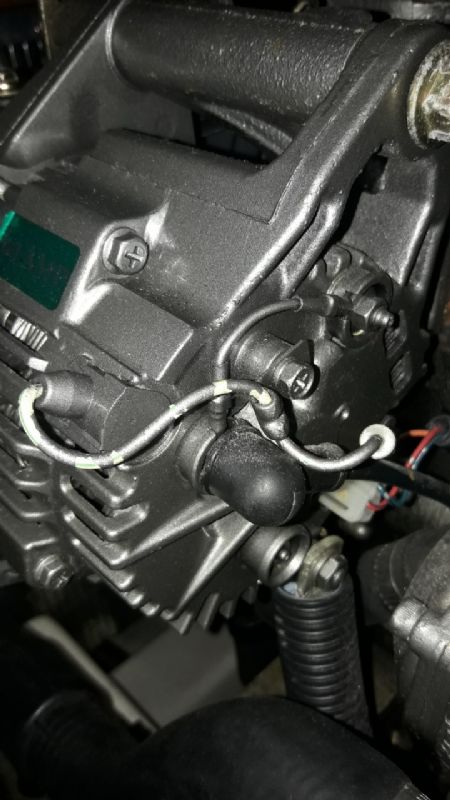 So I inserted the AB12130 in the wire from the Altornator. Engine started normal, but the AB12130 did'nt light up. The reason was that My 370 came with a "Voltage Drop Free - Battery Isolator" that split the current from the Altornator to Starter-battery/Consumer/Winches_thruster.: uploads/2746/_Batteri_splitter_liemo_electronics_manual_13_en.pdf" rel="nofollow - "MBI100/3IG&MBI150/3IG" from Liemo. This Splitter has an "IG" input that the AB12130 needed. So When removing the IG to the AB12130 input the AB12130 turned on when the engined started. But via the remote for the AB12130 I could see that the AB12130 did't do anything. (The Remote also has a built in Engine-hour Counter - nice) But this was because I only used the "Consumer" Output on the AB12130. So I removed the Starter-battery wire from the Splitter and extended it so it could be attached to the AB12130 Starter output. Now it worked. The difference was huge. When in port and the engine in idle the voltage from the Altornator to the starter battery was 13,2 volt and the charge amps was 15 with almost full batteries. But the voltage to the consumer batteries was 14,4 volts. Then I turned off the AB12130 (It then stop altering the current/voltage, but lets the altornator take over). In idle the charge current dropped to 0.5 amps and I could hear the engine sound different. When on and above idle I saw 33+ amps with almost full batteries. From the earlier replies in this thread - it points to the AB12xx/or the altornatoe is not able to do this for a longer period. I did only a prototype test-fitting, so I will have to learn that later on myself. From Viviaenergi.dk I got 3 100AH lifepo4 batteries. They are rated for 14,6v boost and 14,4v and has builtin BMS with bluetooth (With Chinese Spyware app that needs gps/microphone/camera/call-lists+). Both the Mains Charger(Sterling Pro Charge Ultra 60amp) and the AB12130 can be set to lifepo4 (14,6v/14,4v) and when keeping the Splitter I think the boat is ready for a "swap" to lifepo4. I will keep the Calcium-Silver Starter battery. I consider to drop the 2x100ah winch/thruster Lead batteries and replace them with 1-2 lifepo4 and let them join the Consumer-bank. But they will then be in different storage-lockers. I don't know if this is an good idea do to different cable lengths? (All batteries will have their own build-in BMs) If anyone see any pittfalls in my thoughts please reply. Thanks again for the valuable information that is provided on this forum. /H8jer ------------- Hanse 370#487 30HP 3-cabin |
Posted By: Fendant
Date Posted: 14 June 2020 at 18:11
|
I am also in the process to make the switch in the next weeks. I have purchased 2 Victron LFP's with 100 A and a Victron Mini BMS and will start with the 2 this year. The volume used by the 2 165 Ah AGM's would allow to install a third LFP at a later stage. I looked at the Volvo D1-30 F manual and found out that I have an 115 Amo alternator. My Sterling charger delivers 30 Amps. The Victron dealer said, that I should keep the Sterling VSR ( which couples house and starter batteries ). Between the Voltage Sensitive relay ( VSR ) and the LFP's he recommended to install a Cytric Li-Charge modul. He sees no need to change anything on the alternator. Question: Reading the posts here, do I run into a possible problem cookuîng and ruining my alternator ? Thx on beforehand Frank ------------- Frank |
Posted By: Ist
Date Posted: 15 June 2020 at 11:50
|
Very interesting and timely thread! Does anyone know whether the standard Quick shore-charger would need an upgrade? This is on a 2014 H385. thanks I
|
Posted By: Rikard_Swe
Date Posted: 15 June 2020 at 12:19
|
I installed Lifepo batteries in our old boat, and kept them when I sold the boat so last year when we got our Hanse I installed them without any big changes to the electric system. There is some information in my Threat Updates in a Hanse 400. As many systems mine is a Hybrid system with AGM starter battery and Lifpo house battery. I think as others - when the Lifepo is full the alternator continues to charge the starter battery. This will protect the alternator.
I have a LVP - Low Voltage protect - if for some reason the battery bank will be dicharged. This and a good system for monitoring the energylevels, I use a Pico system. I will add some chunts to this so I can monitor refrigerators and heater - so I will know how much energy is needed for the different systems. |
Posted By: H8jer
Date Posted: 15 June 2020 at 19:03
Yes the Hybrid setup looks like the most easy way to do this upgrade. But isn't overVoltage a problem? If I remember correctly my Altornator might provide 14,8volt. My new lifepo4 batteries shuts off at that voltage. The risk is that without anything regulating the Alternator theres a risk you won't charge your lifepo4 batteries but only the old ones? H8jer ------------- Hanse 370#487 30HP 3-cabin |
Posted By: Forth2
Date Posted: 16 June 2020 at 21:07
|
H8jer, I just posted a reply, but it is not visible. Apparently it needs to moderated. Maybe I used some offensive words ?
|
Posted By: H8jer
Date Posted: 16 June 2020 at 21:10
|
Ok. Perhaps you could pm the post to me? ------------- Hanse 370#487 30HP 3-cabin |
Posted By: H8jer
Date Posted: 19 June 2020 at 07:54
|
I was not able to post the message from forth2. My takeway was that small top-up float charge should be avoided. Eg. Leaving the Mains Charger Always on Or having a fixed solar panel and a full battery is not the best idea. Anyways. Yesterday I installed the Sterling Alt Pro C next to the charger and splitter. Before:  Made a white plywood to fit the design:  After:  /H8jer
------------- Hanse 370#487 30HP 3-cabin |
Posted By: H8jer
Date Posted: 23 June 2020 at 22:50
|
Today we were out testing the Sterling AB12130 Pro Alt C. I only saw 33 amps when charging halffull batteries. But the Alternator got really hot. 33 amps is only a bit more than half of it's rating. 15 minutes after power off it was still 86 degrees Celcius. 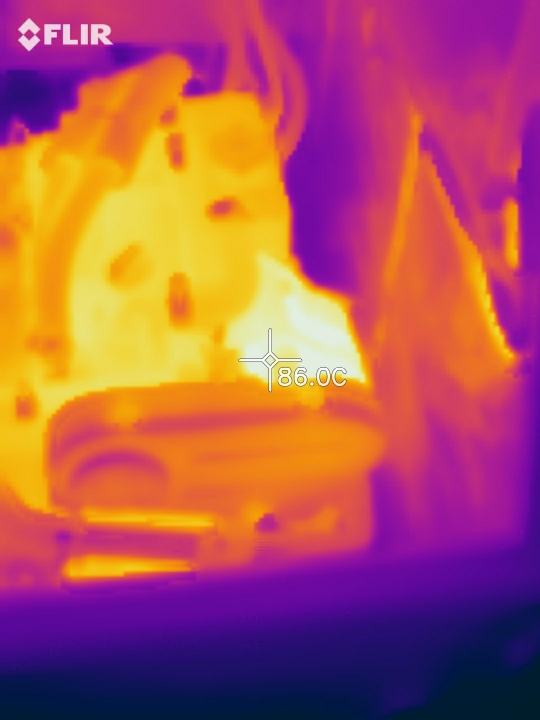 How hot should an Alternator get? Is it about to fail? UPDATE Looks like Balmar Alternators cut off at 109 degrees celcius. So This is very much near the limit. From other forums is looks like it also could be due to wrong belt tension. I also noticed a Warm Rubber smell in the beginning. Another reason could be the cabling. My alternator is a LR160-741, but there was an option for an 80 amps version LR180-03C.The 80' version have fan-blades outside the housing. I consider to upgrade to the 80 amps alternator but I will look at the belt-tension first. /H8jer ------------- Hanse 370#487 30HP 3-cabin |
Posted By: Forth2
Date Posted: 24 June 2020 at 20:54
|
I recommend getting the 125 A alternator from Yanmar. It is a very easy install. It is the alternator with which new 3YM engines can be purchased. It comes with a wider grooved belt that can transfer more mechanical energy without wearing out like the V-belts do. As a bonus I got new grooved wheels that replace the worn, slightly corroded V-belt wheels. I just installed mine last week. It gave out 60+ Amps at some point of in the beginning of the charge. I have not checked it out fully yet.  |
Posted By: jeb
Date Posted: 24 June 2020 at 22:36
|
Where did you buy the 125A alternator kit with new belt and pulleys? Price?
------------- Jesper Hanse 400e |
Posted By: Forth2
Date Posted: 25 June 2020 at 05:25
|
I got the alternator upgrade kit from a Finnish diesel service company. https://www.dieselasennus.fi/" rel="nofollow - https://www.dieselasennus.fi/ The kit is just a collection of original Yanmar spare parts that they were selling as an upgrade kit for 700 €. They also provided the copies of the appropriate service manual pages. |
Posted By: H8jer
Date Posted: 25 June 2020 at 07:36
|
With the new 125A - do you then have to get a bigger cable from the alternator? I cant remember but the cable looked like only 25mm2 or less. Even the 15hp has this new 125A. This looks like a good idea, but I think this upgrade is too big a project so close to our holidays. A good quality 80 Amp is only 150 Euro and will be a drop-in replacement. I will take one along as a spare. /H8jer ------------- Hanse 370#487 30HP 3-cabin |
Posted By: Forth2
Date Posted: 25 June 2020 at 10:15
|
I needed to change the short + cable between the alternator and the start engine. The diameter of the screw is larger (8 vs. 5 mm) on the 125 A alternator. I used a ready made battery cable from biltema. The cables to the batteries are the red and black starter cables in my installation. They are quite thick. I guess 50 mm2. There is also a thinner orange cable between the engine and battery box which is not used. I suppose it was put there for some charging purposes. Also to L and W cables need be extended with a different connector. I think taking high currents from an alternator using just one V-belt will lead to more belt maintenance.
|
Posted By: H8jer
Date Posted: 25 June 2020 at 10:31
|
50mm2 makes sense. In my setup the Orange cable is used and it goes straight to the charge splitter. There must also be a thick cable for the starter. Your 50mm2 goes through the Engine Manual Switch Key? Perhaps I can join the starter and alternator like you and at the batteries I can make a new wire from the Engine Manual Switch Key. I asked my local Yanmar Pusher for a quote for a similar 125A upgrade kit But I am running out of time for doing all this upgrading. I will need to KISS until the holidays... ------------- Hanse 370#487 30HP 3-cabin |
Posted By: Forth2
Date Posted: 25 June 2020 at 11:12
|
The 50 mm2 cable goes through the big master power switch. I understand now that in case you have a charge splitter, you need the separate orange cable for the charging. Using the starter cables, these will directly charge the starter battery.
Then you need a "VSR" to charge the LFP, as mentioned in earlier posts. |
Posted By: H8jer
Date Posted: 25 June 2020 at 12:42
|
Just had some minutes to go the boat and back. The Alternator only has the Orange cable and the IG and a connector with 2 small wires in a connector. The Belt Tension is WAY off, more like 20mm-30mm-ish than 10mm required. The belt is only about 1 year old but filled with rubber powder. I thought it would have been possible to hear it slipping, but no. It looks like the Sterling is really making the Alternator work for it... The minus (blue) from the engine to the bus-bar is 95mm2. The positive to the starter (black -why don't they use red) looks to be similar size. I like the Idea of not using a relay that makes an direct connection between the Starter battery and the House batteries. So if I make a new 25mm2 to join the Orange 25mm2 to get 50mm2 - it is possible to keep the setup with the splitter. During the weekend I will try and sort the heat-issue. I am thinking of a custom "Belt cover" with more ventilation holes and perhaps a computer fan to blow more air into the alternator. The old batteries are kept not fully charged so I can pull max amps from the Alternator. So this heat-issue is major priority and needs to be solved. After this the lifepo4 batteries can be installed.
------------- Hanse 370#487 30HP 3-cabin |
Posted By: H8jer
Date Posted: 25 June 2020 at 17:14
Hi Jesper I don't understand that the Sterling results in a loss? I see much higher output than without stock setup. I don't have the temp sensor, but consider to get one, but perhaps combinding it with a potential-ohmmeter (dont know the english word in danish it is pot-meter aka an adjusteble resistor) so it will be posssible to adjust the cut-off temp myselves. If I get the 125A alternator the splitter might also need an upgrade as I don't know if it is the 100A or 150A version. Sterling has some splitters https://sterling-power.com/products/volt-drop-alternator-splitting-system-pro-split-r?variant=882765499" rel="nofollow - https://sterling-power.com/products/volt-drop-alternator-splitting-system-pro-split-r I installed one in our old Hanse 311 and found it to be a good product. But from your and forth2 comments, it looks like Sterling is perhaps not a frontline company on lifepo4 matters. Perhaps it is possible to consider an other brand? ------------- Hanse 370#487 30HP 3-cabin |
Posted By: H8jer
Date Posted: 25 June 2020 at 19:43
|
Okay this topic fills up alot in my head... Thinking out loud here: What If I drop the Starter battery and just use the lipofe4 batteries as one bank for both service/house and starter batteries? 3 lifepo4 in parallel should crank 900amps and with a https://http://www.victronenergy.com/blog/2016/03/08/batteryprotect-it-does-exactly-what-is-says-and-more/" rel="nofollow - https://http://www.victronenergy.com/blog/2016/03/08/batteryprotect-it-does-exactly-what-is-says-and-more/ It would be possible to keep power left for starting(but looks like it might need output from a victron bms?) The bowthruster/anchorWindlass bank in leadAcid/calcium would through the splitter secure that the alternator doesn't break when the lfp stop recieving charge??? Pros: I can use the 95mm2 from the 'starter battery to the starter' for charging also. Cons: a battery protect shuts off very aruptly and might happen with bad timing..
------------- Hanse 370#487 30HP 3-cabin |
Posted By: jeb
Date Posted: 25 June 2020 at 22:45
|
Hi, some explanation why a alternator to battery charger is less efficient than an external regulator. First of all you need to know that a alternator is limited in the amount of current I can product, not the voltage. This is because the dominant losses is resistive (R*I^2) and it’s basically independent on voltage (if you have high enough rpm). The standard hitachi alternator fitted to older (4-5 years) Yanmar engines has a built in regulator. That means it controls the output on the alternator to typical 14,4 V. But you will also have a voltage drop in your cables. In my h400 with decent thick cables I se about 0,7 V drop@50-60A, leaving 13,7 at the battery. This might give a decent charge at lower SOC. Both a alternator to battery charger and a external regulator measures voltage on the battery and compensates for this voltage drop. They also overrides the internal temperature protection that is designed for an automotive application with the battery in the engine room. So the AtoB will be an improvement to the internal regulator. However, the AtoB is in fact a step up converter. It works like a transformer (but with transistors and induktors) and simulates a low soc battery. The sterling AtoB lodads the alternator down to 13,5 V and transform it up to what’s needed to get 14,4v (or what ever setting you use) on the battery. In my case 15,1 V is needed to get the 14,4 on the battery. Since power is constant (P=UxI) you will loose 13,5/15,1 + the efficiency in the converter. This is typically 15%. I tested this on my AtoB and when the alternator pushed 66A I only got 57 to the battery. With an external regulator you address this I a different way. This device overrides the internal regulator and push the alternators voltage up (by creating higher field than the internal) to what’s needed to get 14,4 V on the battery. In this case every amp that leaves alternator will reach the battery. Drawback is that you need to take the alternator apart and solder a wire to the negative brush (for negative field control as the Hitachi). ------------- Jesper Hanse 400e |
Posted By: H8jer
Date Posted: 26 June 2020 at 07:24
|
Hi Jesper Thx for the explanation. I missed that part where you said you had an external regulator. You've also interested in the Yanmar 125A alternator? but this would also need modding? About the Belt Tension, I am sure it was ok last year, but because of a cooling hose blocking the path to the nut tightening the alternator - it might have moved a little. Looks like a common problem: https://forums.ybw.com/index.php?threads/why-am-i-shredding-belts-on-yanmar.235525/" rel="nofollow - https://forums.ybw.com/index.php?threads/why-am-i-shredding-belts-on-yanmar.235525/ https://forums.ybw.com/index.php?threads/yanmar-alternator-belt-tension-problem.501545/" rel="nofollow - https://forums.ybw.com/index.php?threads/yanmar-alternator-belt-tension-problem.501545/ They recommend using non-original v-belts and the v-belt should not be flat but grooved or toothed. Maybe the loose belt also could be avoided when using something like this to secure the nut/tension:  https://shop.pkys.com/Balmar-BBU-Universal-Belt-Buddy-Tensioner-without-adjustment-arm_p_3020.html" rel="nofollow - https://shop.pkys.com/Balmar-BBU-Universal-Belt-Buddy-Tensioner-without-adjustment-arm_p_3020.html This is only available in the US. Does something similar exist in europe? Update! Found a retailer in UK: https://rjsmarine.co.uk/product/bbu/?v=dd65ef9a5579" rel="nofollow - https://rjsmarine.co.uk/product/bbu/?v=dd65ef9a5579 Update II The BBU is proberly not going to fit on our boat. There is not enough clearance...
------------- Hanse 370#487 30HP 3-cabin |
Posted By: H8jer
Date Posted: 26 June 2020 at 18:59
|
another episode in the saga of getting ready for lifepo4 batteries.. Took the beltcover off and found it very dirty with rubber debri. Tried to vacuum clean it, but it was sticky as hell. The tightening nut was so tight I could barely get it loose. So the slack in the v-belt must have come from wear or that original Yanmar belts just sucks! Before: 18mm play  After 10 mm play  To get a comfortable working position for doing this singlehanded I used an airbag between the engine and the alternator  Then I tried the engine for 15 minutes. At the same time the rpm was measured with a laserCounter. Idle was 730 rpm and charge was 22 amps Normal cruise speed for our boat is 2500 on the tacho, but the real rpm was 2380. Charge was 33 amps. Flat out in neutral was 3720 rpm. Max amps was 33.  It is very clear that something is wrong with the v-belt. It is hotter than the alternator.  The difference between the belt for the waterpump and to the bad vbelt is huge!  I have ordered some new Gates Or Dayco belts that are toothed. The current one is a original Yanmar and flat. One other thing that needs improvement is the ventilation around the alternator. When running there was almost no air in movement. I could only feel a tiny blow. The alternator has no fanblades. So the belt might be the reason that the amps are only 33. But also 15% loss in the Sterling. And the charge cable is aprox 10 meters and only 25mm2 which is calculated to introduce a loss of 5.5%. If the belt is slipping (without any sighs other than heat and rubber dust) and this is fixed I guess the Alternator could provide in the range of 39-48 amps To be continued... ------------- Hanse 370#487 30HP 3-cabin |
Posted By: H8jer
Date Posted: 30 June 2020 at 11:03
|
Searched around and found out that the Yanmar 125A Alternator with partno. 128990-77250 is a in fact the Valeo SG10S078 120A. Sadly there are no replacement/remakes for this Alternator, which keeps the price up. So a conversion kit from Forth2's link to the Finnish company posted earlier for 700 euro looks like a good offer. Balmar has gear for this alternator. https://shop.marinehowto.com/products/balmar-30-sr12-02-external-regulator-conversion-kit" rel="nofollow - https://shop.marinehowto.com/products/balmar-30-sr12-02-external-regulator-conversion-kit ------------- Hanse 370#487 30HP 3-cabin |
Posted By: Fendant
Date Posted: 30 June 2020 at 17:29
|
Have just completed the installation of 2* 100 Ah Victron smart batteries. As others I have maintained my AGM starter batterie. The Victrons have an external mini BMS and are connected through a Cyrix Li charge, which is in the alternator charger cable. My 30 A Sterling charger was switched to LiFePo and charges directly into the service bank. Victron's come with a 50% charge. I tried out the engine and the 115 Amp alternator pumos 75 Amps into the service bank. I then switched back to the Sterling on shore power generating 28 - 30 Amps charge. Will post photos before and after. BTW the boat is no longer listing to port  ------------- Frank |
Posted By: H8jer
Date Posted: 30 June 2020 at 19:26
Good work!  In my Old Hanse I also dropped the lead batteries and made a new bank in the starboard side to avoid bad balance. 115A Alternator? What make/brand is that? ------------- Hanse 370#487 30HP 3-cabin |
Posted By: Fendant
Date Posted: 30 June 2020 at 20:50
|
It is the standard alternator , which came with my Volvo d1-30 F. ------------- Frank |
Posted By: H8jer
Date Posted: 30 June 2020 at 20:59
|
Yet another episode about the lifepo4 project... Earlier it was established that Yanmar original alternator belts are no good. Then I set out to study this in detail and I found a good alternative. For my 3ym30 there are two belts: Yanmar 119831-42290 = Bando A37.5 (A Profile) Flat Yanmar 129612-42290-Q = Bando 3755 13x925Li Cogged (AX Profile) These are DIN 2215 classic belts rubber with operation temperature max 60-90 degrees Celsius . From this paper https://www.continental-industry.com/getmedia/9f5028f5-ffc7-47aa-8ad4-577d5676795f/PTG8955-DeEn_CONTI-V.pdf" rel="nofollow - https://www.continental-industry.com/getmedia/9f5028f5-ffc7-47aa-8ad4-577d5676795f/PTG8955-DeEn_CONTI-V.pdf page 17: "In most cases a narrow-section V-belt can replace a classical-section V-belt without a problem." Modern narrow belts Cogged are DIN 7753 eg. the type XPA that is compatible with A/AX. From https://www.skfptp.com/CategorySearch/Index/1" rel="nofollow - https://www.skfptp.com/CategorySearch/Index/1 I could find the right size by comparing between profiles A/AX and XPA, and discovered that A37.5 equals xpa982. The best XPA belts I could find where both built in EPDM Rubber which is rated for 130 degrees Celcius. And they can't stretch! no need to adjust ever again... Conti FO Pioneer XPA982: Properties – improved temperature resistance from -40 °C to +130 °C – enhanced durability thanks to more abrasion-resistant compound – maintenance-free – power increased by 5.5 % compared to 1st generation – very good flexibility thanks to molded teeth – enhanced running smoothness – matched-set L=L serial production – electrically conductive to ISO 1813 – conditionally resistant to oil – dust-proof and suitable for tropical climates The pioneer was not in stock in my area but I got: Gates Quadpower 4 XPA982: Service-free V-belt Widest temperature range in the market: from -50°C to +130°C Match system: all sizes meet Gates UNISET tolerances, they can be installed without matching Energy efficiencies up to 98% Latest EPDM rubber technology Halogen-free belt Perfect fit on standard ISO/DIN/RMA V-pulleys Manufactured to DIN7753, ISO4184, RMA IP-2 which is very similar to the Conti Pioneer. Today I installed the Quadpower 4 XPA982 and run the engine for a little. With the old belt I only saw 33 amps but with the xpa982 I saw 40 amps even-through the batteries were almost full. The heat signature was also much better: With the old belt the pulley and belt was hotter than the Alternator. Now it is completely the opposite!  The belt seems to run much cooler.  So xpa982 is much better for the 3ym30 and it stopped the slipping of the belt. We know this because the charge amps increased. Beware it was not in any way possible to detect it was in fact slipping. The QuadPower and the Conti Pioneer is the same price as the Yanmar Belts. Next episode will contain an upgrade to the 80 amps alternator which has fanblades attached to the pulley. This should help with air ventilation around the Alternator. It will arrive soon by mail...
------------- Hanse 370#487 30HP 3-cabin |
Posted By: Fendant
Date Posted: 01 July 2020 at 18:30
Here is the complete before and after picture: Here is the current installation ( still needs a better place for the BMS on top of the batteries )  I also tested the alternator with full service battery this morning. It starts ith 25 Amps + and drops within seconds to something between 1 and 3 amps. Please note that I have removed the alternator charging cable with the 125 A fuse from the positive bus bar and connected it to the Cyrix Li-Charge which is connected / controlled by the BMS. Will report any positive or negative surprises.
------------- Frank |
Posted By: H8jer
Date Posted: 01 July 2020 at 18:37
|
looks like there is room for at least one more battery? Is the wooden plate covering everything standard or homemade? ------------- Hanse 370#487 30HP 3-cabin |
Posted By: Fendant
Date Posted: 02 July 2020 at 11:06
|
Yep, there is at least space for a 3rd battery, with a small modification of the wooden panel in the back you might even squeeze in 4 LFP's of 100 Ah. Wooden floor and wooden back are original Hanse installation. Honestly I was happy during the installation that I could use screws to mount the extra equipment, like the battery combiner switch box- This allows to combine starter and service battery. In fact last year when I was out singlehanded and approaching a port to avoid an approaching thunderstorm, my starter batt gave up after 6 years of service. Acrtivated the switch and presto I had he eegine in under 60 secs. ------------- Frank |
Posted By: pdc78
Date Posted: 02 July 2020 at 11:28
|
Frank - I assume you have had to run some big cables from the engine to your House Battery bank for that emergency switch over. I'm fairly sure that Hanse don't put this wiring into a 345 standard build. Did you consider a Lion Car Jump Starter / Portable External Battery Charger such as the Arteck 900A? They are very compact and multi-purpose and can be bought for c. £70. I don't have one at the moment and had the emergency switch option on my previous boat - which was reassuring. I just wondered whether the compact portable jump starter was a lower cost and simpler alternative. Regards, Paul ------------- H345 #269 |
Posted By: Fendant
Date Posted: 03 July 2020 at 08:06
|
Hello Paul, the battery combiner is in the Sterling VSR wiring diagram. It is a single switch overriding the voltage sensitive relaiy. There is a 150 mm2 cable to the positive bus bar installed by Hanse. I have used it only for a few seconds to start the engine. Once ot is running you disconnect the override switch. I had a set of jump start cables on board. However Hanse installed the battery way back in the engine bay. Connecting it safely is a PITA job. Hence I decided against a separate flying cable solution.   ------------- Frank |
Posted By: pdc78
Date Posted: 03 July 2020 at 09:26
|
Thanks Frank. So in effect you are just using the engine battery charging cable for the occasional jump start using your service batteries? Regards, Paul ------------- H345 #269 |
Posted By: H8jer
Date Posted: 04 July 2020 at 08:05
|
New saga update. Got a cheap "Premium Quality Alanko Gmvh Germany" Alternator (LR180-03A)  I was an easy swap with no need to alter anything. The Alternator came with a printout from a test application "DV electronics LTD" From this sheet there was some interesting details. Maximum Alternator output 109 Amps. Alternator TurnOn speed 1255rpm Regulator activation speed 1332rpm Voltage Set Point 14.09 volts It also had a table about output 1600rpm 53 Amps 1800rpm 66 Amps 2000rpm 76 Amps 2400rpm 88 Amps 3500rpm 101 Amps 5000rpm 107 Amps 6000rpm 109 Amps The engine pully and the alternator pulley is not of the same size so a gearing is in play. With Laser Counter it was possible to meassure the speeds of the pulleys. Engine Rpm 1500 equals Alternator 2400rpm. This is Ratio of 1:1,6. This also means that this Alternator needs the engine run 830 rpms or faster before the Regulator starts. This is 100 rpm more than normal engine idle meassured earlier. The new setup was tested for a short while and the cooling fanblades is a great improvement.  This photo shows the Alternator from above and this is when the engine is hot and at 1500rpm. So the fan is not spinning as fast as it would during our normal 2500rpm cruise Speed(Alternator 4000rpm) So the cooling is going to be great.  When I meassure Amps I can only see what is sent to the depleted old House Batteries. 3x75Ah, but the TR16 shunt reports that the batteries in total only hold 100AH. I can't meassure what is sent to the 2x10²Ah Thruster/Winch batteries but they have not been used and only recieve about 2-5 Amps on shore power. I have a ClampMeter but think It is not precise. During the test the max Amps was 50. But I think it is time to insert the 3x100Ah lifepo4 batteries as the current setup looks to be bottlenecked somehow. So to Recap the Altornator Part of this upgrade project: With old batteries down to 9.9volt the max charge was 18Amps from the stock Alternator. With the Sterling ProAltC the Charging was improved but it made the Alternator turn into a fire hazard. It turned out to be that regular belts are no good for high Alternator Output. With the new XPA type belt the slipping stopped. But It also showed the stock 60 amp Alternator was needing additional air circulation which resulted in upgrading to a new Alternator. So next episode will include the replacement of the batteries. ------------- Hanse 370#487 30HP 3-cabin |
Posted By: H8jer
Date Posted: 08 July 2020 at 21:45
|
The lifepo4 batteries (3×100AH) are now installed.  To fit the battery box it was necessary to cut the entry hole for the negative larger so the hole enters at the same height as the battery terminals. (Upmost left corner) The cables are on top of the batteries and they are the ones that needed attention. But to get the seatcover to fit it was quite easy. With some removal of wood is fit perfect.  It took some time to run the batteries down to 75% before I could stress test the new setup. ( 80 amps Alternator, Sterling Pro AltC Alternator to Battery Charger) The engine was run for aprox 15-20 min. The Max charge was 50 amps just like the old Lead Batteries. With the Sterling disconnected max was 18 amps. So again something was bottlenecking... With the thermal camera the was found a cable in the engine room that was on hard work.  This cable is the negative from the Alternator. The stock alternator and my new upgrade are Isolated, meaning they don't share the negative with the engine through it's mountings. So stupid me, that cable is like 10mm2. The positive is 35mm2. A 50mm2 was added between the Alternator and the engine where all the negative cables for the winches also are attached. The engine was run again. This time the max charge was an improvement by 10 amps to 60 amps. As I am not familiar with the charge character for Lifepo4 batteries I was uncertain If there still was an cable thickness issue. The Sterling did increase charge a lot, but the voltage seemed low. The starter battery only got 12.9volt and the Lifepo4 got 13.5. I would have expected it to show 14.6 volts at the batteries. So just to be sure the positive from the Alternator to the Sterling was added a second 35mm2. (Pulled the cable through the hidden areas and it was 7.5meters) The engine was run again and this time it was 71 amps maximum. Without the Sterling it was 24 amps. I think that 71 amps at normal cruise speed is quite reasonable from an 80 amps Alternator. Also the cooling don't seem to be a problem.  ------------- Hanse 370#487 30HP 3-cabin |
Posted By: Forth2
Date Posted: 09 July 2020 at 10:10
|
I was reading the Sterling AtoB manual. It charges the LFPs to 14.8 V and then floats at 14.6V. I hope the float voltage is a typo, since a float voltage of 14.6 will destroy the batteries. There was another lead program with a low float voltage of 13.4 which is perfect for LFPs. I would use that instead.
|
Posted By: H8jer
Date Posted: 09 July 2020 at 18:50
|
the paper manual and the https://cdn.shopify.com/s/files/1/0658/7343/files/AB12130.pdf" rel="nofollow - online states on page three: Lifepo4 - Boost 14.6v and float 14.4v. But thx for the headsup. I will measure it to check. ------------- Hanse 370#487 30HP 3-cabin |
Posted By: Forth2
Date Posted: 09 July 2020 at 19:20
| I took the numbers from memory. Anyway, 14.4 V as float is way too high. |
Posted By: H8jer
Date Posted: 09 July 2020 at 21:48
|
From www.vivaenergi.dk where I bought the thee Lifepo4 has this info( google translated): 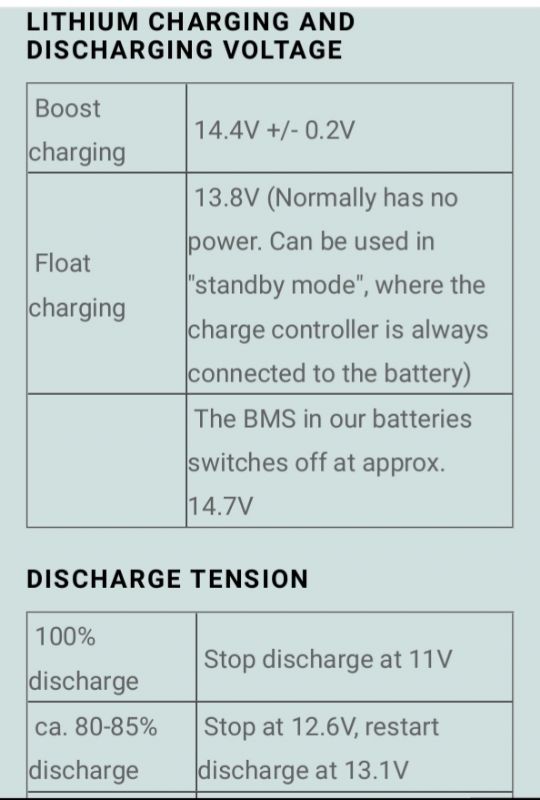 The next days we will cruise and I will monitor the voltage. During the short stress test, there where no voltage above 13.9v but I would expect this to rise with full batteries. If I turn off the Sterling the voltage will drop. ------------- Hanse 370#487 30HP 3-cabin |
Posted By: H8jer
Date Posted: 10 July 2020 at 18:08
Yes. At 14.4v there is still flowing power to the batteries. 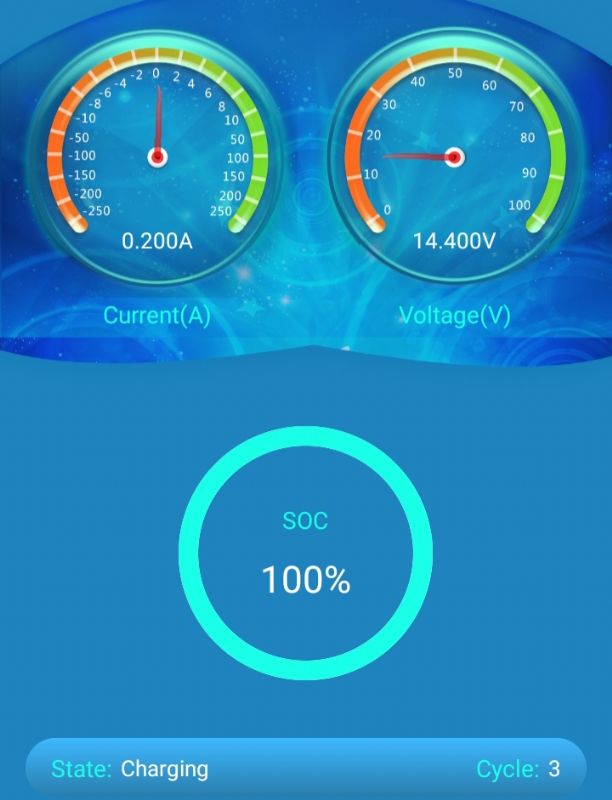 After 3 hours of motoring I will say that the Sterling Pro Alt C (AtoB) has passed. We began with 95+% batteries and sailing 3 knots in the harbour gave 50+ amps in almost idle rpm. This was at 13.9v. At some point the AtoB sensed the voltage and Current and changed from boost 14.6v to 14.4v for 30 min(Absobtion mode). After the 30min it changed to 13.8v ( float mode). This is not described in the manual, but what happend in real life. The first minutes after the AtoB changed to float the batteries were discharging. Then they settled down. During the 30 min Absortion mode the charge amps to each battery was 1-3 amps. In the picture the charge amps are 2.1A. But in float mode sometimes the batteries discharge and sometimes recieve charge. 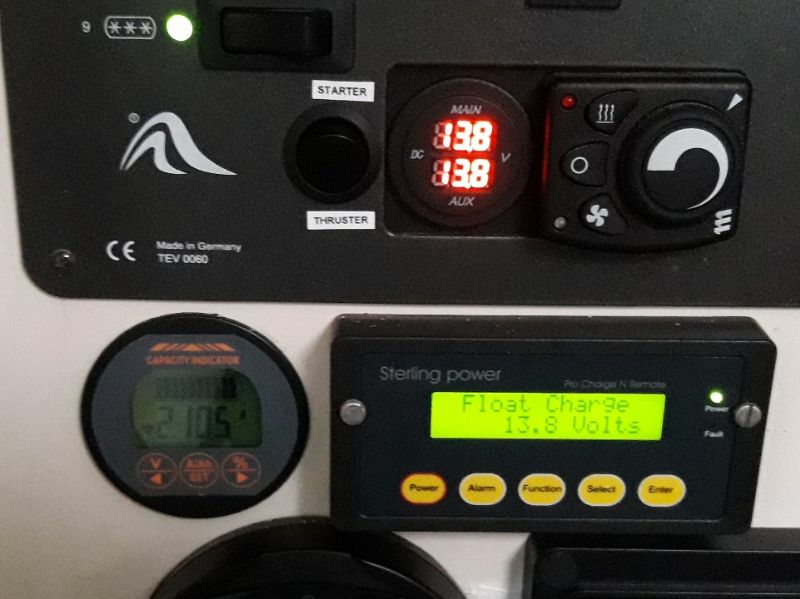 Another Issue it the Mains Charger, Sterling Pro Ultra 60 Amps with has 2 Lifepo4 programmes. The Preset2 is 14.6v/14.4v which I tried but this is like Forth2' comment too much. So I used Preset1 which is 13.8v Boost and 13.8v Float. If you think 13.8v as boost is too low then think again. When harbouring and after waiting 30 minutes the mains charger pumped out 32 amps at 13.8v. So I think now the settings are as they should be and that I dont need to attend to anything else the either start the engine or plug in the mains power. ------------- Hanse 370#487 30HP 3-cabin |
Posted By: Fendant
Date Posted: 11 July 2020 at 07:33
|
I am also using preset 1 on my Sterling charger. After a night connected to shore power with fridge as the main consumer on, the display on the remote shows 14.4 V and "ready".
------------- Frank |
Posted By: H8jer
Date Posted: 11 July 2020 at 08:46
|
Sounds a bit like the Sterling might still be in preset2? ------------- Hanse 370#487 30HP 3-cabin |
Posted By: Fendant
Date Posted: 11 July 2020 at 10:15
Afaik it is not: ------------- Frank |
Posted By: H8jer
Date Posted: 11 July 2020 at 10:27
|
looks like there are 2 versions. This is how ours look: (photo from sterling-power): 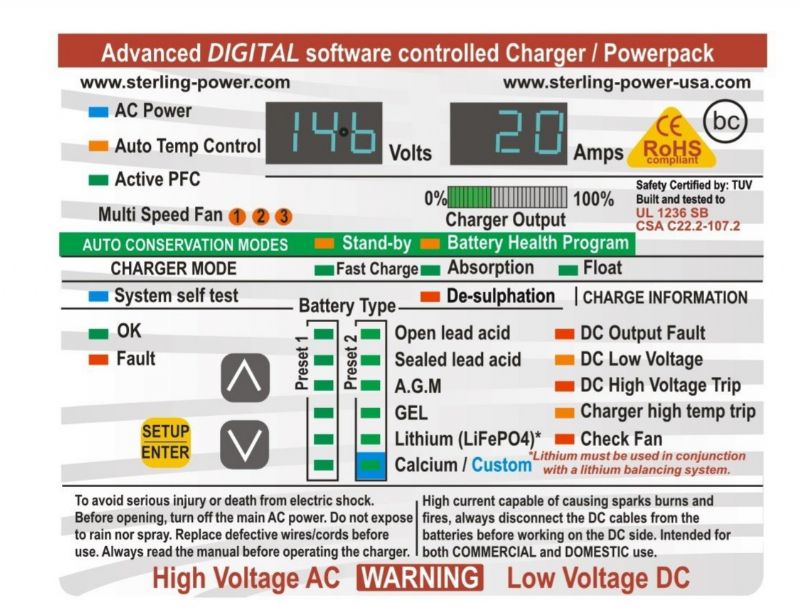 ------------- Hanse 370#487 30HP 3-cabin |
Posted By: jeb
Date Posted: 11 July 2020 at 17:38
|
Hi, attached link is the complete shopping list to upgrade your Hitachi 80A alternator to a Valero 120A incl serpentine belt, new pulleys etc for a Yanmar 3JH4E. I vreated it by comparing the 3jh4E with 3JH5 partslist. Cost is 668€ incl VAT. https://dieselpartseurope.com/sharecart/index/cart/crypt/eERCTk1FRzgwUlQwaVRqbmVNa1pQQT09/" rel="nofollow - https://dieselpartseurope.com/sharecart/index/cart/crypt/eERCTk1FRzgwUlQwaVRqbmVNa1pQQT09/ . ------------- Jesper Hanse 400e |
Posted By: H8jer
Date Posted: 12 July 2020 at 11:12
Good work Jesper! This upgrade will be considered if my new setup is not good enough. My local Engine Repair guy have talked with Yanmar and they didn't have any 125A upgrade Kit. So like the path you and Forth2 follow/ed - it will be a DIY project. Also the tiny Negative from the Alternator, is part of the Yanmar Electic Harness, so a true Genuine Kit would perhaps also include a new Harness and make this incredible expensive. ------------- Hanse 370#487 30HP 3-cabin |
Posted By: H8jer
Date Posted: 19 July 2020 at 15:39
|
We have now been using the new 300ah Lifepo4 Batteries for a week+. They are a huge improvement over the old (3×75ah) lead batteries. We were 2 dags/nights (total 40 hours) at an anchorage. When we left there was still 76% / 230AH left in the batteries. We have a 100watt foldable Solarpanel we place ontop of the lazyjack that providede upto 50watt during a few hours it was sunny. The new 80 amp Alternator and the Sterling Alternator to Battery Charger AB12130 ensured that the batteries were fully charged after 1.5 hours. The charge rate to the Lifepo4 batteries alone was 50-60 amps. But this comes with the expence of heat. 60+ amps is 3 or more horsepower and the Alternator becomes really hot. Via the remote I can manually power off the AB12130 and the charges drops from 50-60 amps down to only 10 amps with is what you get without the Sterling in the loop. I wrote a mail to Sterling-power because I expirences that the AB12130 sometimes when powered off displays "No Communication please wait" then it turns on by itselves. There is also a need for better cooling of the engine room. Right now there is only an blower to extract hot air, but no fresh air inlet. Sterling recommads installing a fresh air inlet blowing to the backside of the Alternator where it sucks in air. Below are pictures showing the lower part of the engine is 100 degrees Celsius and the V-belt (xpa982 Gates QuadPower 4) is 85 degress and the metal casing of the Alternator is a staggering 120 degrees.   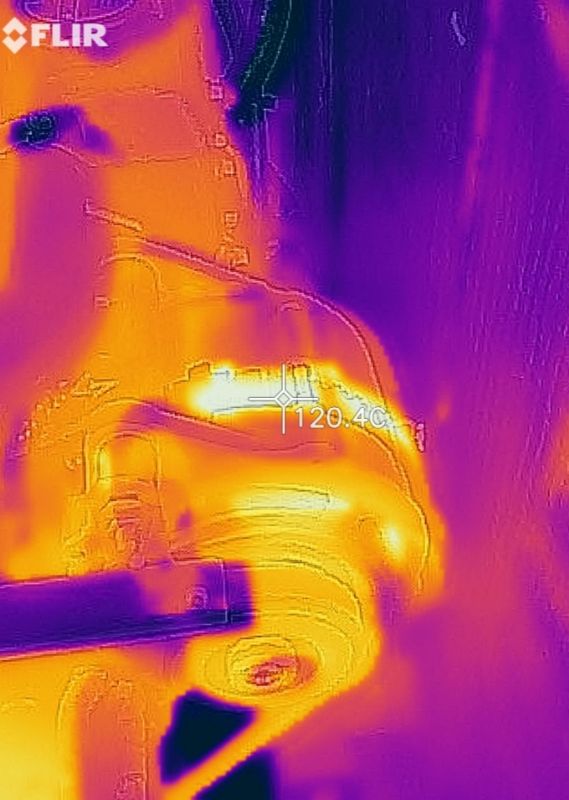 ------------- Hanse 370#487 30HP 3-cabin |
Posted By: Arken2020
Date Posted: 19 July 2020 at 17:53
|
hi Yes I have done this 4 times, in 4 sailboats with very good luck Firstly, since you choose to adress a forum for answers, you are likely to get several answers There are many ways to go and mixing products and suppliers can get you all confused - and things arent working according to plan What kind of boat and engine? What is your normal consumption/ 1 hour/ 24 hr? Do you have other means of charging, w mills/ solar cells? Do you have an infinite budget? :-) I can tell what I have done and how I went about getting there Im very pleased there is never any going back! B rgds Christoffer/ Arken/ Norway |
Posted By: Arken2020
Date Posted: 19 July 2020 at 17:55
| Did u get an answer ? Ru ok? |
Posted By: H8jer
Date Posted: 19 July 2020 at 18:00
|
Hi Christoffer Upgrading to Lifepo4 is complete. If you read the whole thread you can follow the "saga" ------------- Hanse 370#487 30HP 3-cabin |
Posted By: H8jer
Date Posted: 07 July 2021 at 21:39
Ok - it was not completely finished. The Temp sensor was not placed at the hottest point on the alternator. Now I have fitted the tempsensor in a better location on top of the alternator at the stator.  ------------- Hanse 370#487 30HP 3-cabin |