Simrad SimNet Noise Filter?
Printed From: myHanse.com
Category: Hints & Tips
Forum Name: 415/418
Forum Description: 415/418 Hints, Tips and News
URL: https://www.myhanse.com/forum_posts.asp?TID=13441
Printed Date: 26 March 2026 at 23:46
Software Version: Web Wiz Forums 12.06 - https://www.webwizforums.com
Topic: Simrad SimNet Noise Filter?
Posted By: SimonGH
Subject: Simrad SimNet Noise Filter?
Date Posted: 14 June 2022 at 02:40
|
Does anyone have the "Noise Filter" in the triple prong SimNet connector under the mast step? Mine looks like a regular terminator, the "noise filter" is supposed to also have a capacitor. Curious if anyone has this and what theirs looks like? I'm having an issue with my 508 wind sensor (new) where it doesn't come back to life after the power to the SimNet network is turned off. The only solution is to disconnect and reconnect it, where it then comes back to life. It's a brand new sensor replaced in the fall...  |
Replies:
Posted By: Ian Coverdale
Date Posted: 14 June 2022 at 09:11
|
Sorry your picture is not showing. Should not need any kind of 'noise filter' in Simnet. Simnet is an industry standard CANBUS protocol that is very robust providing installation guidelines have been followed. Are you sure this unit is not some kind of lightning protection? If so, they often contain components called varistors that degrade over time. Try unplugging it and see if your problem clears. Cheers. ------------- Ian & Andrea SV Gabrielle (H445) Liveaboards - currently Montenegro. www.facebook.com/sailinggabrielle |
Posted By: iemand
Date Posted: 14 June 2022 at 11:06
|
The purpose of that "Noise Filter" is in the end a termination of the bus. Normally on a Simnet the Windfane terminates the Bus on one side and the Power supply on the other end. When the windfane is not installed you need the "Noise Filter". If everything is fully installed than you don't need that. Basically it is only a Resistor. ------------- Hanse 312 MJ 2004 - Hanse 370e MJ 2007 |
Posted By: Ian Coverdale
Date Posted: 14 June 2022 at 11:26
|
Confusion with terminology. Resistor is 120-Ohms, purpose is to damped 'reflections' back along the cable. It is kind of noise I guess. CANBUS is fussy with terminations. Sure the 508/608 has built in termination resistor; you do not need an extra termination resistor at mast base. It you connector multi-meter across SIMNET L/H, A/B or data+/- connection (whatever they call it in your system) with everything switched off, you should measure ~60-Ohms (two end termination resistors in parallel). If you measure ~40-Ohms them you have an extra termination resistor. If ~120-ohms then you are missing an end termination or there is a break in your SIMNET network. Cheers.
------------- Ian & Andrea SV Gabrielle (H445) Liveaboards - currently Montenegro. www.facebook.com/sailinggabrielle |
Posted By: Peter-Blake
Date Posted: 14 June 2022 at 15:30
|
I am wondering why newer boats still need a noise filter. My boat from 2008 has one under the mast. The reason was, that they used the wrong cable in the sparcraft mast, and we got strange readings from the windvane. Later boats should have the correct cable...... This is how my noise filter looks like:  ------------- Blake 370 
|
Posted By: Ian Coverdale
Date Posted: 14 June 2022 at 15:58
|
Not come across this before .. SIMRAD did sell a noise filter (part number 24006934) but I cannot find any recent reference to it. Mentioned in NSE-8 manual; a 12-15 year old instrument which is about the age of your boat? Not mentioned in later manuals so suggest SIMRAD improved instrument immunity to 'noise'? ------------- Ian & Andrea SV Gabrielle (H445) Liveaboards - currently Montenegro. www.facebook.com/sailinggabrielle |
Posted By: SimonGH
Date Posted: 15 June 2022 at 11:59
|
If you zoom in on the mast area diagram: 
|
Posted By: SimonGH
Date Posted: 15 June 2022 at 12:02
|
I believe it is supposed to be there. Refer to this article in Panbo (ok, from 2011) https://panbo.com/impedance-driven-nmea-2000-simnet-gets-a-noise-filter/" rel="nofollow - https://panbo.com/impedance-driven-nmea-2000-simnet-gets-a-noise-filter/ In one of the comments: "I’ve been told it contains a 120 Ohm termination resistor as well as a 220 μF capacitor. So it is completely passive. It lowers total impedance to 120/3 = 40 Ohm instead of the standard 120/2 = 60 Ohm. Apparently it was cooked up by Simrad when Hanse started equipping 1000’s of sailing yachts with large(r) N2K networks, with the network cable going all the way up into the mast." |
Posted By: SimonGH
Date Posted: 15 June 2022 at 12:03
Thanks Peter. Mine definitely doesn't look like that - that looks like the pictures i've found. Mine looks like a regular terminator. I believe the longer part is the capacitor. Mine looks like this:  |
 Peter-Blake wrote:
Posted By: SimonGH
Date Posted: 15 June 2022 at 12:11
|
Ultimately the question is whether the absence of this item would cause the wind sensor not to "come alive" after the power has been turned off on the bus. I've also got to check the voltages under the mast step in that 3-prong connector, as that may contribute to the issue as well. But the bottom line is that at least in this diagram, the total resistance across the H/L on the bus would actually measure 40 ohm, not 60 ohm, and that apparently was by design. Additionally there should be some capacitance as well. |
Posted By: Ian Coverdale
Date Posted: 15 June 2022 at 13:31
|
Suspect your 508 is not visible due to data errors on SIMNET, not because of voltage problems. SIMNET is 250kbs CANBUS which 'should' be good for a 250m cable length although SIMRAD quote 120m in their specification. Running cable up a 20m mast should be no problem at all. Capacitor cannot be 220 μF; that would kill the bitstream dead. Might be 220 pF or 220 μF across the DC rather than data. Either way, have you tried removing it? Suspect SIMRAD had some poorly performing CANBUS interfaces in their early instruments which is why modern instruments handbooks make no mention of the 'noise filter' requirement. ------------- Ian & Andrea SV Gabrielle (H445) Liveaboards - currently Montenegro. www.facebook.com/sailinggabrielle |
Posted By: SimonGH
Date Posted: 15 June 2022 at 14:25
|
Actually it's the opposite. Right now there is no "filter", just that thing I posted (the small "plug" with the red end, which i suspect is just a termination resistor). From the pictures it definitely looks like a 220uF capacitor (the shape is consistent, it's not a small pico cap). I'll know more when it shows up - as I think you mentioned, it's not a very common part and was difficult to find. So with or without the additional terminator that is currently installed, the 508 acts the same. Its solid while the SimNet is powered up, but will not come back to life after a power cycle. Makes no discernible difference if that plug is installed in the 3-prong connector under the mast step. The very curious thing is that without that terminator installed, powering down the network takes a very long time. I have an extra Triton2 at the Nav station (that is powered only by the SimNet bus) and when you turn off power to the network, it remains on for a long time (minutes). If the terminator is installed, the network powers down "faster" in less than a minute. But either way it seems strange? This is the red-tipped terminator, so I don't believe it has any capacitance, and technically shouldn't touch the power side of the bus cables. But that is the observed behavior. So when i'm back on the boat this weekend, I need to get out the multimeter and see what's going on...
|
Posted By: Ian Coverdale
Date Posted: 15 June 2022 at 14:38
|
Intesrested to hear what you find ... none of this makes any sense! ------------- Ian & Andrea SV Gabrielle (H445) Liveaboards - currently Montenegro. www.facebook.com/sailinggabrielle |
Posted By: SimonGH
Date Posted: 15 June 2022 at 16:42
|
Totally agree. There is something fishy going on. I'm curious to your statement about the bus vs voltage? I guess since it's working the implication is that there is sufficient voltage getting to the mast top? Why should it "come to life" when you un-plug/plug it in, vs just turn the power on...?
|
Posted By: Ian Coverdale
Date Posted: 16 June 2022 at 14:29
|
The only way to be sure of voltage at masthead is to go aloft with a multimeter! SIMRAD do not quote current consumption for their SIMNET powered products; they quote something called Network Load (NL) where 1NL is 50mA. Cannot find NL figure for 508; previous generation wind sensor (IS12) is 2NL = 100mA max so assume never generation is same or less? Also assuming your mast cable is the standard 30m, actual power wire length is twice this at 60m, and SIMRAD used minimum recommended NMEA2000 cable CSA of 0.38mm2 then voltage drop for 100mA on 0.38mm2 over 60m is 0.64V. Even if SIMRAD used half the cable CSA, voltage drop would ~10% which could be just fine? Does your MFD have NMEA2000 diagnostic tool which shows error rates? ------------- Ian & Andrea SV Gabrielle (H445) Liveaboards - currently Montenegro. www.facebook.com/sailinggabrielle |
Posted By: SimonGH
Date Posted: 16 June 2022 at 15:52
|
Yes, the B&G's have a diagnostic page. It shows single digit "fastpacket errors", everything else is 0 and the bus load is around 17%. I guess I can measure the voltage at the bottom and assume a certain voltage drop. So it would only really be an issue if the voltage at the bottom was pretty low (like 11v). My noise filter is arriving today, I'll swap that in first and see what happens. I'm still also going to verify one, robust N2k power tap. I have a N2K ShipModule to USB adapter (not installed), so theoretically I could examine it further on a laptop (I assume there are some pc based diagnostic tools?). I also have an oscilloscope so I could really get all technical on it and see the shape of the signal. That panbo article goes into it a bit: 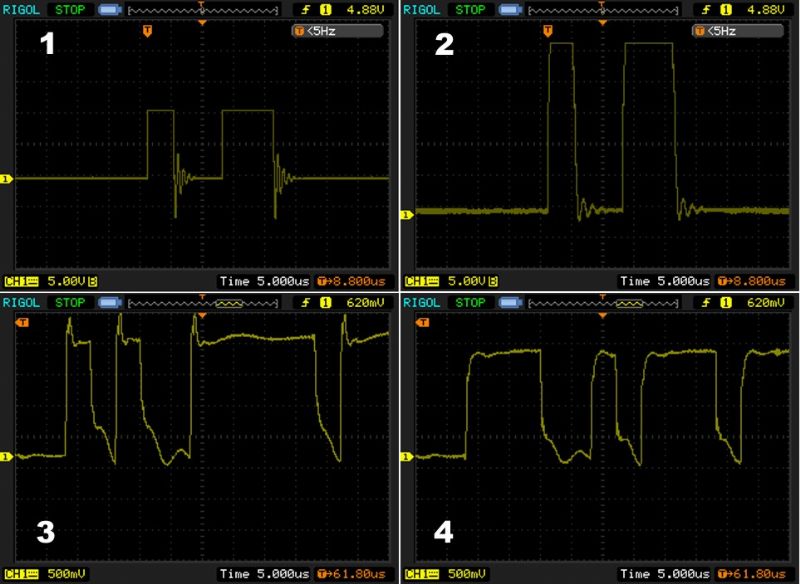 ... screen #1 shows a very short,
simple network with no terminating resistors — which at least partially
accounts for the ringing that follows the nice square NRZ waves, as
demonstrated in screen #2, in which the same backbone has some
terminator-style resistance added. Screen #3 shows what’s actually
happening with 13 active sensors and about 60 meters
of SimNet cabling. Apparently it works, but those waves are looking a
little raggedy. Or were until he installed a SimNet Noise Filter as seen
in screen #4... |
Posted By: Ian Coverdale
Date Posted: 16 June 2022 at 16:18
|
Very interesting. I can see affect of 'filter' but don't actually think trace 3 is that bad! SIMRAD break some CANBUS rules which can have detrimental affect on data quality. For example, CANBUS spec states maximum dropper length (distance from device to main backbone) of 0.3m where my SIMRAD compass came with 5.5m cable which I cut back to minimum. We have 18 SIMNET/NMEA2000 devices over ~40m backbone with no problems so it is possible to make it work effectively. Be interested in you experience with that new filter. ------------- Ian & Andrea SV Gabrielle (H445) Liveaboards - currently Montenegro. www.facebook.com/sailinggabrielle |
Posted By: SimonGH
Date Posted: 16 June 2022 at 20:33
|
So I definitely don’t have the filter. The one I ordered just arrived and looks like this: 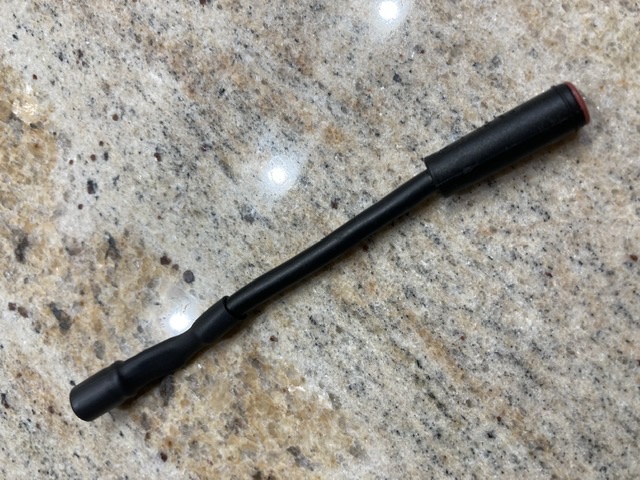 The filter just arrived and it doesn’t look anything like the termination plug that’s in there now. |
Posted By: SimonGH
Date Posted: 19 June 2022 at 21:27
|
Sure enough - I installed the "noise filter", PN 24006934, and the issue resolved itself. I can power the network on and off and the wind sensor returns. The other part was definitely another terminator only, no capacitor. Strange.
|
Posted By: Ian Coverdale
Date Posted: 21 June 2022 at 00:35
|
Pleased you have it sorted!! ------------- Ian & Andrea SV Gabrielle (H445) Liveaboards - currently Montenegro. www.facebook.com/sailinggabrielle |
Posted By: Schjell
Date Posted: 15 March 2026 at 11:14
|
Hi. I realize this is water under the bridge. But just wanted to say that I was measuring 42 ohms across my simnet network, but when I pulled out that «filter» from the simnet «3-way strip» in salon below mast it read 60 ohms as it should. So my thoughts are that when Hanse installed this filter thing, then they in fact violated the 60 ohm «rule» in order to get their top of the mast instruments working. That being said, everything was working on my boat with the mentioned 42 ohms, but from what I’ve been told this third 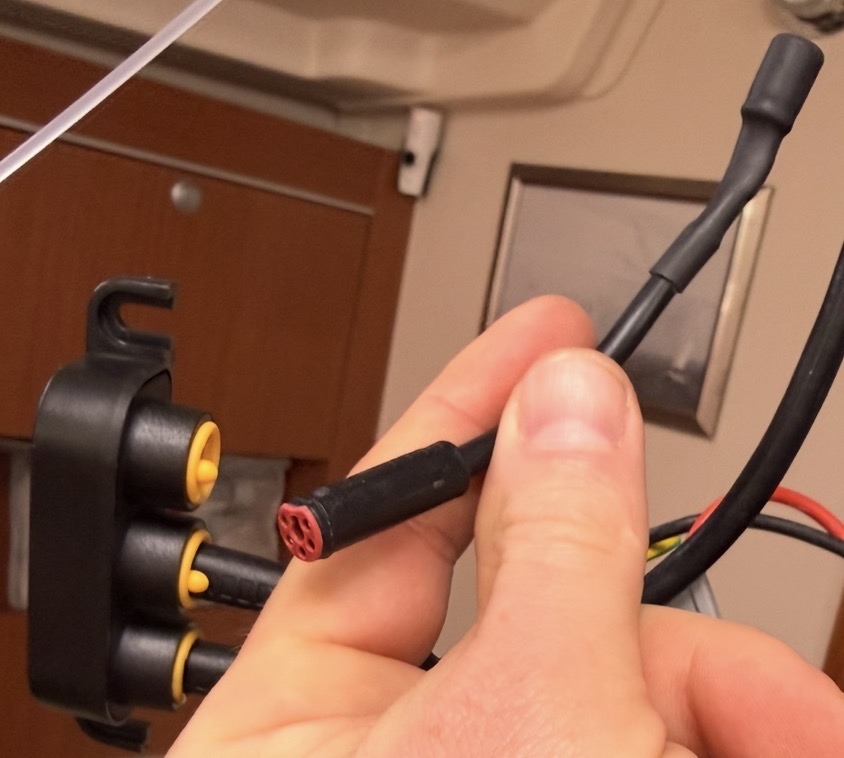 resistor will cause hell when installing my fancy Zeus and Halo+ radar which is less tolerant to out of spec values. Hanse 2012 385 here. resistor will cause hell when installing my fancy Zeus and Halo+ radar which is less tolerant to out of spec values. Hanse 2012 385 here.------------- 2012 Hanse 385 - Second owner |