Engine alarm
Printed From: myHanse.com
Category: General
Forum Name: Chit Chat
Forum Description: Talk about anything to do with your boat
URL: https://www.myhanse.com/forum_posts.asp?TID=14587
Printed Date: 27 March 2026 at 03:40
Software Version: Web Wiz Forums 12.06 - https://www.webwizforums.com
Topic: Engine alarm
Posted By: Johan Hackman
Subject: Engine alarm
Date Posted: 25 April 2024 at 11:12
|
Hi all, You know me. I don't know anything about the engine on my boat. Yesterday I started the engine and the red light and the sound alarm went on. The engine was running fine but the alarm wouln't go off. I have yet not tried to find the cause but I thought I'd ask the forum if anyone had any advice. Johan -------------  http://www.johanhackman.se" rel="nofollow - http://www.johanhackman.se |
Replies:
Posted By: Jooce
Date Posted: 25 April 2024 at 12:07
|
Start by checking cooling water. Does water come out of the exhaust with a steady flow. If not, check impeller. Check if there is any water leaking out from the engine. Second, check the oil level and quality. If you haven't changed the oil filter, please do. Oil and cooling are the two most frequent errors. ------------- KarmaDos- Hanse 385 - 2013 |
Posted By: Johan Hackman
Date Posted: 25 April 2024 at 13:10
|
Thanks for the reply. I have now had a little time to check, more time than I hade yesterday night. There is water coming from the exhaust and the oil level is fine. Now, I get the same alarm and red light when I turn the engine on as I get when I just have turned the ignition on. As you all know, the alarm is supposed to go off once the engine is running, but it does not currently do that. In addition the engine cannot be turned off by pressing the rubber button on the panel. Nothing happens. My battery monitor tells me the the engine charges the batteries when on so the electricity is not completely gone. At this moment I am puzzled. Johan ------------- http://www.johanhackman.se" rel="nofollow - http://www.johanhackman.se |
Posted By: Johan Hackman
Date Posted: 25 April 2024 at 13:45
After having removed the panel it now works to turn of the engine the usual way by pressing the rubber button. I don't know why it changed back to normal. No clue. Johan ------------- http://www.johanhackman.se" rel="nofollow - http://www.johanhackman.se |
 Johan Hackman wrote:
Posted By: Johan Hackman
Date Posted: 25 April 2024 at 14:04
|
The alarm does not go off however. Johan ------------- http://www.johanhackman.se" rel="nofollow - http://www.johanhackman.se |
Posted By: samuel
Date Posted: 25 April 2024 at 17:53
|
You have a bad connection somewhere. My approach would be:- Check wires to the alternator. Check the plugs & sockets on the looms. Disconnect them, spray some contact cleaner on them , then re connect. Waggle all the wires/plugs on the control panels & check for loose ones. A bit amateurish but sometimes works. Good luck. ------------- Daydream Believer- Hanse 311- No GBR9917T- Bradwell Essex |
Posted By: 32mike
Date Posted: 25 April 2024 at 19:10
|
Could it be water in the primary fuel filter? The engine will run but the horn might be telling you that you need to drain the water from the water separator. ------------- Mike S/V Dulces Sueños 458 #087 Tampa, FL |
Posted By: Johan Hackman
Date Posted: 26 April 2024 at 08:56
|
The nature of this thread is that it started in panic. Just before I left my boat yesterday I realised that there are three red lights that come on when the ignition is on but only the middle of the three stays on while the engine is running. I no longer have any symbols to rely on (see picture) so I just memorized this and downloaded the manual on the way to work only to realise that there are four lights so at the moment I cannot be sure which one it was that stayed on. Once I get back to my boat I will find out, no prob. Anyway, it might be the warning light about water in the sail drive. I am leaning towards a bad connection but does anyone have any experience with water in the sail drive? Johan 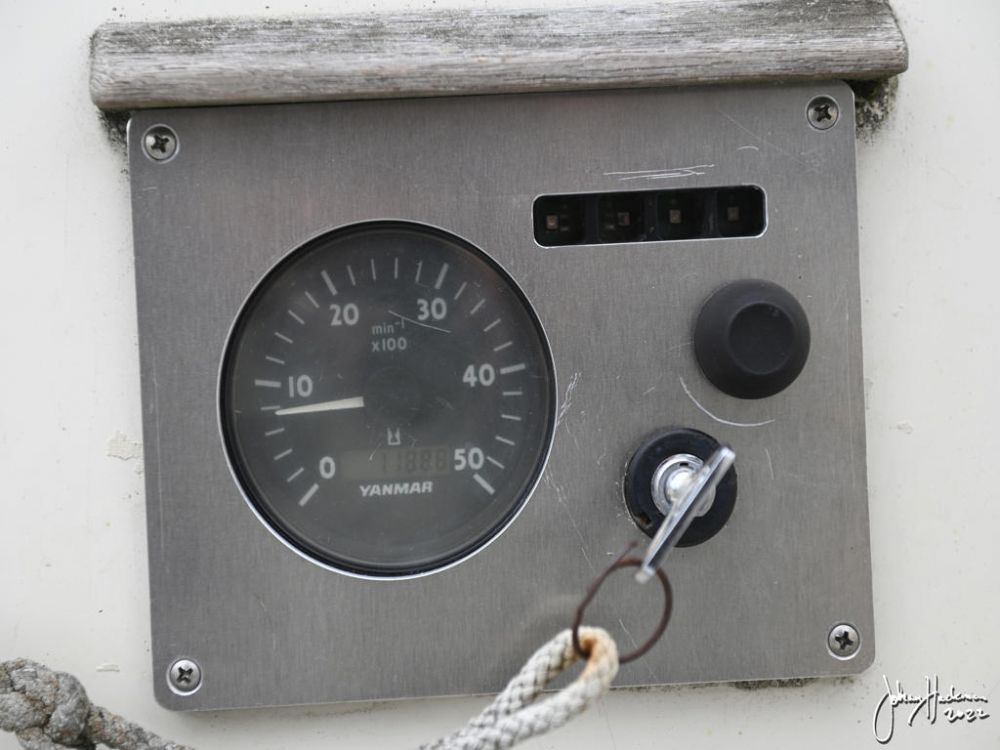 ------------- http://www.johanhackman.se" rel="nofollow - http://www.johanhackman.se |
Posted By: Johan Hackman
Date Posted: 27 April 2024 at 13:12
|
It is now clear to me that the alarm is the one that indicates "seawater is detected between the seals of the sail drive" according to the manual. I suppose I will have to find where the sensor for that is located and look for bad connections in the first place. Any ideas? Johan ------------- http://www.johanhackman.se" rel="nofollow - http://www.johanhackman.se |
Posted By: 415 Singapore
Date Posted: 27 April 2024 at 13:40
|
Hi Johan It could be faulty sensor or it could be doing what it is supposed to do! When did you last replace the sail drive seal? We have a Volvo and they say every 7 years, from memory I think Yanmar is a longer interval Good luck Paul ------------- Paul - Night Train - 415 #136 |
Posted By: Johan Hackman
Date Posted: 29 April 2024 at 09:30
I will try to find out which of the two it is! I wonder how you check for water in the seal other than relying on the alarm? I have found what connector to disconnect in order to get rid of the very annoying sound alarm. So problem fixed in that sense!  All of the accounts of people having changed the seal have told that the seal looked like new so I have not considered changing mine even if my boat now is almost 19 years old. I obviously have to take a better look at that. Johan ------------- http://www.johanhackman.se" rel="nofollow - http://www.johanhackman.se |
Posted By: Martin&Rene
Date Posted: 29 April 2024 at 17:10
|
Johann I have Yanmar 2GM20F with an SD20 saildrive. The sensor for water between the 2 seals is on the starboard side of the saildrive, just near the seacock. The normal recommendation is that you can test it by unscrewing it and putting it in a glass of water. I do this every now and then and ignore the recommendation in my manual that you should replace the seals every 2 years! I replaced the seals on my yacht after 14 years, but my boat is out of the water each winter. Having removed the sensor, and hopefully no water coming out, you can push a piece of tissue down the hole to see if there is in fact any water between the 2 seals. The water sensor only gives a very small signal so there is an amplifier, probably a small box, on the port side of the engine. Thus there are lots of connections for you to check on a white and red wire. The water sensor is in the negative side of the alarm circuit, so the other connection will be a blue negative wire. I am on my yacht now and, if required, I can take my manuals home and email the relevant diagrams. Martin ------------- Martin&Rene Hanse 341 Dipper Wheel steering, 3 cabin layout, normally based in Scotland |
Posted By: Johan Hackman
Date Posted: 30 April 2024 at 07:12
|
Martin, this is very useful. What you are saying is that removing the sensor (that I have located but yet not unscrewed) and making sure that it is dry would stop the alarm from sounding? And then putting it in a glass of water would start the alarm again? That would be a very easy test to see if the sensor it faulty that I will will undertake as soon as I get back to my boat. Johan ------------- http://www.johanhackman.se" rel="nofollow - http://www.johanhackman.se |
Posted By: Johan Hackman
Date Posted: 03 May 2024 at 06:52
|
Here I was thinking I would get demoted from being Admiral of the Fleet by asking a question about the engine, revealing my total ignorance. But this forum shines and I got replies that made me solve the problem in minutes. I am very thankful for this. I removed the saildrive sensor, put tissue in its hole and discovered that it did not get wet, then used the tissue to clean the sensor. After having put the sensor back I started the engine - and the alarm was gone! I will use this experience as a wake-up call to learn more about my engine and consider a future change of the seal. (Or seals, as I think there are two of them?) Johan ------------- http://www.johanhackman.se" rel="nofollow - http://www.johanhackman.se |
Posted By: 415 Singapore
Date Posted: 03 May 2024 at 07:12
|
Well done! Glad you fixed it Happy sailing ------------- Paul - Night Train - 415 #136 |
Posted By: Matros
Date Posted: 07 May 2024 at 12:53
|
Hi Johan, Long time... I just had that problem last summer. It was not the sensor that was the problem and definitly not water in the drive seal. If is a short connection in the cables going from the engine to the panel. Although, I did change the seal after 18 years of usage. The seal looked like it was new. Engine - Yanmar 3YM20 - from 2005. ------------- S/Y Rosetta, Hanse 342 # 245 Definition: boat, a hole in the surface of water, into which money is thrown. |
Posted By: Johan Hackman
Date Posted: 08 May 2024 at 11:26
That is interesting to know. I am however glad that I didn't have to go down that route and look for the cause among the connections. For a while one of my two cats was the main suspect but she has been cleared now since it was the sensor that was dirty. But she has a record of biting cables before. Johan ------------- http://www.johanhackman.se" rel="nofollow - http://www.johanhackman.se |
Posted By: Johan Hackman
Date Posted: 22 May 2024 at 06:31
|
I took the opportunity to contact my insurance company. They said that they always recommend to follow the recommendations from the manufacturer but that they could not recall any case with a broken sail drive seal. If the boat sinks due to a leaking seal that has not been replaced a "duty of care" reduction may be applied, they said. I don't know entirely what to make of this. It is a kind of catch 22 situation. Johan ------------- http://www.johanhackman.se" rel="nofollow - http://www.johanhackman.se |
Posted By: 415 Singapore
Date Posted: 22 May 2024 at 08:18
|
Hi Johan That is why we replaced our sail drive seal at Volvo’s prescribed 7 years, why pay for insurance when they have an excuse not to pay a claim, or even tell you what the reduction might be. As previously mentioned by many, the old seal was perfect, but……. All the best Paul ------------- Paul - Night Train - 415 #136 |
Posted By: pdc78
Date Posted: 22 May 2024 at 08:55
|
I recently did the same for the same reason, and whilst there was no evidence of diaphragm seal problems, the engineer did give the saildrive a full service and spotted wear in the drive plate and a choked exhaust elbow (both which I probably would not have caught until critical), so all in all I am happy that I took the decision to have the seal professionally replaced. Regards Paul ------------- H345 #269 |
Posted By: Martin&Rene
Date Posted: 22 May 2024 at 11:21
|
Johan had asked me the question how much to change the saildrive seal. Mine was changed in 2021, as it was then 17-18 years old, but my yacht is out of the water for 5 months each winter. The estimate was around £2200. I had always had oil collecting on the round plate of the saildrive and one engineer had assured me that the only place it could come from was from the oil filler cap. Numerous new filler caps and seals failed to solve the problem. When a different engineering company pulled the saildrive, they found that the oil seal on the input shaft was worn, hence the oil leak, and it had subsequently damaged the input shaft to the saildrive, so a new input pinion shaft was required. The final bill was around £2800, which included around 3 man days work. I think you just have to accept a big bill is coming and say to the engineers, is there anything else worth looking at whilst you have the engine and the saildrive out where they easily work on it. Better to spend some money now, than finding you have to replace an engine some time in the future. ------------- Martin&Rene Hanse 341 Dipper Wheel steering, 3 cabin layout, normally based in Scotland |
Posted By: Johan Hackman
Date Posted: 23 May 2024 at 09:28
|
I understand the reasoning but would I replace the seal every eight years to stay (fully) insured if the boat sinks due to a leaking seal that is less than eight years old? When every testiment is that when replaced the seal looks like new? This is what I mean by catch 22. When it comes to the other parts of the engine that needs to be looked at, I hear you. Johan ------------- http://www.johanhackman.se" rel="nofollow - http://www.johanhackman.se |
Posted By: 415 Singapore
Date Posted: 23 May 2024 at 10:31
|
It is not necessarily the age or condition of the seal that can cause problems. Recently there was an instance here with a Beneteau (40?) that caught a sunken mooring rope round their prop. The rope was strong enough to stop the engine instantly, the resulting torque broke 2 engine mounts and tore the sail drive seal. Fortunately they were still in a busy anchorage and with a quick thinking crew and rapid outside assistance they stopped the boat sinking, but it did result in a lot of internal water damage. Unfortunately, in such a scenario, I really doubt any insurance company is going to pay out if they can prove you haven’t replaced the seal as recommended. I think you have to add it to the cost of the joys of boat ownership! All the best Paul ------------- Paul - Night Train - 415 #136 |
Posted By: samuel
Date Posted: 23 May 2024 at 12:47
Johan Is it not a bit like rigging? you can look at the wires in the length or the bottlescrews & they look perfect. But one does not know what chemical changes has happened within the structure itself. How does one know that the rubber has maintained its flexibility. I do not think that you can do a test just by flexing it with your hands. Perhaps you feel that you can. I change my Volvo seal every 7 year & note the date on it when I buy it to check that I am not buying old stock to start with. Sometimes I hook things with the prop that really shake the boat ( several times a year in fact) & I do worry that it affects the seal in a way that I cannot see. It might be my imagination, but I reckon the old one is always stiffer than the new one.Is it going hard? Absolutely no idea. I do not suppose anyone else has even thought to compare the old with new. As for The comment about shaft seal & water ingress by M & R above. I change the seals everytime I change the saildrive seal as a general maintenance item. Just seems a sensible precaution easily done with the drive on the bench. It takes 30 mins to do.
------------- Daydream Believer- Hanse 311- No GBR9917T- Bradwell Essex |
Posted By: Johan Hackman
Date Posted: 23 May 2024 at 14:11
I was going to say that. In my insurance policy there is no requirement to replace the rigging regurlarly but I have read about others that do. In fact, my insurer advertise their service with no reduction for age. That means that if I loose my mast they will compensate for a new one. On my previous boat, a 20-footer I sailed 30 years ago, I lost the mast and had to pay for most of the new mast since there was a reduction at the time. I find this discussion interesting but do not claim to have the right answer to any of the questions. By the way, an Arcona was recently lost because the Jefa rudder stock broke. That should worry me since I have replaced my rudder just recently. I know very little about the case but at the moment I am not worried that it will happen to me. Johan ------------- http://www.johanhackman.se" rel="nofollow - http://www.johanhackman.se |
Posted By: samuel
Date Posted: 23 May 2024 at 17:09
|
I think that you missunderstood my rigging comment. It was more about reviewing stainless steel as a typical example of material than anything else. I just happened to pick rigging. It could just have easily been mooring chain,life lines or dynema. ------------- Daydream Believer- Hanse 311- No GBR9917T- Bradwell Essex |
Posted By: Johan Hackman
Date Posted: 23 May 2024 at 22:20
|
I am trying to figure out how I misunderstood you, Samuel. We usually don't misunderstand each other. What I am saying is that there is a difference between what you must look after on your boat and what the insurance will cover in the case of something going wrong. The policy states that the insurance covers "sudden and unforeseeable" events. There will always be a lot of things on a boat that you can inspect ever so carefully that will fail in the least favourable moment and we should all be aware of that. The insurance itself can also go wrong. You expect to be covered but when it gets down to it you are not. Johan ------------- http://www.johanhackman.se" rel="nofollow - http://www.johanhackman.se |
Posted By: Henryk
Date Posted: 17 June 2025 at 17:43
|
Hi everybody, if you con not stop the engone, it should be the solenoid. The solenoid is activeted to stop the fuel supply to the pomp. ------------- Henryk |