Lower hot water flow / pressure
Printed From: myHanse.com
Category: Hints & Tips
Forum Name: 350
Forum Description: 350 Hints and Tips
URL: https://www.myhanse.com/forum_posts.asp?TID=15242
Printed Date: 26 March 2026 at 23:37
Software Version: Web Wiz Forums 12.06 - https://www.webwizforums.com
Topic: Lower hot water flow / pressure
Posted By: Mark Pullen
Subject: Lower hot water flow / pressure
Date Posted: 07 July 2025 at 13:01
|
I've noticed that the pressure on the hot side of my water system on a Hanse 350 is lower than the cold. For all outputs - galley sink, heads basin, heads shower and bathing platform shower. Does anyone have any experience with this problem and how to fix it. Many thanks, Mark ------------- Mark |
Replies:
Posted By: perry
Date Posted: 08 July 2025 at 11:31
|
Im guessing you find the lower outlet pressure when system is delivering water flow. Under static conditions the pessure will be the same, as both hot and cold outlets are pressurised from the cold water pump. the hot water will see an inability to deliver the same flow rate at dynamic condition as the additional pipe work/calorifier will offer flow restriction. Can you explain what problem this causes you? Regards Perry Yacht Bloto 4 Cowes IOW ------------- Current Yacht Hanse 315 2007 Last Yacht Hanse 301 Round GB in 2017 |
Posted By: Mark Pullen
Date Posted: 08 July 2025 at 12:11
|
Hi Perry, the hot water flow is significantly lower than the cold. As a result the hot water flow for the showers and taps is reduced. My concern is that the flow should be the same for hot and cold. As you say, the pressure for hot and cold are both maintained by the same pump and accumulator tank. As there is a difference, there is something wrong with the hot side. I'm asking for ideas as to the underlying cause, so that either I or a marina technician can investigate/fix. I suspect limescale in pipes and calorifier, but are there other potential causes that I'm missing? Many thanks, Mark ------------- Mark |
Posted By: Lyn
Date Posted: 08 July 2025 at 14:20
|
Sorry to reply with obvious items that perhaps you've checked ... my calorifier/boiler/water heater has a gate valve on it. Is there any chance the output is restricted by a valve? If not a valve -- corroded fittings before it reaches the tubing? A tube that is kinked/pinched around a stringer before it branches out to all the distribution points? A degraded chunk of the calorifier that maybe made its way into your tubing upstream in the distribution (hopefully not!)? If you have access to tubing, a 1/2" fitting with a tubing barb, and a barb with a valve, then you could stub into the output of the calorifier and determine if your problem is the tank (or the cold water supply to the tank) or the distribution after the tank.
------------- Jon S/V Lyn 2017 Hanse 588 | Hull 19 | Deep draft | 150hp | 220v & 110v systems | Lithium House Bank |
Posted By: Mark Pullen
Date Posted: 08 July 2025 at 17:14
|
Hi Jon, the yacht is on Leros and I've just returned from a vacation there. I had a number of other jobs to do whilst there, but want to go prepared later this year on a return visit. Sounds like in addition to a vinegar flush of the pipes, I need to thoroughly check the calorifier and related connections. Many thanks, Mark
------------- Mark |
Posted By: Arcadia
Date Posted: 08 July 2025 at 17:54
|
It’s a bit of work but Jon is on the right track. I’d plumb a length of 1/2 pex from the hot water tank to the nearest faucet or shower and see if it normalizes. If it does, then you’ve ruled out the worst case scenario (clogged lines). You need to zero in on the restriction so process of elimination is best. ------------- Leon / ARCADIA 2018 Hanse 588 Sag Harbor, NY |
Posted By: Mark Pullen
Date Posted: 08 July 2025 at 18:34
|
Many thanks. ------------- Mark |
Posted By: Lyn
Date Posted: 08 July 2025 at 19:12
|
From my experience, guessing fitting sizes from afar sometimes ruins my plans when I return to the boat. In the event that my sizes are different from your boiler, would someone with a factory boiler on a 350 confirm the size & gender of the hot water output interface to the distribution? In this picture I found of mine, the distribution connects via a 1/2" BST female union (so there is a flat nylon washer between the two fittings to seal). To make an inexpensive test, I would get a 1/2" BST female fitting to attach (along with a nylon flat washer so you can seal). Other end of that fitting would be a barb (let's pick 1/2"). Then put some simple 1/2" tubing on it (can be a cheap/short length of PVC or whatever is around). On the other end of the tubing, put a fitting that has a barb on one end for the tubing with a valve you can open/close. Once you turn the water pump back on and open the valve, they you'll know that your distribution tubing is fine if you have the same restriction. If you bring along a male 1/2" BST (if my size is the same as yours), then you can plug into the tubing that supplies the calorifier. If there's no restriction there, then I would think it would be your calorifier [edited correction]. 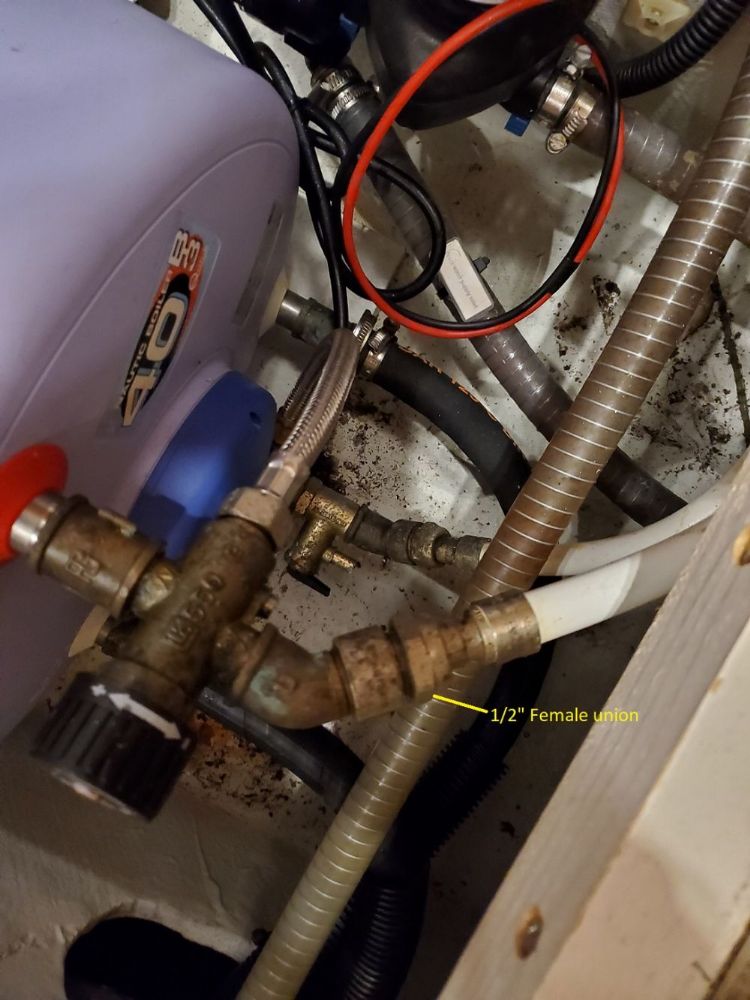 ------------- Jon S/V Lyn 2017 Hanse 588 | Hull 19 | Deep draft | 150hp | 220v & 110v systems | Lithium House Bank |
Posted By: Arcadia
Date Posted: 08 July 2025 at 19:21
|
Actually, that black knob and the braided tubing doesn’t cycle hot water back. It mixes cold water into the output line in order to adjust the temperature of the output. Important when the engine loop can bring the tank temperature up to 180 F.
------------- Leon / ARCADIA 2018 Hanse 588 Sag Harbor, NY |
Posted By: Mark Pullen
Date Posted: 08 July 2025 at 21:13
|
I'll take some tube, barbs and a valve. If I need more, there is a well stocked hardware shop in Lakki. I'll disconnect the hot output to test the pressure from the tank with the pump on. If there is a problem with the calorifier, I'll probably need to hand off to the marina to sort out. It's beyond my expertise and the time I have available this year. Once disconnected, I'll take the opportunity to connect a hose/funnel to the output line and soak the system with vinegar. ------------- Mark |
Posted By: Arcadia
Date Posted: 08 July 2025 at 21:26
|
A correction on my part. If the output of the water heater is normal, then the problem likely IS the hot water lines (I misstated the opposite). However, I will say that if you simply observe that output of an open hose, it may be difficult to determine if it is normal without comparing it to something (like the cold water supply for instance). I think if you connected it to a fixture it would be easy to compare hot pressure vs cold pressure. ------------- Leon / ARCADIA 2018 Hanse 588 Sag Harbor, NY |
Posted By: Mark Pullen
Date Posted: 11 July 2025 at 22:15
|
Understood. Many thanks, Mark ------------- Mark |
Posted By: NORStian
Date Posted: 14 August 2025 at 21:28
|
Hi Mark. Were u able to fix the problem by disassemble hot water line from you’re heater? Did you find any inclusion inside the pipe/tube? I hav the same issue on my Hanse 415 2013mod. Regards Stian |
Posted By: Mark Pullen
Date Posted: 15 August 2025 at 15:33
|
Hi Stian, I've not visited the boat yet. I'm next out during late September. I'll update this post when I do and hopefully have time to investigate. ------------- Mark |
Posted By: Mark Pullen
Date Posted: 18 October 2025 at 09:48
|
Update - success... On my recent visit I took the following steps to improve the flow on the hot water side: The water tank was hot, after motoring. Checked the bathing platform tap was on hot. Drained the water tank from the cold taps to retain the heat in the calorifier. Added 12 litres of cheap supermarket vinegar directly to the tank. Ran each hot tap individually, until I could smell vinegar. Left for about three hours. I figured this was long enough was the tank was hot. Part filled the tank and flushed the system a few times. The flow on the hot side has now much improved - almost as good as the cold water side. I'm having the tank replaced with a flexible bladder over the winter. At this point, I'll introduce a T junction after the tank and before the pump, so that I can bypass the new tank when adding vinegar. I'll add this routine into my annual (maybe once every two years) maintenance regime. It was easy to do, inexpensive (£15 in vinegar) and the vinegar smell was barely noticeable after I flushed the system. Thanks for all of the above advice. ------------- Mark |