Dismasted!
Printed From: myHanse.com
Category: Hints & Tips
Forum Name: 575/588
Forum Description: 575/588 Hints, Tips and News
URL: https://www.myhanse.com/forum_posts.asp?TID=15543
Printed Date: 27 March 2026 at 03:29
Software Version: Web Wiz Forums 12.06 - https://www.webwizforums.com
Topic: Dismasted!
Posted By: Mainer
Subject: Dismasted!
Date Posted: 07 March 2026 at 01:53
|
Hi all, Sharing a bit of a disaster and looking for some advice… Sailing from Grenada to Carriacou yesterday, we lost our rig on Bonny Doon — a 2015 575 with a Selden mast, Furlerboom furling boom, and a Furlex headsail furler. Winds were moderate (18-21 kn) and seas were moderate (probably 2m). We were motor sailing with a double reef in the main and a sliver of jib out. As far as we can tell, the dismasting was triggered when the headstay broke at the sta-lok connector at the bow — there was a loud noise and we noticed the backstay dramatically sagging. For about 15-30 seconds, the jib halyard held everything together and we started to take the load off the rig (furling in the jib and starting to drop the main). Before we got too far though, the jib halyard broke, the jib came down, and then the mast snapped at deck level. The boom kicker and the gooseneck separated from the mast and we were left with the boom (after smashing into our dodger) sitting on the port gunwale — it’s complete but has some damage and would need repairs. The mast fell over the boom into the water off the port side while the furled jib fell onto the water on the starboard side. We spent what seemed like an eternity but was probably 10 minutes using hand tools and an angle grinder to disconnect the shrouds, cut the retaining lines, separate the mainsail from the boom, and cut through the furled jib just above the deck. The rig sank into the ocean but unfortunately we had managed to wrap some of the spinnaker halyard and the courtesy flag line around our prop so we couldn’t use the engine. The Grenada coast guard arrived after about an hour and spent three hours towing us back to St. George (THANK YOU Grenada Coast Guard!). After a diver came to remove the lines from our prop, we were able to make it safely back to dock. No one hurt and the hull intact — just some scratches in the gel coat on the port side hull and gunwale. We’re now thinking about repairs — both where to do it and what to the new rig should look like. If anyone has advice on the following, I’d love to hear from you… - Rigging repairs in the Caribbean: we’re in Grenada now - any recommendations where to have repairs done? There is a local option but we’re also thinking about Trinidad, St. Lucia, or Martinique. - Mast: is there a beefier option than Selden that we should be thinking about? - Main furling: we’ve found the Furlerboom finicky (boom-mast angle needs to be perfect and the boat needs to be heading straight into wind to easily furl) and squeaky (big mass means lots of securing lines to stop it moving in rolly conditions). Are there better boom furling alternatives? Should we be thinking about mast furling instead (I have concerns about reduced sail performance and mast strength)? - Headsail furling: I’ve learned that some furling options (e.g., ProFurl) rely on an independent headstay (e.g., with a swaged connector) instead of an integral stay using sta-lok connector. If anyone has had positive experience with ProFurl and specs on what works with a 575, I’d love to hear about it… Any feedback much appreciated!! -Mainer |
Replies:
Posted By: marsella
Date Posted: 07 March 2026 at 06:18
|
Sorry to hear about this unfortunate event. Probably a bit too much motoring from Grenada but can highly recommend "Antigua Rigging" located in Falmouth harbor of Antigua, pm me if you need more info. |
Posted By: Mainer
Date Posted: 07 March 2026 at 10:28
| Thanks Marsella — we left Bonny Doon with Raphan in Antigua over Christmas and they did some great work to prep us for our trip. As you note, it is a ways away from Grenada and based on our brief experience in the surf between islands yesterday, we’d like to minimize travel without a mast. |
Posted By: marsella
Date Posted: 07 March 2026 at 11:13
| Yes, Raphan is great! Original founder was Stan Pearson from New Zeeland with 30+ years of rig experience but he passed away a couple years ago very sadly. He trained quite a few riggers who now run separate companies mainly in Antigua. In any case keep also in mind that those guys travel between the islands if any special work is needed therefore ask them for help. Regarding the rig config, I cannot comment about in-boom furling, but I am solo sailing all the time and ordered in-mast furling for my 458, which is very forgiving. I do try to be into the wind when furl/unfurl the mainsail if conditions allow but in princple can furl my main from any point of sail in emergency. I also never touch the boomvang, therefore whole handling is a breeze. Im only unhappy with Elvstrom sail that I got, it starts showing some delamination but most importantly I keep breaking two outer battens which are made of 8mm carbon rods. I like to have them since they prevent any flapping but yet to find the solution. |
Posted By: Mainer
Date Posted: 07 March 2026 at 14:21
|
Thanks for the feedback, Marsella. I actually got a call from Raphan this morning and we chatted things through. His perspective was that both boom and mast furling work but they have different strengths / weaknesses and it’s really a matter of personal preference. He offered to help us if we can get up to Antigua but didn’t think it would be feasible for him to try to do anything if we’re down in Grenada.
|
Posted By: marsella
Date Posted: 07 March 2026 at 16:32
| Ok hope you find some good riggers down in Grenada and quickly recover. And say hi to Raphan next time you chat, he and Stan took very good care of Marsella. |
Posted By: Arcadia
Date Posted: 07 March 2026 at 19:25
|
I’m so sorry for your troubles Mainer and relieved that no one was hurt. That’s a lot of hardware and weight to come crashing down on your deck. And impressive response to be able to cut things away quickly. I do need to say that we should all take this as a warning. The rig was not very old and of good quality. This should not have happened so soon and the question is why. I will dismantle my furler and take a good look at that sta-Lok fitting. They are supposed to be more resistant to corrosion failure. I put an offer in on that boat in 2017, about three owners ago. Was work done on that head stay that we don’t know about? Anyway, good luck with getting things back up and please keep us posted.
------------- Leon / ARCADIA 2018 Hanse 588 Sag Harbor, NY |
Posted By: Mainer
Date Posted: 07 March 2026 at 19:39
|
Hi Leon, Thanks for the sympathies! We haven’t had any changes made to the head stay or the rigging more generally since buying the boat three years ago. We had a rigging inspection done by our home yard in October before heading down to the Caribbean and they didn’t flag anything. Attached you’ll see what remains of the head stay within the sta-lok fitting. The inner core looks pretty corroded. It definitely has me inclined to replace the setup with one that uses a full swage fitting. 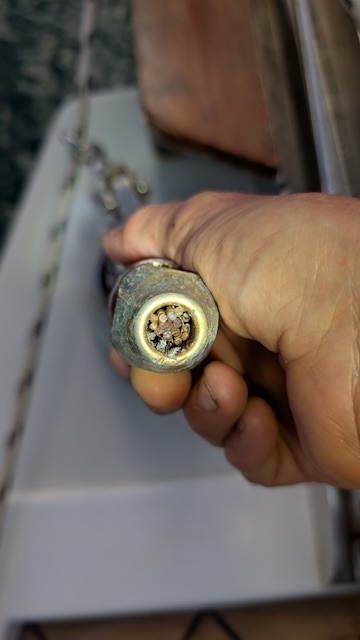 |
Posted By: kipwrite
Date Posted: 07 March 2026 at 23:55
|
Most unfortunate, very glad to hear everyone was safe. And best of luck with your repairs. Question: about how many nautical miles were on the boat since new? ------------- Kipwrite |
Posted By: Mainer
Date Posted: 08 March 2026 at 13:12
| Thanks Kipwrite. I’m the third owner of the boat so I’m not exactly sure. Over the course of her life she’s made a total of 1-1/2 circuits from New England to the Caribbean and back so I’m guessing less something less than 10K miles total. |
Posted By: Arcadia
Date Posted: 08 March 2026 at 16:01
|
Mainer, have you reached out to Sta-Lok or Selden (reseller) about the mode of failure? Your photo may indicate evidence of some kind. I’m no expert but it looks like the fitting did not fail but rather the wire itself. I’m wondering if the below deck installation of the furler accelerated corrosion. ------------- Leon / ARCADIA 2018 Hanse 588 Sag Harbor, NY |
Posted By: Mainer
Date Posted: 09 March 2026 at 07:52
| Hi Leon, you’re right that the fitting itself looks intact — the failure was with the head stay cable that fits into it. The corrosion that I can see is most pronounced in the inner core of the cable (the 1 + 6 strands that sit within the wedge component of the sta-lok). For reference, the failure point is above deck but shielded from view by what Selden/Furlex calls the adaptor tube, a big cone of stainless steel that sits on top of the lower bearing assembly. There’s no way to see the connector without completely disassembling the whole thing. I don’t see any evidence that sealant was applied to the cable to prevent corrosion and the installation instructions from Selden don’t mention it (they do recommend using loctite on the connector threads to secure it). Searching the internet however (e.g., https://www.practical-sailor.com/blog/mechanical-rigging-terminals-to-seal-or-not/" rel="nofollow - https://www.practical-sailor.com/blog/mechanical-rigging-terminals-to-seal-or-not/ ), many folks do recommend using sealant to prevent this problem. |
Posted By: Pzucchel
Date Posted: 10 March 2026 at 10:44
|
i am happy to share my rigging "history". in 2020, some expert but self-assured sailor kept running the electric winch badly to furl the jib. But the swivel at the top was not rotating, because the forestay was not tensioned enough...we stopped too late the brute force attempt. To a more careful analysis, we noticed that the furling jib swivel had transfered the rotation torque to the forestay, and the steel therefore unwound: it was visibly deformed in the area near to the swivel - see pictures. Story short: I had to replace the forestay, and since then i always start my furling manually - shifting to electric winch when i lose my breath.... the pictures explain more than a thousands words. My message: if you don't understand why it broke - point the finger towards the electric winch!  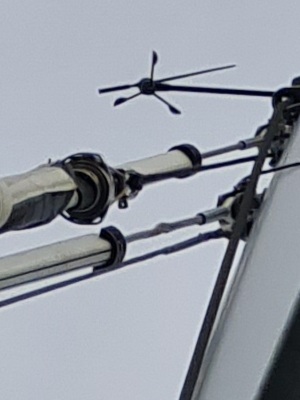 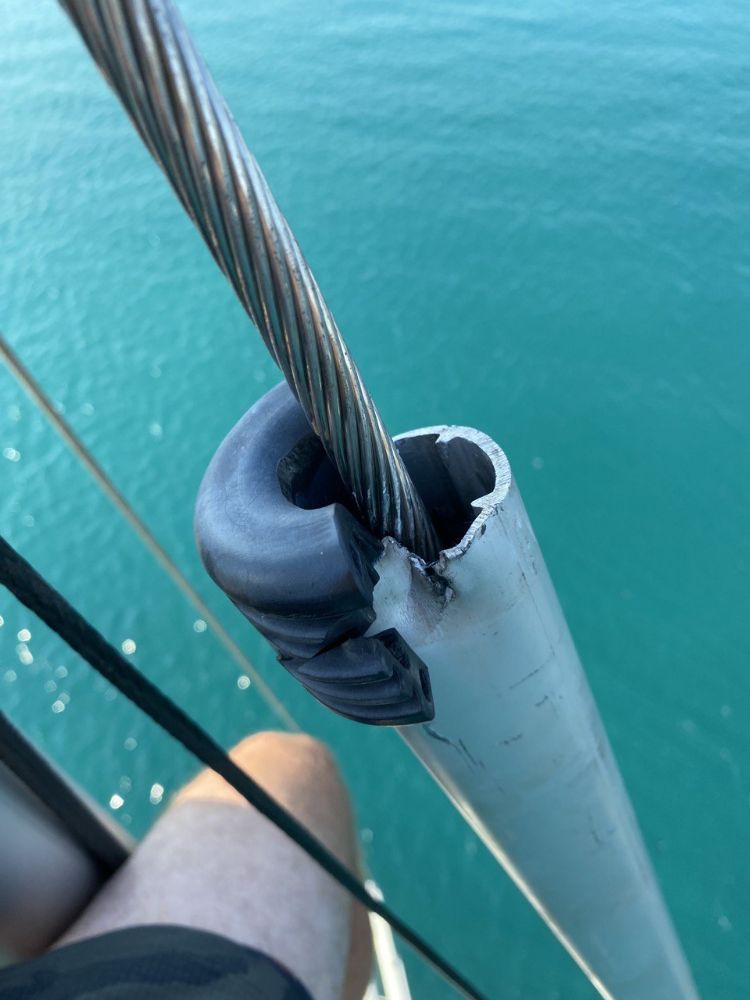 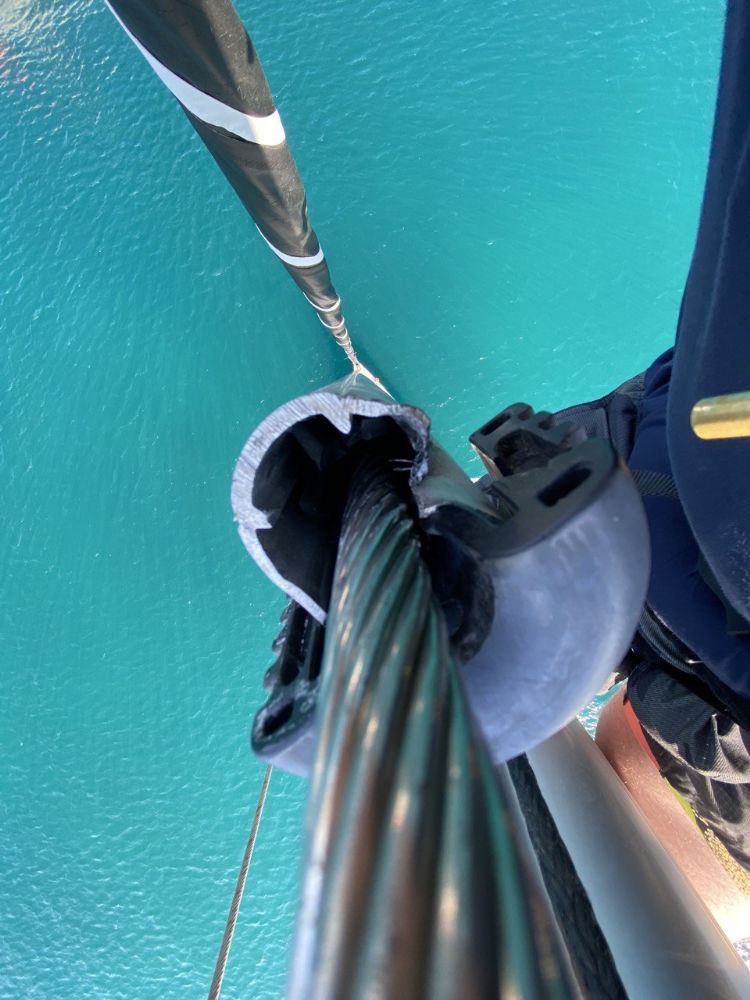 ------------- Hanse588#55 |
Posted By: marsella
Date Posted: 10 March 2026 at 12:21
| Mainer - did you find a suitable rigger in Grenada? Pay attention to the location of the installation site since those masts are very easy to ship from US to Caribbean by ocean cargo but next to impossible to transport them over small island roads due to their lenght. Either it has to be all done by sea or you can order a two piece version (Selden has this) which are sticked together afterwards. |
Posted By: Black Diamond
Date Posted: 10 March 2026 at 21:30
|
Scary story. I had my rigging inspected (getting too old to be going up the mast) and it checked out but who knows? Wondering if the spare spinaker halyard might have done something to help. Rather than clipping it to the rail (or whatever), would securing it to a deck fitting or the bowsprit d-ring have halped carry some of the load? ------------- Rick S/V Black Diamond Hanse 575 Build #192, Hull# 161 Newport, RI |
Posted By: Arcadia
Date Posted: 10 March 2026 at 22:13
|
Rick. The furling drum needs to be removed to look at that Selden Sta-Lok. First thing I’m doing when I get back to the boat. I agree that a spare halyard (pre-rigged) to the bow with good tension could have saved the rig. ------------- Leon / ARCADIA 2018 Hanse 588 Sag Harbor, NY |
Posted By: Pzucchel
Date Posted: 11 March 2026 at 06:34
|
single point of failure... despite the incredible performance of rigging , taken care of its limited weight , I always thought it's a design that is intrinsically limited by this flaw (and probably the reason why aviation has moved away from tension -based rigging ). I recently made the calculation of the forces on the lateral rigging for my own understanding on how much heeling makes sense. I came to the conclusion that , on our boat , an upwind 35kt wind and heeling at 30 degrees nears the dynamic load limit (I used the momentum to right the boat to assess how much force is on the lateral rigging). does anybody agree/disagree ? ------------- Hanse588#55 |
Posted By: Black Diamond
Date Posted: 11 March 2026 at 09:14
|
He actually had removed the drum. We were having some "fun" with it not rolling after a certain point. I crawled into the sail locker... moved everything out of the way to get to the anchor locker (where our TD version sits of course) and couldn't figure it out. No riding turns, no poor leads, etc.. It turned out there was some kind of rmovement for the drum that caused it and my rigger did the usual embarrassing "there... all set" with one 3-second move of his hands.. While there... he said "I might as well look at things".... The old joke about $5 to actually do something and $400 to know what to do and where... ------------- Rick S/V Black Diamond Hanse 575 Build #192, Hull# 161 Newport, RI |
Posted By: Richard M
Date Posted: 12 March 2026 at 08:14
|
Hi Mainer I'm very sorry to hear this. So relieved to learn of no injuries. I have no helpful advice to contribute. I hope you are soon sorted. Best wishes Richard ------------- Richard M (S/Y BrightStar - H 455 #90; ex S/Y Providence - H 400e #290) |
Posted By: kipwrite
Date Posted: 12 March 2026 at 11:51
|
This mishap raises an important question on the replacement cycle for wire rigging. After ten years, at minimum annual rig inspections, and about 26,000 miles on my '16 505 Lilia, with regular offshore passages, and a few broken wires on a lower diagonal, my rigger strongly suggested I replace all the standing rigging. His rule of thumb was 15 years, or miles equivalent to a circumnavigation. The broken wires were in his opinion a warning - of potential corrosion hidden under all those fittings. Took his advice. Selden FL made up the new set at a reasonable cost One less thing to worry about for a few more years. ------------- Kipwrite |
Posted By: Arcadia
Date Posted: 13 March 2026 at 03:23
|
Piero, your conclusion seems accurate and not the margin of safety that I’ve always assumed on the rigging. At 30 degrees of heel, I calculate a load on the cap shroud of about 40 percent of breaking strength. At 50 degrees of heel (maximum load), I get about 50 percent of breaking strength. This is based on Hanse published stability curve and static load. Well done for chasing this down for us. ------------- Leon / ARCADIA 2018 Hanse 588 Sag Harbor, NY |
Posted By: Pzucchel
Date Posted: 13 March 2026 at 04:44
hi Leon , scaring , isn't it ? and we perfectly know the difference between a rigging in PERFECT state and a real one. Corrosion , cable crimping: the weakest element of the chain will determine the global rigging failure . I give you another hint for an interesting calculation: euler' s column buckling. compression load reduces the mast resistance to deflection ... I have quite thought to it , this is the mode of failure of the mast when the static rigging fails or it is not well tuned . ...and going back to the rigging , add the other dynamic forces now. A boat that heel under sailing has the mast pulling the boat forward. but a boat that heels significantly increases its drag, so beyond the lateral rigging the LONGITUDINAL rigging is under higher stress ... I wouldn't mind if you could think to my calculation and find out if I got it right ! you can find it here : https://galvanicworks.com/2026/02/10/heels-and-heeling-the-physics-of-looking-good-while-going-bad/" rel="nofollow - https://galvanicworks.com/2026/02/10/heels-and-heeling-the-physics-of-looking-good-while-going-bad/ I didn't say it yet , but all my kudos to Mainer. living and managing a dismasting is probably one of the top three stress events a sailor can undergo. you're now one of my involuntary heroes ! 🤣 in preparation I had an electric disc cutter initially - but I found something better . There is a very smart device that is a wire cutter that works like an hydraulic crick but it's mechanical . every time you close it completely , it becomes slightly smaller around the wire ...and cuts out wires like butter (I tried it ). it was suggested to me in south of France from an ex military sailor , I had never seen it before and I can't even find a name for it ... it only works for wires , but I thought about myself with an electric disc cutter on deck in a storm with cables swinging around ...worse than a horror movie, let's change channel ... addendum: as some of you may remember, I had a double steering cable failure last summer on my 2017 boat that required a pan pan. there is a common element here, and a lesson for all of us. steel cables do corrode and suffer from fatigue ...fresh water washing, grease , inspection, inspection , inspection... ------------- Hanse588#55 |
 Arcadia wrote:
Posted By: Mainer
Date Posted: 17 March 2026 at 20:07
|
Thanks all for the additional inputs. One of my key learnings is to store away a lot more than 3 cutoff disks for the angle grinder. With all of the chaos happening, I quickly broke the first two and was scared of losing my last one. Get a dozen! My wife and I took the US Sailing Safety at Sea course a couple of years ago and were very glad to have learned what’s likely to happen when a dismasting occurs and what to do about it. During the course, the instructors had hoped to show folks how to use a hydraulic line cutter (which is what I think you’re talking about, Piero). It turned out that they couldn’t find a functional cutter within a day’s drive of Marblehead, MA. FWIW, one of the things I had to do was to cut through the 5-inch diameter sausage formed by the furled jib wrapped around the furler foil. The angle grinder managed this quite well and I doubt the hydraulic line cutter would have done anything.
|
Posted By: Mainer
Date Posted: 17 March 2026 at 20:17
| Based on feedback from several folks and constraints imposed by our insurance (which defines the hurricane exclusion zone as everything south of Hattaras after July 1) and the realities of making repairs in the Caribbean (it’ll take months to get a mast here), we’ve decided to motor to Antigua and put Bonny Doon on a cargo ship to Newport RI. Does anyone have experience transporting a 575 by cargo ship? — we’re looking for docking plans and specs that Hanse doesn’t seem to make readily available. |
Posted By: marsella
Date Posted: 17 March 2026 at 22:01
| Sounds like you have a working plan and the weather in Caribbean looks good for the next 10 days or so. I dont know about 575 but I managed to move 458 from Greifswald to Antigua by SevenStar, they just put it on a standard cradle. So I think you will need to find large cradle for regular cargo, or do it with SevenStar which have those. Maybe you can try to rent a cradle in a boatyard here? Let me know if you need any help, I will be in Antigua till April 1. Their customs have a complicated bureaucracy, so everything is done by customs brokers like Bryson Shipping |
Posted By: Wayne's World
Date Posted: 18 March 2026 at 05:38
|
I have just noticed this thread. We have been on holidays back in Australia for 6 weeks. Mainer, sorry to hear about your problems. Our boat has done about 40,000nm over the last 12 years and we have had yearly inspections for about the last 6 years. We had two of those done by FKG in Sint Maarten and they found a minor issue with a ferral on the backstay and replaced the cable. The next year we discussed with them about replacing the headstay because as they said it can't be inspected fully unless it is removed. So, we decided to replace it as well mainly because we were heading to Panama and across the Pacific that year. We are currently in Fiji and will be home in Aust by the start of cyclone season this year (end Oct) and we will probably look at replacing the standing rigging once we are there. I haven't heard of many rigging issues with the Selden 575 rig except for the Pzucchel's problem. Good luck with the fix. ------------- Wayne W Cruising, currently in the Pacific until the end of 2026. |
Posted By: Pzucchel
Date Posted: 18 March 2026 at 05:42
my device is not hydraulic but mechanical . said this , it would have miserably failed with the 5 inch sausage , thanks for the information !!! ------------- Hanse588#55 |