Reefing
Printed From: myHanse.com
Category: Hints & Tips
Forum Name: 461 / 470
Forum Description: 461 / 470 Hints and Tips
URL: https://www.myhanse.com/forum_posts.asp?TID=7069
Printed Date: 27 March 2026 at 03:40
Software Version: Web Wiz Forums 12.06 - https://www.webwizforums.com
Topic: Reefing
Posted By: hobietiger
Subject: Reefing
Date Posted: 13 November 2012 at 21:20
|
I would like to hear your advise on reefing with the Hanse 470. When taking either the first or the second reef, tipycally the pulley at the front (near the mast- please excuse my lack of technical english), reaches the boom, before the pulley at the back. Quite often it makes it impossible to take the pulley at the back all the way down, closer to the boom. I make sure that the vang is completely loosen but this still continues to happen. How do you avoid this? Is there anyway to take the reef that allows both pulleys to come down at the same time? Thank you in advance for your assistance ------------- ¡Órale! Hanse 470e Spain |
Replies:
Posted By: Gregor
Date Posted: 14 November 2012 at 07:03
|
I recognize your problem and therfore I decided to change my reef system. Please have a look in the 311/312/315 section. Gregor ------------- Uisge Beatha Currently sailing Dehler 36 JV (2002) Previous boat: Hanse 311 #80 http://www.uisge-beatha.eu" rel="nofollow - http://www.uisge-beatha.eu |
Posted By: Wild
Date Posted: 14 November 2012 at 09:24
|
Hello Hobietiger, I have try out both system.First I have 2 reefinglines for each reef, one in the front one on the back leach. I changes this by a one reefline system but than I become the Same problems like you so I changes it back. So far I know the decklayout of our 545 is simular to the 470 and the loads almost the same. First I release the mainsheet and the vang, than release the halyard a little more than necessary take the front reefline by hand in and than the back reefline(elect winch) till the reef is complete in.Put back tension on the halyard,mainsheet and vang till the sail is flat.I have put markers on all the reeflines and halyard to not overtensioned (elect winch) and damaged the sail.I have the two frontreeflines and the mainhalyard on portwinch and the two backreeflines on the starboardwinch to avoid changing the lines on the winches while reefing.It works well even solosailing. Wil 545#268 ------------- Wild and Wet Belgium 545e#268 |
Posted By: Swanji
Date Posted: 14 November 2012 at 11:22
|
Hi Folks Great question and interesting responses which so far are suggesting that we need to change Hanse's single line reefing to Gregor's system or to Wild's 2 line system. The downside with Gregor's system IMO is that, apart from being dificult to implement, there is a block inside the boom which could cause problems if the lines get sheaved and fixing the problem will not be too easy. The downside with Wild's 2 line system is that each reef will take up 2 clutches instead of 1. If you have 3 reefs in the main, that means you will be using 6 clutches  . The upside of the 2 line system of course is that it is easy to implement and should be trouble free. . The upside of the 2 line system of course is that it is easy to implement and should be trouble free.I have had the same problem of getting the clew down low enough to the boom. I have tried releasing the mainsheeet and kicker/vang which definitely helps but is still not perfect. I also changed the reefing lines from 10mm to 8mm to reduce friction and added non-turning blocks to the luff to aid reefing. This has also helped but you need to be careful not to snag the blocks on the boom. Marking the halyard is definitely the way to go. I will follow this thread with interest. ------------- Onwards and upwards Nidri, Levkada, Ionian, Greece Hanse 350 #7, SY Evolution, standard keel, 3YM20 sail drive, 3 cabins, cherry wood interior, teak decks, feathering prop |
Posted By: seileren1
Date Posted: 14 November 2012 at 12:50
|
In my experience, the reef point in the front always reaches the boom first. The way I have solved this is to loosen the kick so that the boom points slightly upwards. After lowering the sail and securing the reef line, I tighten the kick and both reef points are now on the boom. This is a bit more fiddly for the second reef than for the first reef but the el. winch helps. Cheers |
Posted By: sailkoop
Date Posted: 14 November 2012 at 16:36
|
Hi Hobietiger, I absolut agree with seileren1. What you have to check, maby to exchange are the blocks on the Main. Hanse/North are delivering cheap block which increase the friction a lot!! regards ------------- best regards Bjoern |
Posted By: samuel
Date Posted: 14 November 2012 at 19:40
|
Instead of marking the halliard i put 2 pieces of tape on the mast. I have dinema halliards & release the halliard in stages as I take up the tension on he reef lines. I leave the halliard with 2 or 3 turns round the winch bit not fixedin the stopper so it slips as the load comes on. This keeps a bit of tension on it & enables the slack to come in at the clew to avoid tangles. This way the sail comes down fairly evenly When I see the end of a batten coming near the corresponding mark on the mast I lock the halliard off but still keep winching in the reef line. Letting the vang off a bit helps. When the clew is nearly in I let off the halliard so the end of a batten lines up with the corresponding mark on the mast. I then give the final pull on the reef line to get the clew in. It takes as long to write this as it does to do it. I use roller bearing oversize non rotating blocks on the luff but no block on the clew. I find nothing like the friction others claim & i certainlywould not entertain blocks inside the boom But to each his own ------------- Daydream Believer- Hanse 311- No GBR9917T- Bradwell Essex |
Posted By: hobietiger
Date Posted: 14 November 2012 at 20:04
|
Thanks to all. I will try Samuel's suggestion. The perfect solution is to have independent reefing lines, but I am afraid I do not have room for them. I am already missing a third reef. ------------- ¡Órale! Hanse 470e Spain |
Posted By: samuel
Date Posted: 14 November 2012 at 21:16
|
I think you have room for a third reef. You need to cut slots in the sail cover similar to the ones for first & second. You put a strop with an eye each end around the boom & put in 2 knots to stop it dropping out. Lay the two ends each side of the sail until needed. When setting up pass one end through the cringle for the third reef then the other end through this loop. Hook the free loop onto the normal clew out haul. Mine is fitted with a snap shackle. As this strop is pulled it tightens down the clew At the boom end you possibly have a spinnaker ring fixed to the front of the mast Pass a strop either under it or through it. This strop has a snap shackle each end. These fix to a pair of rings passing through the cringle on the luff & should be made the correct length to avoid crushing the luff sliders at the bottom of the sail . This os also handy as a reserve in case reef line snaps or gets lost in the boom ------------- Daydream Believer- Hanse 311- No GBR9917T- Bradwell Essex |
Posted By: samba
Date Posted: 14 November 2012 at 21:21
|
Hi All, I am sailing on an XP as well and they have an interesting single line reefing system. They have an eye on the mast which prevents the line to entert the boom. Although it is difficult to release the reef. The reef sets very nice. Hard to explain. I will try to remember to make a picture next time. ------------- Samba - Hanse 411 - Bruinisse |
Posted By: Gregor
Date Posted: 14 November 2012 at 22:46
|
IMO, if the system I have would cause difficulties, I don't think it would be promoted by riggers and yacht brokers.... I have sailed with the new system three times (used it) and it was easy to use, less strength needed and a very flat reef. Gregor ------------- Uisge Beatha Currently sailing Dehler 36 JV (2002) Previous boat: Hanse 311 #80 http://www.uisge-beatha.eu" rel="nofollow - http://www.uisge-beatha.eu |
Posted By: samuel
Date Posted: 15 November 2012 at 08:24
|
samba My Hanse has an eye on the boom. Its purpose is not to stop one sheeting too far down because if I do it jams on the eye The actual purpose is to keep the luff forward & counteract the pull from the clew ------------- Daydream Believer- Hanse 311- No GBR9917T- Bradwell Essex |
Posted By: Wild
Date Posted: 15 November 2012 at 08:57
|
Hello Gregor, A simular system to yours http://www.seldenmast.com" rel="nofollow - 595-688-E but the car is moving ,front and backwards ,inside the bome. www.seldenmast.com product information Manuals for assembly single line reefing conversion (if the link dont works) Wild 545#268 ------------- Wild and Wet Belgium 545e#268 |
Posted By: Wild
Date Posted: 15 November 2012 at 09:15
|
Hello Samuel, Interesting! Can you post a small drawing of your tird reef system? It is not very clear to me(my bad english ,probably) Wild ------------- Wild and Wet Belgium 545e#268 |
Posted By: Swanji
Date Posted: 15 November 2012 at 09:31
|
Hi All @Seileren @Sailkoop Good to know that Hanse's system works well for some. We have an upgraded vang on our boat which I am certain has never been serviced. When the vang is released, the boom does NOT lift beyond the horizontal(although we don't need to use our topping lift). 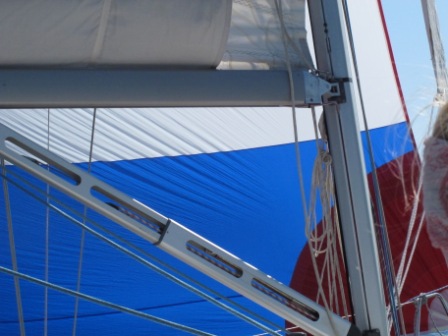 I am beginning to wonder whether the gas strut in the vang needs to be serviced. If the boom were to lift over the horizontal, then getting clew down to the boom should be easy enough. @samuel I like the idea of marking the mast instead of the halyard and using the battens to line up to the mark. A couple of questions do spring to mind though
Thanks to all for sharing experiences ------------- Onwards and upwards Nidri, Levkada, Ionian, Greece Hanse 350 #7, SY Evolution, standard keel, 3YM20 sail drive, 3 cabins, cherry wood interior, teak decks, feathering prop |
Posted By: sailkoop
Date Posted: 15 November 2012 at 13:40
|
Hi Swanji, to the vang, my vang goes up almost 10° over the horizontal position. So, their is not a Problem to fix the leech on the boom. I also hold the Main with the Halyard, that the block which is in the Main are not touching the boom. The reason therefor is that I doesn't want to have add. Friction. And yes, if you have markes on the Mast or on the Halyard for the right Positions of the Main by reefing will help alot!!  Last word to the bimini. I also have my boat in Croatia, but I never go out for sailing and having the bimini in use! It's storaged by sailing, even if you come in more Wind by gusts or anything else, you have a lot better control with an eye on your Sail and your Rigg as without.  You can Support your Crew (in my case very often my wife!!) to coordinate there work and you can reduse damages coming from an electrical Winsch!! regards ------------- best regards Bjoern |
Posted By: Gregor
Date Posted: 15 November 2012 at 13:50
Hello Wild, Can't open the link. Inside the boom there are two cars moving, one for the first and one for the second reef. Gregor ------------- Uisge Beatha Currently sailing Dehler 36 JV (2002) Previous boat: Hanse 311 #80 http://www.uisge-beatha.eu" rel="nofollow - http://www.uisge-beatha.eu |
 Wild wrote:
Posted By: Wild
Date Posted: 15 November 2012 at 15:27
|
Gregor It works by me but try www.seldenmast.com Product information Manuals for assembly and operation Single line reef conversion. ------------- Wild and Wet Belgium 545e#268 |
Posted By: jeancharleb
Date Posted: 15 November 2012 at 18:42
|
All interresting. I have incountered ripping out the third reef from the sail. My third reef is installed just like the others. But one thing, reefs at both ends makes to mutch rope in the cockpit bags MUCH TO MUCH. My salesman told me that the most efficient would be having the reefs at the leech only and that all three reefs at the mast should me attached to a hook on the boom. The outcoming is releaf for reefing and a hell of allot of rope in less. I always found that reefing is done to late resulting in problems doing it. I for one make the 1st reef at 14 knots, the second at 20 knots and the third at 26. Mind you in the Med they say , chances of gusts of 40% superior. It happens all the time. The Jeanneau wich I had in an other life had the hooks and worked well. To attach them we had a system that resembles the straps that truckers use to attach there loads. The strength is above needed. Ciao ------------- Jean Charlebois |
Posted By: Gregor
Date Posted: 16 November 2012 at 12:53
|
To give an overview. The block in the middle of the boom is inside the boom. 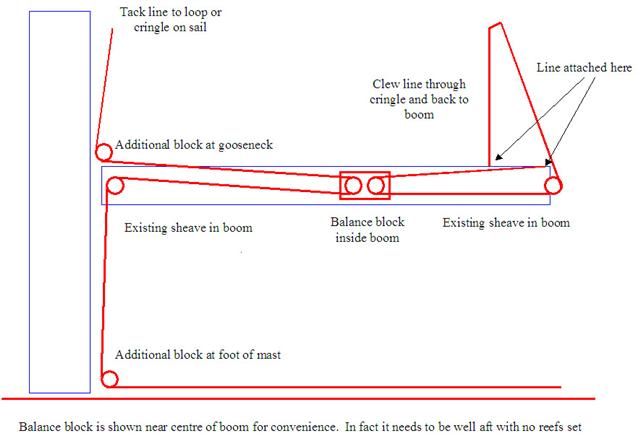
Gregor ------------- Uisge Beatha Currently sailing Dehler 36 JV (2002) Previous boat: Hanse 311 #80 http://www.uisge-beatha.eu" rel="nofollow - http://www.uisge-beatha.eu |
Posted By: samuel
Date Posted: 16 November 2012 at 17:02
|
Gregor May I ask For 2 reefs you need 2 cars. What stops them colliding Is there a division down the middle of the boom The second car has more rope to pull in from the leech so will need to pass the first car unless the rigger has rigged the first car to go to the gooseneck before it puts on tension & the second reef to put on tension before the car reaches the first reef car What happens if a line comes undone & slips inside the boom. How do you re threadle it What stops the car twisting if the line gets a twist as it is loaded up making the car want to twist & getting caught in the line for the other reef Are the cars made with nicely tapered ends to stop any part snagging on the other reef lines How do you propose to do third reef is there room in the boom Is there room for the clew outhaul Effectively you have 4 more lines of ropes in the boom plus 2 cars running up & down inside where you cannot get to them if there is a problem If you get , say a slack second reef line kink & get caught in the block for the first reef how do you clear it ------------- Daydream Believer- Hanse 311- No GBR9917T- Bradwell Essex |
Posted By: Gregor
Date Posted: 18 November 2012 at 08:09
|
A lot of questions Samuel. I'll give it a try to answer and some have to wait (or answered by a rigger) because I haven't experienced faults or issues with this new way of putting a reef. In the 311-section I placed several photo's made during the build. As you can see, the lines run through blocks without the possibility to get out of it. Each reef line has it's own side of the boom, however there is no division made, besides the division that is already there. There is no room left for a third reef using the same system, meaning placing a third block inside the boom. The line of the outhaul stays in place. It's just a single line. I had to replace mine after ten years and the rigger put in an 8mm line instead of the previous 10mm. This makes pulling and putting slack a lot easier. Considering the break load of an 8mm line, this is more than enough. 10mm is overkill. The length of each reef line was calculated upfront, however I did not measure the length and therefor it's hard to say what is the exact place of each block. My best guess is, that they are at the point of the boom where the reef line is knotted to the outside of the boom. I don't think the lines will twist because they don't have loose ends inside the boom. As soon you put tension to a reef, it will un-twist, if twisted. Gregor ------------- Uisge Beatha Currently sailing Dehler 36 JV (2002) Previous boat: Hanse 311 #80 http://www.uisge-beatha.eu" rel="nofollow - http://www.uisge-beatha.eu |
Posted By: Andrew
Date Posted: 20 November 2012 at 10:19
|
Hi Samuel
I can answer some questions for you, as I did mistaking pull a reef line out of the boom. To get it back in it is the same principle as dropping the halyard down the mast. I removed the boom. Tipped it up on a 45 degree angle, then SWMBO passed a tracer line with a lead weight on the end down and I pulled the reef lien through with the so called mouse line. Essentially a piece of cotton thread. The two reef lines do not get tangled because reef 1, runs on a car in a track on the port side of the boom, and reef 2, runs on a car in a track in the starboard side of the boom. The Outhaul is a single line running in the center of the boom. I reduced the size of my reef lined from 10mm to 8mm. This makes reefing so much easier. The maximum length of luff you can pull down to reef, is 95% the length of your boom. Both reef line can be the same length or reef 1 could be 5 meters shorter to save money. I made mine both the maximum length so I can swap them over after a few years. I hope this answer some of your question. Andrew |
Posted By: samuel
Date Posted: 20 November 2012 at 11:49
|
Andrew I suspect having a track for the cars would solve a lot of the tangle problems that I forsee I cannot see this on Gregor's boom & assumed his cars just flap about Rather an expensive operation if you have to buy a new boom or did you fit the tracks on to an old boom I assume that to do the re threading you have to remove the end fittings along with all the pop rivets etc. not what you want when at sea I do not see how the use of cars gives a mechanical advantage. In fact it looks like a "disadvantage" ie 1:2 not 2:1 at the outer end & the reverse on the other end ------------- Daydream Believer- Hanse 311- No GBR9917T- Bradwell Essex |
Posted By: Gregor
Date Posted: 20 November 2012 at 11:58
|
Samuel, I have been sailing with the new reef system about 80Nm, bumby weather, and no problems to reef. None of the cars flapped about. The boom remains the same otherwise I would never have done this, far too expensive. In fact, setting a reef was much easier than before. Have a look at this page: http://coxengineering.sharepoint.com/Pages/Singlelinereefing.aspx" rel="nofollow - http://coxengineering.sharepoint.com/Pages/Singlelinereefing.aspx Gregor ------------- Uisge Beatha Currently sailing Dehler 36 JV (2002) Previous boat: Hanse 311 #80 http://www.uisge-beatha.eu" rel="nofollow - http://www.uisge-beatha.eu |
Posted By: Andrew
Date Posted: 20 November 2012 at 13:52
|
your right I would not like to try and rethread the reef lines at sea. However not impossible. I removed the outer boom end because it has allen screws. I bought my Hanse pre riged so the boom must have by default the tracks.
You actually have two ropes inside the boom. With pullys you get a 3:1 purchase on the leach and a 2.1 purchase on the luff.
Andrew
|
Posted By: samuel
Date Posted: 20 November 2012 at 18:44
There is something wrong here & perhaps someone can tell me where i am going wrong If one splits he drawing shown earlier into 4 parts one can examine the mechanical advantage of each part 1) the part above he boom a the clew is basically 2:1 which is the same as the original single line. 2) The part to the car to the end of the boom. If one moves the car one metre the line comes in 2 metres that is a mechanical disadvantage of 1:2 3) if one now looks at the luff line. If one pulls the line from the cockpit & the car does not move then there is no mechanical advantage . It is still 1:1.On the luff of the sail but as there is normally a block on the luff the advantage becomes 2:1 4) now if the car is allowed to move the mechanical advantage at the car is 2:1 which offsets the mechanical disadvantage of the car I really cannot see what mechanical advantage the addition of a car gives in the drawing shown earlier. In fact friction reduces the advantage to a negative. Or is the drawing wrong & are there extra falls on the line to the car to the gooseneck It is 49 years since I did physics at school but surely I have not had total brain fade Anyone show me where i am wrong ------------- Daydream Believer- Hanse 311- No GBR9917T- Bradwell Essex |
Posted By: sailkoop
Date Posted: 21 November 2012 at 08:39
|
Hi Samuel, the drawing shoes two reduction points of the force from the Reef. One is still the existing ones from the Sail to the boom. the second is coming from the block inside the boom which is not going directly to the winch what it is in the standard. That one goes back to the boom end (2:1). The line which is regular going to the winch is now going trough the block (2:1). Over all you have a divided force by 4:1! regards ------------- best regards Bjoern |
Posted By: samuel
Date Posted: 21 November 2012 at 08:55
|
Sailkoop I disagree The one to the outer end of the boom is 1:2 not 2:1 The one to the gooseneck is 2:1 Result is 1:1 less friction Get a couple of lengths of cord & 2 blocks & try it by measuring the amounts pulled through If you were correct you would pull 4 metres of line to get 1 metre of line at the outer end I say you get 1 for 1 ------------- Daydream Believer- Hanse 311- No GBR9917T- Bradwell Essex |
Posted By: Gregor
Date Posted: 21 November 2012 at 10:26
|
Just to clarify how things are setup: Two new roller into the goose neck  The blocks that are inside the boom:  Reeflines attacthed to the boom:  Whilst using the system, I noticed a much easier (using less power) to put in a reef and the reef is far more flat than in the "old" system due to the fact that the lines put more equal force to both reef eyes. Gregor ------------- Uisge Beatha Currently sailing Dehler 36 JV (2002) Previous boat: Hanse 311 #80 http://www.uisge-beatha.eu" rel="nofollow - http://www.uisge-beatha.eu |
Posted By: Wild
Date Posted: 21 November 2012 at 12:39
|
Hello,
here a drawing of the Selden single line reef coversion set.
 I am waiting for comments to give my experiences. ------------- Wild and Wet Belgium 545e#268 |
Posted By: samuel
Date Posted: 21 November 2012 at 12:42
|
That s a totally different concept to the drawing shown in Gregor's earlier post ------------- Daydream Believer- Hanse 311- No GBR9917T- Bradwell Essex |
Posted By: sailkoop
Date Posted: 21 November 2012 at 17:09
|
Hi Samuel, If you are looking to the drawing of Gregor, you can pull 1m the block which is sitting inside the boom. Than you'll reduce the the distance of the reef line only by 0,5m! This is still a 2:1 Reduction  I absolut agree with you that the reefing System from Wild / Selden is working completely in an other way. It looks like more difficult to install it later on! regards ------------- best regards Bjoern |
Posted By: Gregor
Date Posted: 21 November 2012 at 18:11
|
I considered the Selden system too. After a talking to the rigger he suggested the other system because it is easier to install and use. Besides that, it's cheaper too. Gregor ------------- Uisge Beatha Currently sailing Dehler 36 JV (2002) Previous boat: Hanse 311 #80 http://www.uisge-beatha.eu" rel="nofollow - http://www.uisge-beatha.eu |
Posted By: samuel
Date Posted: 21 November 2012 at 18:37
 In the picture I have replicated Gregor's system inside the boom
at the right hand end the cord is tied to a nail representing the reef line tied to the end of the boom. The cord coming through the block is the one going up to the clew where ther is a 2:1 as in single line reef.
at the left hand end the cord tied to the nail represents the line going up the luff where there is 2:1 as in single line reefing
where this passes out through the block at the LH end this represents the reef line going down the mast to the deck
We are not interested in the parts above the boom this is as for single line reefing
the 2 ends of my cord are tied together in a knot to demonstarte that line going in equals line going out. if one moves the knot left to right & back again the 2 ends compensate each other & the car moves back & forth. THIS MEANS RATIO IS 1:1 NOT 2:1
The car does not increase the purchase on the reefline & as far as power is concerned it has no effective rellevance
see pic below with the knot moved to the right & the car moving back & forth
So where is the advantage of placing the car in the boom???????
 ------------- Daydream Believer- Hanse 311- No GBR9917T- Bradwell Essex |
Posted By: Gregor
Date Posted: 21 November 2012 at 19:31
|
Samuel, You are missing one block, the one at the goose neck. Gregor ------------- Uisge Beatha Currently sailing Dehler 36 JV (2002) Previous boat: Hanse 311 #80 http://www.uisge-beatha.eu" rel="nofollow - http://www.uisge-beatha.eu |
Posted By: Peter-Blake
Date Posted: 22 November 2012 at 08:31
|
I am following this thread some days now. For my own understanding i made a small sketch, that i want to share with you. You see that with the same handpower on the winch, with the System from Gregor you get less power into the sail! But in the system "Gregor" you get diffrent loads in front and at the end of the boom to the sail. So - is this really a advantage? Am i right with my drawing? OK the moving of the blocks inside the boom is not considered. But is this the diffrence? BTW: If you would add another block to the front reefing point on the Sail in system "Gregor", than the loads are equal again and will be the same as the hanse reefing system.  Ouch Ouch ------------- Blake 370 
|
Posted By: sailkoop
Date Posted: 22 November 2012 at 10:10
|
I am coming back with your example and some drawing. In general, every moving block will reducing the load by 50%!   Hopefully you can read it! Overall, you'll come to a reduction of load if you add on an moving block!! regards ------------- best regards Bjoern |
Posted By: Gregor
Date Posted: 22 November 2012 at 11:26
|
Looking at Sailkoop's drawing, it supports my experience that the main overall is more flattened and that one needs less power to put in a reef. BTW, nice to have my own named reef system :) Gregor ------------- Uisge Beatha Currently sailing Dehler 36 JV (2002) Previous boat: Hanse 311 #80 http://www.uisge-beatha.eu" rel="nofollow - http://www.uisge-beatha.eu |
Posted By: samuel
Date Posted: 22 November 2012 at 12:54
|
Sailkoop Your figures are wrong The figure for the car shows 50kg to the left but ot should be 100 That alters your final figure back by 50 kg so the final outcome is the same as the hanse rig In my demostration rig i demonstrated that the car does not make a power advantage The same goes for your second drawing You have 2 lots of 150 kg equalling 200 Infact the pull os 2 lots of 100 kg Get the figures correct & you will see there is no difference in the output ------------- Daydream Believer- Hanse 311- No GBR9917T- Bradwell Essex |
Posted By: Gregor
Date Posted: 22 November 2012 at 13:23
|
@Samuel, what do you mean by "my figures are wrong"? As far as I'm aware, I did not put any figures on any drawing. You are most welcome in Herkingen to experience the system yourself. I'm happy with it and will get experience over time whilst using the system. Gregor ------------- Uisge Beatha Currently sailing Dehler 36 JV (2002) Previous boat: Hanse 311 #80 http://www.uisge-beatha.eu" rel="nofollow - http://www.uisge-beatha.eu |
Posted By: samuel
Date Posted: 22 November 2012 at 13:33
|
Gregor Please accept my apologies i meant to type sailkoop I have edited the post I must add - to each his own-If it works for you then OK It is just that the figures suggest that there is no mechanical advantage so I cannot understand how it improves the system That is what I was trying to find out Please accept that there was no wish to cause offence ------------- Daydream Believer- Hanse 311- No GBR9917T- Bradwell Essex |
Posted By: Gregor
Date Posted: 22 November 2012 at 13:37
|
Clear Samuel, thanks for getting back. Gregor p.s. only 16 to go :) ------------- Uisge Beatha Currently sailing Dehler 36 JV (2002) Previous boat: Hanse 311 #80 http://www.uisge-beatha.eu" rel="nofollow - http://www.uisge-beatha.eu |
Posted By: gizmo
Date Posted: 22 November 2012 at 16:27
|
Gregor How quickly you have got down from 31 to 16 ! To what do attribute your success ? Ken ------------- Ken 430e # 161 UK |
Posted By: sailkoop
Date Posted: 22 November 2012 at 17:11
|
Hi Samuel, when the the block on the Mast is on the boom, then the point is "fixed" and you have devide the Load from 100kg by 50% (remenber the moving block which is also working now on that line!). thats the Reason for the 50 + 50Kg in my example! And sorry I am correct. If you build up that drawing one to one in your workshop you will see that it works. regards ------------- best regards Bjoern |
Posted By: Peter-Blake
Date Posted: 22 November 2012 at 17:22
|
@ Gregor: BTW Preparing for your appointment are already running in the background  ------------- Blake 370
|
Posted By: Brufan
Date Posted: 22 November 2012 at 17:35
|
I'm one of the very rare owner of a Selden Mast & boom fitted on a Hanse (I still don't know why but I'm very happy with that). The Selden reefing system is a piece of complex engeeniring but very easy to use. It is also quite light to handle even with such a complex line and block system. I can tighten the reefs but hand (if heading to the wind of course). Another plus with Selden boom : it is very very rock solid and a lot thickier than the Z-spar. On the other hand it is also a lot lot heavier but it won't bend in a (normal) gybe. ------------- Bruno hanse 355 - 57 S/Y Spicy Ginger White hull, 2 cabins, Volvo D1-30, Selden rig, removable mainsheet track system, Simrad (now B&G)-Jefa autopilot. |
Posted By: samuel
Date Posted: 22 November 2012 at 18:35
No the line coming off the clew has 100 kg load (just like the line coming off luff) the line from the car to the back of the boom is also 100 kg This gives a total figure of 200 kg which has to be 200 kg to counteract the force of the luff side of the car You cannot have 100 one side & 200 the other Look at Peter Blakes drawing which is correct & demonstrates the situation very well It is a simple law of physics every force has an equal & opposite force . ---with the greatest of respect ---i still say you are wrong ------------- Daydream Believer- Hanse 311- No GBR9917T- Bradwell Essex |
Posted By: Gregor
Date Posted: 23 November 2012 at 07:27
|
@Peter Blake: a place in the hall of fame is waiting for me :) Gregor ------------- Uisge Beatha Currently sailing Dehler 36 JV (2002) Previous boat: Hanse 311 #80 http://www.uisge-beatha.eu" rel="nofollow - http://www.uisge-beatha.eu |