|
| |
| Welcome to myHanse.com the forum for Hanse Yachts owners throughout the world. | |
lithium and agm batteries: a warning ! |
Post Reply 
|
Page <123 |
| Author | |
32mike 
Commadore 

Joined: 26 March 2020 Location: FLorida, US Status: Offline Points: 453 |
 Post Options Post Options
 Thanks(0) Thanks(0)
 Quote Reply Quote Reply
 Posted: 06 July 2025 at 13:38 Posted: 06 July 2025 at 13:38 |
|
|
|
Mike
S/V Dulces Sueños 458 #087 Tampa, FL |
|
 |
|
|
marsella
Rear Admiral 
Joined: 21 June 2022 Location: Antigua Jolly H Status: Offline Points: 592 |
Post Options
Thanks(0)
Quote Reply
Posted: 06 July 2025 at 14:12 |
|
My understanding is that DCDC should go into engine room or close, where another end of the alternator cables are now connected to the engine bat. Thats where DCDC should be inserted. I think engine room is not a good location becaue it gets hot and DCDC gets hot, but somewhere around it.
|
|
|
|
|
32mike
Commadore
Joined: 26 March 2020 Location: FLorida, US Status: Offline Points: 453 |
Post Options
Thanks(0)
Quote Reply
Posted: 06 July 2025 at 15:13 |
For the Victron Dc-Dc, the manuals say to mount close to but not above the battery (which is a lead acid thing with potential off-gassing). Heat is an issue. The smaller 30 amp units apparently get very hot and many people in vans and boats installed ventilation fans. The newer 50 amp units don’t get as hot but the manual says it can get up to 90C and to mount on a surface that can withstand that temperature.
|
|
|
Mike
S/V Dulces Sueños 458 #087 Tampa, FL |
|
|
|
|
Arcadia
Admiral 

Joined: 27 November 2017 Location: Sag Harbor, USA Status: Offline Points: 1112 |
Post Options
Thanks(0)
Quote Reply
Posted: 06 July 2025 at 15:38 |
|
Piero, the combiner activates based on a threshold voltage of about 13.2 v. So the service bank will not engage until the engine battery reaches 13.2. So often when the much larger service bank engages, the voltage can then drop back below threshold and will open the combiner. This cycle can repeat over and over if the service bank is heavily discharged. Bad design !!
|
|
|
Leon / ARCADIA
2018 Hanse 588 Sag Harbor, NY |
|
|
|
|
Arcadia
Admiral
Joined: 27 November 2017 Location: Sag Harbor, USA Status: Offline Points: 1112 |
Post Options
Thanks(0)
Quote Reply
Posted: 06 July 2025 at 15:48 |
|
There is heavy cable that brings the charge current from the alternator to the combiner near the positive bus bar. You can repurpose that cable as a direct connection. I then moved my combiner to a location near the engine battery to control its charge. No more cycling. The combiner won’t engage until the service bank reaches a good charge level.
|
|
|
Leon / ARCADIA
2018 Hanse 588 Sag Harbor, NY |
|
|
|
|
Arcadia
Admiral
Joined: 27 November 2017 Location: Sag Harbor, USA Status: Offline Points: 1112 |
Post Options
Thanks(0)
Quote Reply
Posted: 06 July 2025 at 15:57 |
|
Also forgot to mention. My combiner no longer uses threshold voltage. There is a separate trigger input that will activate the combiner. I ran a trigger voltage from the engine blower and also from my battery charger so that the combiner will engage whenever charging takes place.
|
|
|
Leon / ARCADIA
2018 Hanse 588 Sag Harbor, NY |
|
|
|
|
32mike
Commadore
Joined: 26 March 2020 Location: FLorida, US Status: Offline Points: 453 |
Post Options
Thanks(0)
Quote Reply
Posted: 06 July 2025 at 16:30 |
I think it works fine with AGM’s on both sides of it. There is built in delays for connect and disconnect. It engages at 13.2v and disconnects at either 12.8 after 60 seconds or 11.8 after 4 seconds. I would also think, that with the alternator running and putting out good amperage, even the discharged lithium bank wouldn’t pull the voltage down below 12.8 for a solid minute, but I could be mistaken on that. In any case, this is really an AGM device. Most lithium designs these days don’t incorporate a battery combiner at all. I’ve even seen setups where people completely separate their AGM start battery from their lithium service bank just to simplify things. I think the big stumbling blocks with adding lithium to our previous all-AGM boats is the different chemistries/ charge profiles and the fact that the alternators were designed for lead/acid batteries - they don’t have lithium charge profiles built in and they don’t have an installed shutoff that the new lithium BMS can activate when needed to safely cut off the charge under any circumstances. So, we need to start jury-rigging things by adding or subtracting devices to overcome the stumbling blocks. I’m still struggling with the possibilities with an eye for keeping it as simple as possible while still covering all bases with the minimum of modifications and money spent. It’s a challenge! |
|
|
Mike
S/V Dulces Sueños 458 #087 Tampa, FL |
|
|
|
|
marsella
Rear Admiral
Joined: 21 June 2022 Location: Antigua Jolly H Status: Offline Points: 592 |
Post Options
Thanks(0)
Quote Reply
Posted: 06 July 2025 at 18:45 |
I think one can just replace the combiner with a solenoid, something like Lewmar el.winch contactor would have a right amperage for this. In this case as long as BMS allows charging sources, the contactor is closed, and the alternator charges the service bank. When BMS signals to stop charging, the contactor will just open.
Edited by marsella - 06 July 2025 at 18:46 |
|
|
|
|
Pzucchel
Rear Admiral

Joined: 13 March 2020 Location: floating Status: Offline Points: 659 |
Post Options
Thanks(0)
Quote Reply
Posted: 07 July 2025 at 09:53 |
|
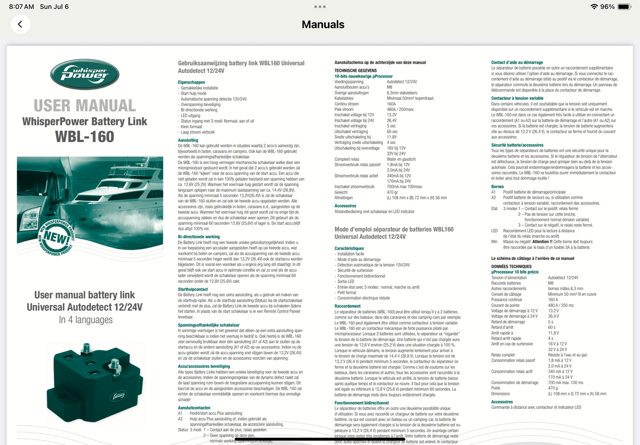
update: I confirm I do have a battery splitter. it's a different model from the ones described here , it's the mastervolt chargemate 2502 and it does sit nearby the service battery compartment bus.
you can see the manual here : it's configured in automatic mode. It seems it has histeresis and delay features preventing flipping on and off, and very interestingly one could both wire a manual switch , overriding the off position allowing to start on the service battery , and even an indicator /czone information to know what's happening without taking the sofaaway ... I checked all the cables , and I confirm whatever had been said above by 32mike, Marsella and Arcadia. in my system I have two additions: 2x mppt, on the service bus , charging the service battery, and another battery that's used to start the generator. in particular , the agm generator service battery is completely in parallel of the engine battery. there is no battery splitter. I was puzzled by this : when I had the problem I couldn't start the engine , but I could start the generator. this is probably simply because the crank requirements are lighter. then , I realise I have an old agm battery in parallel to a new one : I'm sure it's a bad idea , the new battery may be continuously discharging into the old one ... going back to my original problem , I start suspecting that the sequence of events was: the service battery went below 13v, it disconnected from the engine battery and the generator battery. then the engine battery discharged partially even if fed by the generator battery (higher internal resistance because of lower CCA) ...and both couldn't provide the cranking current. when I started the generator , the splitter went on and the 10kWh lithium batteries covered the engine battery problem... now I need surely to replace the engine battery , it shows some sulfation signs on the contacts . ..and now I know that I can overwrite the battery splitter and use the service batteries to start the engine! as a last piece of information , I even have 2x masterbus controlled isolators (ml-rbs from ocean systems) on the lithium batteries: they are programmable with masteradjust, and I currently use it for last resort discharge below 10% and thermal limit. it rarely happens , and I think this is what is described here as a abyc requirement. ultimately , I could redesign the system ...but admittedly it worked flawlessly for 4 years , up to the moment the engine battery got old (the battery was used for 5 years ) so you could understand my hesitation: don't break what works ! I know the current limitations now: 1) agm batteries , generator and engine , aren't optimally using ideal bulk/abs/float timings and voltages...but this deserves another thread, because the differences been lfp and agm settings are not very big. 2) the two agm batteries are in parallel without a split. is this what I want/like ? the two batteries aren't identical in capacity... 3) potentially and theoretically, the lithium batteries could disconnect from the alternator when the engine is running creating load jumps that may affect the alternator. admittedly , this should happen only on very rare situations, and the BMS should anyway have priority because of safety Edited by Pzucchel - 07 July 2025 at 16:46 |
|
|
Hanse588#55
|
|
|
|
|
Post Reply
|
Page <123 |
| Tweet |
| Forum Jump | Forum Permissions You cannot post new topics in this forum You cannot reply to topics in this forum You cannot delete your posts in this forum You cannot edit your posts in this forum You cannot create polls in this forum You cannot vote in polls in this forum |
|
Links : www.hanseyachts.co.uk www.hanseyachts.com www.fjordboats.co.uk www.dehler.co.uk www.varianta.co.uk |


 Topic Options
 Pzucchel wrote: